Within AI Energy Use
How Much Electricity Does One AI Chatbot Question Use?
Ordinary AI text queries can use less than one watt-hour, but complex reasoning, supporting equipment and billions of requests change the total.
Published
On this page
- What Google's 0.24 Wh measurement and independent 2026 estimates reveal
- Why short text prompts and demanding reasoning tasks consume different amounts of electricity
- How measurement boundaries and billions of daily requests change the overall electricity picture
Page outline Jump by section
Updated
Introduction
A typical short AI chatbot question can use around 0.2–0.3 watt-hours (Wh) of electricity, according to recent measurements and research estimates. That is roughly enough electricity to run a 10-watt LED light bulb for one to two minutes. More demanding questions, particularly those involving extended reasoning, lengthy documents or multiple AI operations, can consume several watt-hours or considerably more.
Google reported 0.24 Wh for the median text prompt sent to its Gemini assistant in May 2025. A peer-reviewed study published in Joule in April 2026 independently estimated a median of 0.31 Wh for standard queries handled by efficiently operated, large AI models. Google Services
These figures challenge older claims that every chatbot question requires 3 Wh or more. But they do not mean AI electricity demand is negligible. The amount used by an individual question depends on the model, the length of the answer, the hardware and the supporting data centre equipment. When billions of requests are processed, even small amounts add up.
How much electricity does a typical AI question use?
Electricity consumption is measured in watt-hours (Wh). One watt-hour is the electricity used by a one-watt device running for an hour. One kilowatt-hour (kWh), the unit commonly used on household electricity bills, equals 1,000 Wh.
When an AI chatbot responds to a question, specialised computer chips perform calculations to generate the answer. This process is called inference. The electricity consumed depends partly on how much computing is required and partly on how efficiently the data centre handles the request.
The following figures show why there is no single reliable electricity cost for every chatbot question.
| Source and scenario | Electricity per query | What the figure represents |
| Google Gemini, May 2025 | 0.24 Wh | Measured median text prompt, including allocated supporting equipment and data centre overhead |
| Epoch AI, February 2025 | Approximately 0.30 Wh | Analytical estimate for a typical GPT-4o text query |
| Joule, April 2026 | 0.31 Wh | Modelled median for standard queries under optimised large-scale serving conditions |
| Joule, April 2026, extended reasoning | 3.91 Wh | Modelled median for substantially longer responses, around 5,000 output tokens |
| Epoch AI, very long inputs | Approximately 2.5–40 Wh | Estimated GPT-4o consumption for prompts containing 10,000–100,000 input tokens |
Sources: Google’s technical measurement study, Epoch AI’s February 2025 analysis and Oviedo and colleagues’2026 Joule study. These are different workloads and methodologies, not directly interchangeable measurements. Google Services
The most useful rule of thumb is that an ordinary, efficiently served text exchange may consume less than 1 Wh, while a complex exchange can require several times or tens of times more.
These are estimates of electricity used to operate the AI service, rather than a complete accounting of every resource needed to create and maintain it. They should not be applied automatically to image generation, video production or other substantially different AI tasks.
What Google’s 0.24 Wh measurement reveals
In August 2025, Google published a technical paper, Measuring the Environmental Impact of Delivering AI at Google Scale. It provided unusually detailed information about the electricity used to answer requests in its Gemini service.
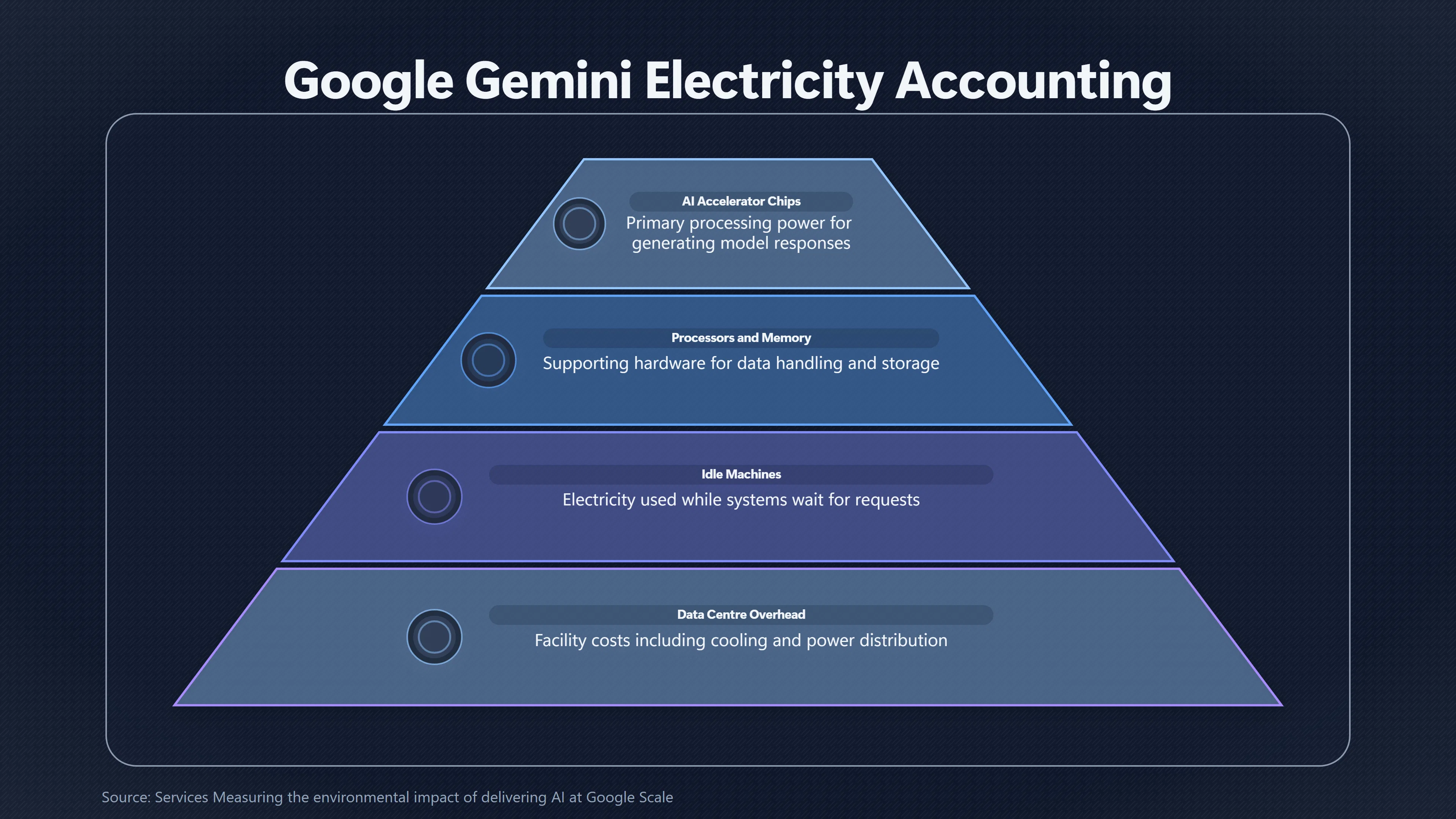
Google calculated that the median text prompt in May 2025 consumed 0.24 Wh. Crucially, this was not simply the electricity drawn by the main AI processing chip. The calculation also included several supporting sources of consumption. Google Services
Electricity used by Google’s median Gemini text prompt
AI accelerator chips
0.14 Wh
Processors and memory
0.06 Wh
Idle machines
0.02 Wh
Data centre overhead
0.02 Wh
Total
Google’s fleet-wide median, May 2025. Percentages are approximate and may differ slightly because of rounding.
The distinction between chip electricity and total operating electricity is important. Google’s narrower measurement approach produced a figure of 0.10 Wh, while its more comprehensive calculation produced 0.24 Wh.
The two figures describe the same general type of activity but use different accounting boundaries. A narrow measurement can make AI appear substantially more efficient simply because it leaves out some supporting electricity consumption.
Google also estimated that the median prompt generated 0.03 grams of carbon dioxide equivalent and consumed 0.26 millilitres of water under its comprehensive accounting approach. Those figures depend on the company’s infrastructure, energy accounting and operating conditions; they should not be treated as universal values for all AI systems. Google Services
How reliable is Google’s figure?
Google’s research has a significant advantage over estimates based only on published chip specifications: the company can observe its own production systems and their operating characteristics.
Nevertheless, the 0.24 Wh result has limitations.
First, it is a median, not an average. Half the measured prompts fall below the median and half above it. A relatively small number of extremely demanding requests could raise the average electricity consumption without substantially changing the median.
Second, the measurement describes Gemini text prompts during a particular month. It does not establish how much electricity every Gemini model, enterprise application or future version consumes.
Third, Google’s measurement methodology is company-developed, and outsiders do not have unrestricted access to the underlying production data. The detailed breakdown makes the calculation more informative, but it does not make the result independently reproducible in full.
For these reasons, the figure is best understood as strong evidence that short, efficiently processed text prompts can be relatively inexpensive in electricity terms, rather than proof that every AI question uses approximately a quarter of a watt-hour.
What independent research found in 2026
The strongest recent comparison comes from research published in Joule in April 2026 by Felipe Oviedo and colleagues, including researchers at Microsoft.
Their study, Energy Use of AI Inference, Efficiency Pathways, and Test-Time Scaling, estimated electricity consumption using realistic assumptions about AI models, computer hardware, processing speed and data centre operation.
The researchers examined large language models, including models with hundreds of billions of parameters. Parameters are numerical values learned during training that help determine how a model produces an answer.
For standard queries, the study estimated a median electricity requirement of 0.31 Wh, with the middle half of modelled results falling between 0.16 and 0.60 Wh. ScienceDirect
This is close to Google’s measured 0.24 Wh and Epoch AI’s earlier estimate of 0.30 Wh for GPT-4o. The agreement is meaningful because the estimates were developed using different approaches, although the research does not constitute a fully independent audit of commercial chatbot electricity consumption.
The Joule study also identified a major reason why some earlier estimates were much higher: they did not adequately reflect how commercial AI systems share processing capacity between many requests.
A data centre serving millions of customers can group requests together, distribute work efficiently and use specialised software to reduce unnecessary calculations. Testing one model on an underused machine can therefore produce a much higher electricity-per-query figure than operating the same type of model in a carefully optimised service.
The researchers estimated that some previously published figures overstated electricity consumption under comparable large-scale serving assumptions by factors of four to twenty. That does not mean every high estimate is wrong. It means measurements from different operating conditions cannot automatically be compared as though they represent the same service. ScienceDirect
A useful independent check comes from the ML.ENERGY research initiative, which measures the electricity required by different AI models and workloads. Its January 2026 analysis covered 46 models across seven tasks and 1,858 configurations using Nvidia H100 and B200 processors. Such benchmarking helps demonstrate how much model choice, hardware and workload can change energy consumption, although laboratory configurations do not necessarily reproduce commercial deployment conditions. ML.ENERGY Blog
Why some AI questions use far more electricity
The length and difficulty of a request can matter more than the fact that it is being sent to an AI chatbot.
A question such as’What is the capital of France?’requires relatively little generated text. Asking an AI assistant to analyse a lengthy contract, compare financial documents or solve a complex mathematical problem can require much more processing.
Three factors are especially important.
1. The number of tokens processed
AI language models divide text into small units called tokens. A token might be a word, part of a word or a punctuation mark.
The system must process the input tokens supplied by the user and generate output tokens to produce an answer. Longer inputs and outputs generally require more computation, although the relationship is affected by model architecture, caching and hardware efficiency.
Epoch AI’s February 2025 analysis estimated approximately 0.3 Wh for a typical GPT-4o question. It also estimated that a request containing 10,000 input tokens could require around 2.5 Wh, while one containing 100,000 input tokens could approach 40 Wh under its assumptions. Epoch AI
These are not measured electricity costs for every long-document request. They illustrate how a large amount of input text can change the workload substantially.
A user who uploads a lengthy report and asks for a detailed summary may therefore generate considerably more computing demand than someone requesting a one-sentence factual answer.
2. Extended reasoning
Some AI models perform additional processing before producing their final response. This can improve their ability to tackle difficult tasks, but it can also increase electricity consumption.
The 2026 Joule study compared ordinary queries generating a median of approximately 300 output tokens with demanding queries generating around 5,000 tokens.
[Estimated electricity per query by workload]theverge.comHe also estimated that each query consumes about 0.34 watt-hours of electricity, comparable to the energy an oven uses in just over one s…
0 Wh 2 Wh 4 Wh 6 Wh Standard text Extended reasoning
- Standard text: Electricity 0.3 Wh
- Extended reasoning: Electricity 3.9 Wh
Source: Oviedo and colleagues, Joule (2026). Modelled median estimates, not measurements of every chatbot.
The extended reasoning scenario required approximately 13 times as much electricity. The study also found that some demanding requests exceeded 10 Wh. ScienceDirect
Other research illustrates how much results depend on the test. Hugging Face’s December 2025 AI Energy Score benchmarking reported much larger increases for particular models when reasoning was enabled. Across its tested configurations, reasoning models used about 30 times more energy on average than non-reasoning alternatives, with substantially larger differences in certain matched comparisons. These were controlled benchmark results, not universal multipliers for commercial chatbot requests. Hugging Face
The practical implication is that the phrase’one AI question’can conceal very different amounts of computation. A brief answer and a complex reasoning task are not necessarily comparable units of electricity demand.
3. Model size, hardware and serving efficiency
Two AI systems can answer the same question while consuming different amounts of electricity.
A smaller model may need fewer calculations than a larger one. Newer processors may perform those calculations using less electricity. Software can also reduce unnecessary processing or allow multiple requests to share hardware more efficiently.
Stanford University’s 2026 AI Index report highlights this variation. Drawing on research by Jegham and colleagues, it reported estimated electricity consumption of approximately 5–6 Wh for some models handling medium-length prompts, compared with around 22–23 Wh for some more demanding configurations.
These figures were based on a workload of approximately 1,000 input tokens and 1,000 output tokens, using estimates of commercial infrastructure rather than direct access to every provider’s electricity meters. They should not be interpreted as typical energy consumption for all requests to those models. AI INDEX REPORT 2026
The choice of model therefore matters, but selecting the smallest model is not automatically the most efficient way to complete a task. If a less capable model requires repeated attempts, the total electricity consumption can rise.
The relevant comparison is the electricity required to complete a useful task successfully, rather than simply the electricity used by one isolated model response.
What should be counted in the electricity figure?
A reliable estimate needs to specify where the measurement starts and stops.
The AI processing chips are only one part of the infrastructure. Servers also contain conventional processors and memory. Data centres require networking equipment, electricity distribution systems and cooling.
Some machines remain powered on while waiting for requests so that the service can respond quickly. This standby capacity consumes electricity even when it is not actively generating text.
Researchers commonly distinguish between three measurement boundaries:
- Chip-level electricity: the electricity consumed by the specialised processor performing the AI calculations.
- Server-level electricity: chip electricity plus the supporting processors, memory and other server components.
- Data centre-level electricity: server electricity plus allocated facility overhead, including cooling and electrical losses.
Google’s 2025 results demonstrate why these distinctions matter. Its comprehensive measurement was substantially higher than its narrow accelerator-focused result. Google Services
One widely used data centre efficiency measure is power usage effectiveness (PUE). It compares total facility electricity consumption with the electricity consumed by computing equipment. A PUE of 1.2 means that a facility uses 1.2 units of electricity for every unit consumed by its IT equipment.
However, PUE alone cannot reveal how much electricity a chatbot query consumes. Two data centres with identical PUE values can have very different electricity consumption per request because their models, processors, utilisation rates and workloads differ.
There is also a distinction between operating electricity and the broader resource costs of AI. Manufacturing chips, constructing data centres and training the original model require resources and energy. A per-query inference figure generally does not represent all those lifecycle costs.
Why the average and median can tell different stories
For someone estimating the electricity used by a single ordinary question, the median is often useful. It describes a typical request without being heavily influenced by unusually demanding tasks.
For someone forecasting a data centre’s electricity bill, the average is more important because it captures the contribution of high-consumption requests.
Consider an illustrative service in which 90% of requests consume 0.3 Wh and the remaining 10% consume 4 Wh.
The median is still 0.3 Wh, but the arithmetic mean is:
0.9 × 0.3 + 0.1 × 4 = 0.67 Wh per request.
The average is more than twice the median, even though most requests are relatively inexpensive.
This distinction matters when companies report the electricity consumed by a’typical’AI prompt. Without information about the distribution of workloads, the median cannot establish the total electricity used by the service.

How much electricity do billions of AI queries consume?
The electricity used by one chatbot question may be small, but AI services operate at enormous scale.
The basic calculation is straightforward:
Daily electricity consumption = number of queries × average electricity per query.
To convert watt-hours into kilowatt-hours, divide by 1,000. To convert into megawatt-hours, divide by one million.
The table below applies different average electricity consumption assumptions to a hypothetical service handling one billion requests each day.
| Average electricity per query | Electricity per day | Electricity per year |
| 0.24 Wh | 240 MWh | 87.6 GWh |
| 0.30 Wh | 300 MWh | 109.5 GWh |
| 0.67 Wh | 670 MWh | 244.6 GWh |
| 3.00 Wh | 3,000 MWh | 1,095 GWh |
These are illustrative calculations, not measured electricity consumption for a particular AI company. They assume that the chosen per-query figure consistently includes the relevant operating electricity and that request volumes remain constant.
The difference between 0.3 Wh and 3 Wh per query becomes substantial at this scale: one billion daily requests would consume either 109.5 GWh or 1.095 terawatt-hours (TWh) annually.
A real-world illustration comes from OpenAI. In June 2025, its chief executive, Sam Altman, stated that an average ChatGPT query consumed approximately 0.34 Wh. The figure was broadly consistent with contemporary independent estimates, but OpenAI did not provide a sufficiently detailed public methodology to establish the workload mix and accounting boundaries. DCD
IEEE Spectrum subsequently examined OpenAI’s reported traffic of more than 2.5 billion ChatGPT queries per day. Applying 0.34 Wh to that volume gives approximately 850 MWh per day, or about 310 GWh over a year at an unchanged daily rate. IEEE Spectrum
That calculation shows how a seemingly tiny unit of electricity consumption can become a significant continuous load. It does not capture all of OpenAI’s training, infrastructure or other operating activities.
Why a minority of complex requests can dominate demand
The 2026 Joule study examined how changing the mixture of ordinary and demanding requests affects overall electricity consumption.
Its modelled data centre scenarios found that serving one billion standard queries daily could require around 0.7 GWh. Introducing a 10% share of longer, reasoning-intensive queries increased the estimated total to around 1.7 GWh per day.
The increase is substantial even though nine out of ten requests remain ordinary. The result reflects the much greater computation associated with the demanding minority, alongside the study’s serving-system assumptions. ScienceDirect
This is particularly relevant as AI products expand beyond short conversations into document analysis, programming, research and automated workflows.
An automated AI task might generate several prompts, call different models, retrieve information and revise its output before presenting one final answer to the user.
From the user’s perspective, this can look like a single request. From the infrastructure’s perspective, it may involve many separate inference operations.
Counting only the final visible answer can therefore understate the computing work required to complete the task.
Does improving AI efficiency reduce total electricity demand?
More efficient AI models can reduce the electricity required for a given request. But lower electricity consumption per query does not guarantee lower total demand.
The 2026 Joule study identified potential efficiency improvements through better model design, computing hardware and serving software. Its scenarios suggested that combinations of improvements could substantially reduce per-query energy requirements, potentially by factors of eight to twenty under favourable assumptions. Microsoft Research
Those are potential improvements, not a forecast that every commercial chatbot will achieve them.
The key uncertainty is how quickly the volume and complexity of AI use will grow.
For example, suppose a service handles one billion queries daily at 0.3 Wh each. It consumes 300 MWh per day.
If improved technology halves the electricity required per query but usage triples, the calculation becomes:
3 billion × 0.15 Wh = 450 MWh per day.
Electricity efficiency has improved by 50%, but total electricity consumption has risen by 50%.
This is one reason forecasts of AI data centre electricity demand cannot rely on per-query efficiency trends alone. They also need assumptions about adoption, reasoning workloads, service availability and the number of tasks performed by AI systems.
The International Energy Agency’s updated Key Questions on Energy and AI analysis that global data centre electricity consumption could rise from approximately 485 TWh in 2025 to 950 TWh in 2030, with AI-focused data centre consumption growing faster than the overall sector. These figures include infrastructure and workloads beyond ordinary chatbot text inference, so they should not be attributed solely to conversational AI. IEA
How to judge claims about AI query electricity consumption
A useful estimate should answer more than’How many watt-hours?’. It should also explain what is being measured and whether the result applies to the task being discussed.
When comparing figures, the most important checks are:
- Identify the workload. Is the figure for a short text prompt, a lengthy document, a reasoning task or a complete automated workflow?
- Check whether it is measured or estimated. Direct production measurements and analytical models provide different kinds of evidence.
- Look for the accounting boundary. Does the result include only AI chips, complete servers or data centre overhead?
- Distinguish median from average. A median describes a typical request; an average is generally more useful for estimating total electricity consumption.
- Check the date and technology. Figures based on older hardware or inefficient deployment conditions may not describe newer production systems.
- Consider the number of requests. For electricity demand at scale, the workload mix and total request volume can matter as much as the cost of a single response.
These checks help resolve two common misconceptions.
The first is that every chatbot question consumes several watt-hours. Recent production measurements and optimised-system estimates show that many ordinary text requests can use considerably less.
The second is that a low per-query figure makes AI infrastructure electricity demand unimportant. Billions of requests, more complex reasoning and the need to maintain large computing systems can still produce substantial electricity demand.
The strongest available evidence supports a clear distinction: the electricity cost of a simple AI chatbot question is often modest, but the electricity cost of operating AI services at scale depends on what those services are asked to do, how often they are used and how efficiently their infrastructure is run.
That distinction is essential for understanding the wider cost of AI. It connects the electricity consumed by one answer to the practical decisions facing data centre operators, electricity suppliers and communities accommodating new computing infrastructure.
Amazon book picks
Further Reading
Books and field guides related to How Much Electricity Does One AI Chatbot Question Use?. Use these as the next step if you want deeper reading beyond the article.
eBay marketplace picks
Marketplace Samples
Live-tested eBay searches with available results related to this page.
Selected fromartificial intelligence poster oneBay.co.uk.

Current eBay listing
A.I. Artificial Intelligence Blu-ray with A3 Travel Poster new and sealed

Current eBay listing
METAL POSTER A.I. Artificial Intelligence SIGN PLAQUE Film Movie A6 A5 A4 A3
 </article>
<article class="fr-book-card" data-ebay-listing-card data-ebay-card-kind="listing" data-ebay-card-position="4"data-offer-freshness="current" data-offer-observed-at="2026-10-26T20:24:24Z">
 </article>
Endnotes
1.
Source: help.openai.com
Link:https://help.openai.com/en/articles/8590148-memory-faq
2.
Source: services.google.com
Title: Services Measuring the environmental impact of delivering AI at Google Scale
Link:https://services.google.com/fh/files/misc/measuring_the_environmental_impact_of_delivering_ai_at_google_scale.pdf
Source snippet
November 1, 2025...
Published: November 1, 2025
3.
Source: sciencedirect.com
Link:https://www.sciencedirect.com/science/article/pii/S2542435126001145
Source snippet
Energy use of AI inference, efficiency pathways, and test-time scalingApril 22, 2026...
Published: April 22, 2026
4.
Source: epoch.ai
Title: AIHow much energy does Chat GPT use?
Link:https://epoch.ai/gradient-updates/how-much-energy-does-chatgpt-use
Source snippet
How much energy does ChatGPT use?February 7, 2025...
Published: February 7, 2025
5.
Source: cloud.google.com
Title: Cloud Blog Measuring the environmental impact of AI inference
Link:https://cloud.google.com/blog/products/infrastructure/measuring-the-environmental-impact-of-ai-inference?e=48754805%3Futm_source%3Dlinkedin
Source snippet
August 21, 2025...
Published: August 21, 2025
6.
Source: ml.energy
Title: diagnosing inference energy consumption with the mlenergy leaderboard v30
Link:https://ml.energy/blog/measurement/energy/diagnosing-inference-energy-consumption-with-the-mlenergy-leaderboard-v30/
Source snippet
BlogDiagnosing Inference Energy Consumption with the ML.ENERGY Leaderboard v3.0January 29, 2026...
Published: January 29, 2026
7.
Source: hai.stanford.edu
Title: ai index report 2026
Link:https://hai.stanford.edu/assets/files/ai_index_report_2026.pdf
Source snippet
1.4 ENERGY AND ENVIRONMENTAL IMPACT | RESEARCH AND DEVELOPMENTApril 13, 2026...
Published: April 13, 2026
8.
Source: datacenterdynamics.com
Link:https://www.datacenterdynamics.com/en/news/sam-altman-chatgpt-queries-consume-034-watt-hours-of-electricity-and-0000085-gallons-of-water/
Source snippet
DCDSam Altman: ChatGPT queries consume 0.34 watt-hours of electricity and 0.000085 gallons of waterJune 11, 2025...
Published: June 11, 2025
9.
Source: spectrum.ieee.org
Title: Spectrum AI Energy Use: The Hidden Cost of Chat GPT Queries
Link:https://spectrum.ieee.org/ai-energy-use
Source snippet
IEEE SpectrumAI Energy Use: The Hidden Cost of ChatGPT QueriesOctober 1, 2025...
Published: October 1, 2025
10.
Source: microsoft.com
Title: Research Energy use of AI inference, efficiency pathways, and test-time scaling
Link:https://www.microsoft.com/en-us/research/publication/energy-use-of-ai-inference-efficiency-pathways-and-test-time-scaling/
Source snippet
April 1, 2026...
Published: April 1, 2026
11.
Source: iea.org
Link:https://www.iea.org/reports/key-questions-on-energy-and-ai/executive-summary%C2%A0
Source snippet
Executive summary - Key Questions on Energy and AI...
12.
Source: microsoft.com
Link:https://www.microsoft.com/en-us/research/publication/energy-use-of-ai-inference-efficiency-pathways-and-test-time-scaling/?lang=zh-cn
Source snippet
use of AI inference, efficiency pathways, and test-time scaling - Microsoft ResearchApril 1, 2026...
Published: April 1, 2026
13.
Source: spectrum.ieee.org
Title: A I Energy Use: The Hidden Cost of Chat GPT Queries
Link:https://spectrum.ieee.org/ai-energy-use/particle-2
Source snippet
IEEE SpectrumOctober 1, 2025...
Published: October 1, 2025
14.
Source: academy.openai.com
Title: Environmental Impact of AI
Link:https://academy.openai.com/en/public/clubs/higher-education-05x4z/resources/environmental-impact-of-ai
Source snippet
Resource | OpenAI AcademyAugust 22, 2025...
Published: August 22, 2025
15.
Source: cloud.google.com
Title: Measuring the environmental impact of AI inference | Google Cloud Blog
Link:https://cloud.google.com/blog/products/infrastructure/measuring-the-environmental-impact-of-ai-inference?trk=public_post_comment-text
Source snippet
August 21, 2025...
Published: August 21, 2025
16.
Source: epoch.ai
Title: how much energy does chatgpt use
Link:https://epoch.ai/gradient-updates/how-much-energy-does-chatgpt-use?trk=article-ssr-frontend-pulse_x-social-details_comments-action_comment-text
Source snippet
? | Epoch AIFebruary 7, 2025...
Published: February 7, 2025
17.
Source: device.report
Title: PD F document
Link:https://device.report/m/75949c7e62f3b92eb5676870834a5faf3c32147c5dc815419b0de4bc768480a9
18.
Source: iea.org
Title: www.iea.org Executive
Link:https://www.iea.org/reports/key-questions-on-energy-and-ai/executive-summary?_bhlid=10646f272364cf3af59c0fa8f3886b1cfe01e627
Source snippet
summary – Key Questions on Energy and AI – Analysis - IEA...
Additional References
19.
Source: arxiv.org
Link:https://arxiv.org/abs/2505.09598
Source snippet
How Hungry is AI? Benchmarking Energy, Water, and Carbon Footprint of LLM InferenceMay 14, 2025...
Published: May 14, 2025
20.
Source: substack.com
Link:https://substack.com/%40davidsj/note/c-126517911
Source snippet
(People are often curious about how much energy a ChatGPT query uses; the average query uses about 0.34 watt-hours, about what an oven wo...
21.
Source: theverge.com
Link:https://www.theverge.com/news/685045/sam-altman-average-chatgpt-energy-water
Source snippet
He also estimated that each query consumes about 0.34 watt-hours of electricity, comparable to the energy an oven uses in just over one s...
22.
Source: tech.yahoo.com
Link:https://tech.yahoo.com/ai/articles/sam-altman-says-energy-needed-054035140.html
Source snippet
Sam Altman says the energy needed for an average ChatGPT query can power a lightbulb for a few minutesJune 11, 2025...
Published: June 11, 2025
23.
Source: linkedin.com
Title: www.linkedin.com How much energy does a Chat GPT query consume?
Link:https://www.linkedin.com/posts/epochai_how-much-energy-does-a-chatgpt-query-consume-activity-7300899999268167680-JRTh
Source snippet
One common estimate is 3 watt-hours per query. However, in a previous edition of our weekly newsletter, Gradient Updates, Josh You, Alexa...
24.
Source: nostr.com
Link:https://nostr.com/nevent1qqsve22md860cgej9zukz9xnhesuc20skuk5fk2r7a0z55c83s4au7qprpmhxue69uhhyetvv9ujumt0d4hhxarj9ecxjmntqgsyx9dpslszfqvyjtnpjwqf8wng8khxvcjdyqkdgdecmedchgvccrcjda0ry
Source snippet
"People are often curious about how much energy a ChatGPT query uses; the average...June 10, 2025...
Published: June 10, 2025
25.
Source: huggingface.co
Title: Hugging Face AI Energy Score v2: Refreshed Leaderboard, now with Reasoning 🧠
Link:https://huggingface.co/blog/sasha/ai-energy-score-v2
Source snippet
December 4, 2025...
Published: December 4, 2025
26.
Source: indiatoday.in
Title: www.indiatoday.in Sam Altman explains energy cost of a single Chat GPT query
Link:https://www.indiatoday.in/amp/technology/news/story/sam-altman-explains-energy-cost-of-a-single-chatgpt-query-2738962
Source snippet
Altman explains energy cost of a single ChatGPT query - India TodayJune 11, 2025...
Published: June 11, 2025
27.
Source: theregister.com
Title: www.theregister.com Open A I’s Sam Altman muses about superintelligence
Link:https://www.theregister.com/software/2025/06/11/openais-sam-altman-muses-about-superintelligence/362972
Source snippet
June 11, 2025...
Published: June 11, 2025
28.
Source: techcrunch.com
Title: Chat GP T may not be as power-hungry as once assumed | Tech Crunch
Link:https://techcrunch.com/2025/02/11/chatgpt-may-not-be-as-power-hungry-as-once-assumed/
Source snippet
February 11, 2025...
Published: February 11, 2025