Within AI Power Demand
Where Is AI Putting Power Grids Under Pressure?
Ireland and the United States show how concentrated data centre growth can strain regional electricity networks despite modest global demand shares.
Published
On this page
- Ireland's data centre electricity surge and what it reveals about concentrated demand
- United States data centre growth and the uncertainty in electricity forecasts
- Why grid connections, transmission capacity and substations constrain AI expansion
Page outline Jump by section
Updated
Introduction
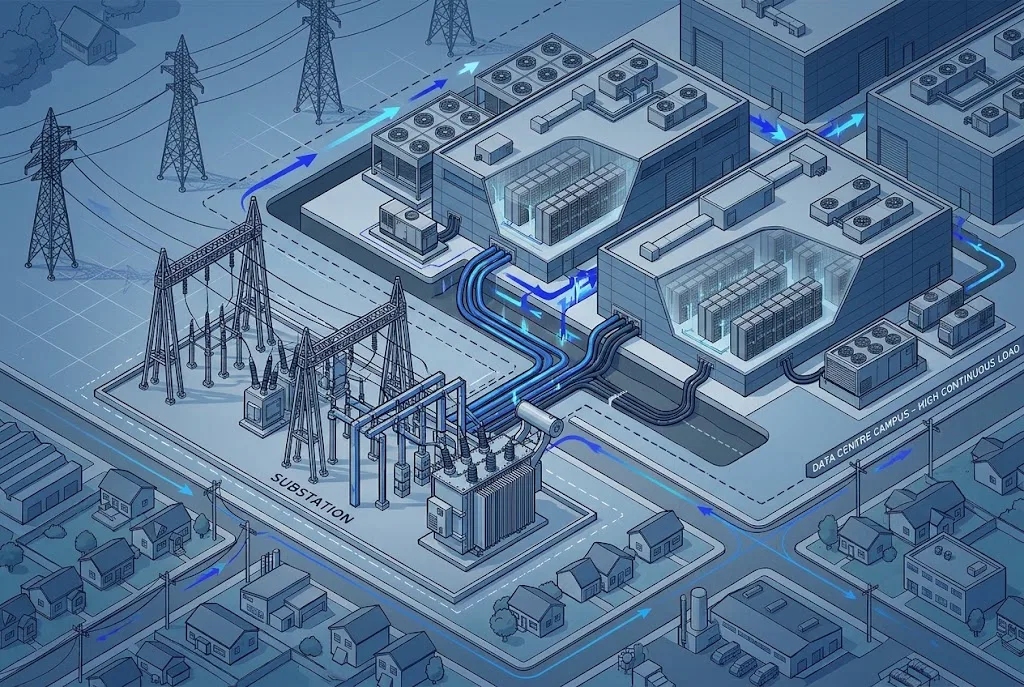
AI data centres are putting electricity grids under pressure because large amounts of new demand are arriving in a relatively small number of locations, often faster than electricity networks can expand. Although data centres account for a modest share of electricity consumption worldwide, their impact can be much greater in technology hubs where many facilities compete for the same power supplies, substations and transmission lines.
Ireland and the United States illustrate this problem particularly clearly. In Ireland, data centres accounted for 23% of metered electricity consumption in 2025, compared with just 5% in 2015. In the United States, rapid development around Northern Virginia and other technology centres is forcing electricity utilities to reconsider how much generation and grid infrastructure they need.
The central issue is not simply whether a country can generate enough electricity. It is whether enough power can reach a particular location, at the required time, without undermining reliability or imposing unreasonable costs on other customers. Central Statistics Office
Why local electricity grids face more pressure than global figures suggest
Data centres are not distributed evenly across countries. They tend to cluster near major cities, cloud computing hubs, high-capacity fibre-optic networks and existing data centre campuses. These locations offer reliable digital connections, established suppliers, specialist workers and proximity to customers.
For technology companies, clustering can reduce operating costs and improve connectivity. For electricity networks, however, it can concentrate enormous demand in places that were never designed to accommodate so many large, continuously operating industrial facilities.
A data centre requiring 100 megawatts (MW) of electricity can consume approximately 876 gigawatt-hours (GWh) annually if it operates at full power throughout the year. That is 876 million kilowatt-hours, before considering whether the facility’s actual operating load is lower than its maximum connection capacity.
A campus containing several such facilities can therefore represent a substantial new industrial electricity load. Unlike housing developments, where individual households consume relatively little electricity and demand varies considerably throughout the day, data centres can maintain high levels of consumption around the clock.
This creates three distinct challenges.
- Electricity supply: Enough generation must be available to meet the additional demand, including during periods of low renewable output or high consumption elsewhere.
- Network capacity: Transmission lines, substations and local distribution networks must be capable of delivering the required electricity without exceeding safe operating limits.
- Connection timing: Grid infrastructure must be ready when a data centre begins operating, even though major network upgrades can take years to plan, approve and construct.
The International Energy Agency (IEA) estimates that grid constraints could delay around 20% of global data centre capacity planned for construction by 2030. Its assessment also notes that building new transmission lines can take four to eight years in advanced economies, while delivery times for important equipment such as transformers and cables have increased substantially. IEA
This helps explain an apparent contradiction: a country may have sufficient electricity generation in aggregate while a particular data centre cannot secure a connection.
Electricity is not simply drawn from a national pool without physical restrictions. It must travel through infrastructure with finite capacity. A power station hundreds of miles away does not automatically solve congestion at a local substation.
AI is making this existing problem more urgent. Large clusters of specialised chips can create unusually high electricity requirements, while demand for AI training and inference encourages operators to develop increasingly powerful facilities. Yet not every data centre serves AI workloads, and publicly available electricity statistics rarely separate AI from other computing activities precisely.
Ireland’s electricity surge: from 5% to 23% in a decade
Ireland provides one of the clearest examples of how data centre expansion can reshape electricity demand in a relatively small national market.
The country attracted major international technology companies partly because of its established digital industry, access to European markets and favourable conditions for multinational investment. Data centre development became concentrated around Dublin, where connectivity, existing facilities and supporting infrastructure were already established.
As the sector expanded, electricity demand grew much faster than consumption elsewhere in the economy.
According to Ireland’s Central Statistics Office (CSO), data centres consumed approximately 1,240 GWh in 2015. By 2025, that figure had reached 7,663 GWh, more than six times the earlier level.
Ireland: data centres’share of metered electricity consumption[cso.ie]cso.ieSource details in endnotes.
0% 6.25% 12.5% 18.75% 25% 2015 2017 2019 2021 2023 2024 2025
- 2015: Share of metered electricity 5%
- 2017: Share of metered electricity 7%
- 2019: Share of metered electricity 9%
- 2021: Share of metered electricity 14%
- 2023: Share of metered electricity 21% * 2024: Share of metered electricity 22%[cso.ie]cso.ieSource details in endnotes. * 2025: Share of metered electricity 23%[cso.ie]cso.ieSource details in endnotes.
Source: Ireland’s Central Statistics Office, Data Centres Metered Electricity Consumption 2025.
Shares are rounded. Figures cover data centres generally, not AI alone. Central Statistics Office
The most revealing comparison is not simply how much electricity data centres consumed, but how quickly their consumption increased relative to everyone else’s.
Between 2024 and 2025, Irish data centre electricity use grew by approximately 10%, while consumption among all other metered customers increased by only 2%. By 2025, data centres accounted for 23% of metered electricity consumption, compared with approximately 28% for all residential customers combined. Central Statistics Office
These are shares of metered electricity, not shares of Ireland’s entire energy consumption. Transport fuels, direct heating fuels and other energy uses are outside that comparison. Nevertheless, the figures demonstrate how one industry can become a major influence on electricity planning.
Why Dublin became a particular pressure point
Ireland’s challenge is intensified by geography. Much of its data centre development has been concentrated in the greater Dublin region, while electricity generation, including substantial wind resources, is distributed across other parts of the country.
This creates a mismatch between where electricity is generated and where large amounts are needed.
When numerous facilities seek connections in the same region, they can collectively exceed the spare capacity available in nearby substations and transmission infrastructure. Expanding the national electricity supply does not remove that local constraint unless the network can transport the additional power.
Ireland’s electricity regulator, the Commission for Regulation of Utilities (CRU), responded in November 2021 with restrictions on how system operators assessed new data centre connection applications. The criteria included the location of a proposed facility, its ability to provide electricity generation and its potential to reduce demand when required.
The policy did not constitute a permanent nationwide ban on data centres. Instead, it made access to the grid conditional on the consequences for the electricity system, with constrained locations facing greater difficulty. CRU
This marked an important change. Grid access could no longer be treated as a routine final stage of a commercial property development. Electricity availability had become a fundamental factor in deciding whether a project was viable.
Ireland’s 2025 policy: developers must contribute to electricity supply
In December 2025, the CRU introduced a new connection policy for data centres, replacing the previous approach for new applications.
Under the revised framework, larger new data centres must provide qualifying electricity generation or storage capacity, either on-site or nearby, broadly matching their maximum permitted electricity import capacity. The requirements vary with the size of the connection.
Data centres above the relevant minimum threshold must also meet at least 80% of their annual electricity demand through additional renewable electricity generated in Ireland, with a six-year period to reach that requirement. CRU
The policy reflects two separate concerns.
First, the grid needs reliable capacity that can support electricity supply when demand is high. Wind and solar generation can reduce annual fossil-fuel consumption, but their output changes with weather conditions. Generation or storage that can operate when required addresses a different problem from renewable electricity purchasing.
Second, new data centres should contribute to expanding Ireland’s renewable electricity supply rather than relying exclusively on existing resources.
These requirements can shift some investment obligations towards developers, but they do not eliminate the wider trade-offs.
A data centre with associated generation still requires network infrastructure. New gas-fired generation could improve supply security while creating additional emissions. Batteries can support the grid, but their usefulness depends on how long they can discharge and how they are recharged. Renewable electricity contracts can support new without guaranteeing that renewable power is physically available at the data centre during every hour of operation.
The Irish experience therefore illustrates a wider policy dilemma: encouraging digital infrastructure investment while ensuring that its electricity requirements do not outpace the system supporting households, businesses and public services.
The United States: rapid growth and uncertain electricity forecasts
The United States faces a related challenge on a much larger scale. Its data centre industry serves domestic and international customers, and its electricity system consists of multiple regional markets, utilities and transmission networks.
Demand is particularly concentrated in established technology corridors, including Northern Virginia, but growth is also spreading to other regions as developers search for suitable land, reliable power and available grid connections.
The scale of potential growth is substantial.
Lawrence Berkeley National Laboratory’s 2025 update estimated that US data centres could consume between 521 and 843 terawatt-hours (TWh) of electricity annually by 2030, equivalent to approximately 9.5–15.3% of projected national electricity consumption.
Its central reference estimate was 649 TWh, or approximately 11.8% of US electricity consumption. Building & Industrial Energy Systems Division
US data centre electricity demand in 2030
0 TWh 250 TWh 500 TWh 750 TWh 1K TWh Low estimate Reference High estimate
- Low estimate: Annual electricity consumption 521 TWh
- Reference: Annual electricity consumption 649 TWh
- High estimate: Annual electricity consumption 843 TWh
Source: Lawrence Berkeley National Laboratory, United States Data Center Energy Usage Report: 2025 Update.
Modelled scenarios, not guaranteed outcomes. The estimates cover all US data centres, including non-AI computing. Building & Industrial Energy Systems Division
The uncertainty is significant. The difference between the low and high estimates is 322 TWh annually, illustrating how sensitive future electricity requirements are to assumptions about technology deployment and operations.
The laboratory’s modelling considers factors such as shipments of computing equipment, electricity consumption per device, cooling performance and the operating characteristics of different facilities.
Future demand could be lower if AI chips become more efficient, facilities operate below expected capacity or are cancelled. It could be higher if more specialised chips are installed, utilisation increases or AI services expand faster than expected.
Importantly, improvements in computing efficiency do not automatically translate into lower total electricity demand. More efficient systems may make AI services cheaper and encourage greater use, offsetting some of the electricity savings.
For grid planners, this creates a difficult investment problem. Building too little infrastructure risks delaying economically valuable projects. Building too much risks leaving electricity customers paying for assets that are not fully used.
Northern Virginia: when a technology hub becomes an electricity planning challenge
Northern Virginia, particularly Loudoun County and surrounding areas, has developed into one of the world’s largest concentrations of data centres.
The region benefits from extensive fibre-optic connectivity, established cloud infrastructure and proximity to major business and government customers. Those advantages have attracted successive waves of development.
However, the resulting electricity requirements are changing the scale of infrastructure planning.
A 2024 investigation by Virginia’s Joint Legislative Audit and Review Commission (JLARC), an independent legislative oversight body, found that data centre expansion was the principal driver of the state’s projected electricity demand growth.
Virginia’s electricity demand had been broadly flat between 2006 and 2020. Yet JLARC’s independently commissioned forecast suggested that unconstrained electricity demand could double over the following decade, largely because of data centres.
The report concluded that meeting even half of the projected unconstrained growth would require substantial new generation and transmission infrastructure. Data Centers in Virginia
The term unconstrained demand matters here. It describes what customers might want if electricity availability did not limit development. It is not a guarantee that every proposed facility will be built, connected or operated at its requested capacity.
This distinction is essential when interpreting alarming electricity forecasts. Proposed data centres can be delayed, redesigned, relocated or abandoned. Developers may also apply for connections in several places before choosing where to invest.
Nevertheless, the Virginia findings demonstrate the physical challenge created when a rapidly expanding industry depends on electricity infrastructure that takes years to construct.
Why electricity forecasts keep changing
The regional grid operator PJM coordinates electricity transmission and wholesale power markets across Virginia and numerous other eastern and midwestern US states.
Its long-term forecasts are particularly important because utilities and regulators use them to assess future electricity requirements.
In January 2026, PJM published a forecast that was lower in the near term through 2032 than its 2025 forecast. Among the reasons were revised assumptions about electric vehicles, economic conditions and large electricity customers.
PJM also strengthened its treatment of large-load requests. Near-term projections require firmer evidence of commitments, while less certain further into the future receive reduced weighting. January 2026 ## Exec
This adjustment is important because a grid connection request is not the same as actual electricity consumption.
A developer may request capacity for a project that is still awaiting financing, planning permission or commercial customers. Some may never materialise. Others may reach their maximum electricity consumption gradually rather than immediately.
At the same time, waiting until every project is certain before planning new infrastructure can create serious delays.
Grid operators must therefore distinguish between credible demand and speculative development without overlooking genuine growth.
The uncertainty does not mean that electricity demand from AI is imaginary. It means that forecasts should be read as planning scenarios, not as measurements of electricity already being consumed.
Why grid connections, transmission lines and substations are the real bottlenecks
The most immediate obstacle to AI data centre expansion is often not the price of electricity, but the availability of a sufficiently large and reliable grid connection.
Developers can purchase land, obtain computing equipment and construct buildings without necessarily securing the electricity capacity needed to operate them at full scale.
Three physical constraints explain why.
Substations cannot supply unlimited electricity
A substation connects different parts of the electricity network and uses transformers to change electricity between voltage levels.
Large data centres often require connections to high-voltage networks because their electricity needs are far greater than those of ordinary commercial buildings.
However, substations have limits determined by their transformers, switchgear, cables and wider network connections.
Suppose a proposed data centre requests a 200 MW connection in an area where only 50 MW of suitable spare capacity is available. The developer cannot simply pay a higher electricity tariff and immediately receive the missing 150 MW.
The network operator must assess whether transformers need replacing, new equipment must be installed or additional transmission infrastructure is necessary.
It must also ensure that the connection will not compromise electricity supply to existing customers.
The difficulty becomes greater when several developments request large connections in the same area.
Transmission lines take longer to build than data centres
Transmission networks carry large quantities of electricity over long distances, generally at high voltage.
When demand grows in a region, new transmission lines or upgrades may be required to bring additional electricity from generators elsewhere.
These involve engineering assessments, land acquisition or access agreements, environmental reviews, planning permission and construction.
They can face opposition because of their effects on landscapes, property and local communities.
The IEA estimates that new transmission lines can take four to eight years to develop in advanced economies. By comparison, individual data centre buildings can often be constructed much more quickly.
Virginia’s JLARC investigation reported that construction of a typical data centre building generally takes approximately 12–18 months. IEA
This mismatch creates a structural problem.
A technology company may be able to finance and build computing infrastructure within two years, while the electricity network needed to support it could take considerably longer.
As a result, grid connection dates increasingly influence where data centres are built, when computing equipment can be installed and whether proceed at all.
Grid equipment is becoming another supply constraint
Even after a network upgrade has been approved, utilities may face long waits for specialist equipment.
Large transformers, high-voltage cables and switchgear are essential to expanding electricity networks. Manufacturing capacity is limited, and electricity utilities worldwide are competing for many of the same components.
The IEA identifies growing order backlogs for power transformers and wider supply-chain pressure affecting equipment used in data centres and electricity networks.
The materials involved, including copper, aluminium and specialised electrical components, are also required for renewable energy, industrial electrification and other infrastructure projects. IEA
This means AI infrastructure expansion is competing for more than electricity itself.
It also requires manufacturing capacity, engineering expertise and physical materials needed by other sectors.
The result can be higher infrastructure costs and longer construction schedules, even where financing is available.
Who pays when electricity networks expand for data centres?
Grid pressure is not only an engineering problem. It raises an economic question: who should bear the costs of expanding infrastructure to accommodate very large electricity users?
Electricity networks generally recover their costs through regulated charges paid by customers. Large data centres typically pay substantial electricity bills and network charges, but the allocation of new infrastructure costs varies between jurisdictions.
A new data centre may directly fund equipment needed for its connection. Other investments, such as transmission upgrades or additional electricity generation, can benefit multiple customers and become part of the wider electricity system’s costs.
This distinction is important because the financial consequences can extend beyond the companies building the facilities.
Virginia’s JLARC investigation found that existing electricity tariffs were broadly allocating current service costs appropriately, including to data centres. It did not conclude that data centres were simply avoiding their electricity bills.
However, it warned that the scale of future demand could increase electricity costs for other customers.
Its modelling suggested that a typical Dominion Energy residential customer could face an increase of approximately $14–$37 per month in generation-and transmission-related costs by 2040, expressed in inflation-adjusted dollars. This was a scenario-based estimate, not an observed bill increase or a prediction that every household would pay that amount. Data Centers in Virginia
There are several reasons why costs could rise.
First, new generation and transmission assets require substantial investment, much of which must be recovered over many years.
Second, rapidly increasing demand can place upward pressure on wholesale electricity prices when additional generation is expensive or slow to build.
Third, utilities may invest in infrastructure for projected demand that subsequently fails to materialise.
The third risk is especially relevant to AI.
If a utility builds a major substation or transmission upgrade for a planned data centre campus, but the developer cancels the project, the infrastructure may be underused. Depending on the applicable contracts and regulations, some costs could fall on other electricity customers.
Conversely, requiring developers to pay the entire cost of every associated network improvement could discourage investment even where infrastructure would provide wider economic benefits.
JLARC identified stronger cost-allocation rules, separate data centre customer categories and more frequent tariff adjustments as possible ways to protect other electricity users. Data Centers in Virginia
The underlying issue is how to distribute financial risk fairly between developers, utilities, investors and the public.
Can AI data centres reduce pressure by changing how they operate?
Grid constraints are not necessarily fixed. Developers and electricity operators can reduce some pressures through location choices, operational flexibility and additional power infrastructure.
However, each option has limitations.
Building where electricity is available. Locating new facilities near existing generation and underused transmission capacity can reduce the need for major upgrades. This may be especially practical for AI training workloads that do not require the lowest possible response times. It can be less attractive for services needing close proximity to users, established cloud regions or particular network connections.
Reducing demand during stressed periods. Some computing tasks can be postponed or moved between facilities. A data centre that temporarily reduces consumption during a period of grid stress may help the electricity system avoid shortages or expensive emergency measures. Yet not all workloads are flexible. Customer-facing services, contractual availability commitments and tightly coordinated training runs can restrict when computing can be interrupted.
Adding local generation or storage. Batteries and electricity generation located near data centres can support supply reliability and potentially reduce dependence on the wider network at particular times. Their value depends on fuel availability, storage duration, operating rules and whether the equipment genuinely supplies additional capacity.
Improving equipment efficiency. More efficient chips, cooling systems and electricity distribution can reduce the energy needed for a given amount of computing. But efficiency improvements do not guarantee falling total consumption if operators simultaneously expand the number of servers or increase their use.
The IEA identifies better site selection, operational flexibility and improved management of connection requests as important ways to reduce the risk of grid delays. IEA
Ireland’s revised connection policy provides a practical example of attempting to make developers contribute additional electricity resources.
Yet Virginia’s JLARC analysis offers an important qualification: efficiency improvements, renewable development and demand-response programmes can help, but were expected to have only a limited effect on reducing the scale of electricity demand in its high-growth scenarios. Data Centers in Virginia
In other words, smarter operation can ease some bottlenecks without replacing the need for substantial infrastructure investment.
What Ireland and the United States reveal about AI’s electricity costs
Ireland and the United States face different electricity challenges, but their experiences point towards the same underlying problem: data centre growth can be highly concentrated, while electricity infrastructure is expensive, location-dependent and relatively slow to expand.
Ireland demonstrates how a single industry can become a major share of national electricity consumption within a decade. Its regulatory response has increasingly linked new data centre connections to local grid conditions, additional generation and renewable electricity development.
The United States demonstrates how the same pressures can emerge across a much larger electricity system. National demand projections are substantial, but regional concentrations such as Northern Virginia can create much more immediate infrastructure requirements.
The comparison also highlights different kinds of uncertainty.
In Ireland, the historical growth in metered electricity consumption is well established. The more difficult question is how quickly the country can accommodate additional demand while maintaining electricity security and meeting renewable energy objectives.
In the United States, both the scale and geographical distribution of future growth remain uncertain. Forecasts depend on which data centre proceed, how quickly AI adoption develops and how much electricity future computing equipment requires.
These differences matter when judging the costs of AI infrastructure.
A high national electricity demand forecast does not establish that every proposed grid upgrade is necessary. Equally, a modest national or global share of electricity consumption does not establish that local networks can accommodate rapid development.
The most useful questions for evaluating a proposed AI data centre are therefore concrete: how much electricity will it require at full operation, where will that power come from, what network upgrades are necessary, when will they be available and who will pay if the project grows more slowly than expected?
There is also a distinction between the benefits and the costs of concentrated development. Established data centre hubs offer digital connectivity, investment and employment opportunities. Virginia’s JLARC investigation found significant economic and tax benefits, particularly during construction, alongside the infrastructure pressures associated with continued growth. Data Centers in Virginia
The policy challenge is not necessarily to prevent data centre development, but to ensure that its location, timing and financial arrangements reflect the real capacity of the electricity system.
For AI companies, electricity availability is becoming a strategic constraint alongside access to chips, capital and computing expertise. For governments and regulators, it creates difficult choices about infrastructure investment, industrial priorities and the distribution of costs.
For local communities, the consequences can be especially tangible: new transmission lines, expanded substations, electricity pricing concerns and decisions about which developments receive access to limited grid capacity.
The central lesson is that AI’s electricity costs are determined not only by how much power data centres consume, but also by where that demand appears and how quickly the surrounding infrastructure can respond.
A relatively small share of global electricity consumption can therefore translate into a major local infrastructure challenge. Understanding that difference is essential to assessing the true physical and economic cost of AI.
Amazon book picks
Further Reading
Books and field guides related to Where Is AI Putting Power Grids Under Pressure?. Use these as the next step if you want deeper reading beyond the article.
Building a Sustainable Future at the Intersection of...
The convergence of semiconductors, energy, and artificial intelligence (AI) creates a more sustainable and technologically advanced...
Demand-Side Energy and Power Management in Data Centers
This book explains the principles, foundations and methodologies adopted in data centers to achieve demand-side energy and peak power...
The AI Data Center Boom Explained
Behind every AI response is a physical world of computer chips, servers, power lines, and cooling systems. What happens when that world...
AI Control Strategies for Optimal Power Distribution
The global energy landscape is transforming as economies prioritize decarbonization and energy resilience. Microgrids—intelligent,...
eBay marketplace picks
Marketplace Samples
Live-tested eBay searches with available results related to this page.
Selected fromartificial intelligence poster oneBay.co.uk.

Current eBay listing
AI ARTIFICIAL INTELLIGENCE . 2001 ORIGINAL MOVIE POSTER vintage 24 YEARS OLD
 </article>
<article class="fr-book-card" data-ebay-listing-card data-ebay-card-kind="listing" data-ebay-card-position="3"data-offer-freshness="current" data-offer-observed-at="2026-10-26T20:24:24Z">
 </article>
<article class="fr-book-card" data-ebay-listing-card data-ebay-card-kind="listing" data-ebay-card-position="4"data-offer-freshness="current" data-offer-observed-at="2026-10-26T20:24:24Z">
 </article>
Endnotes
1.
Source: cso.ie
Link:https://www.cso.ie/en/releasesandpublications/ep/p-dcmec/datacentresmeteredelectricityconsumption2025/index.html
2.
Source: jlarc.virginia.gov
Title: Data Centers in Virginia JLARC Total lines: 117
Link:https://jlarc.virginia.gov/landing-2024-data-centers-in-virginia.asp
3.
Source: iea.org
Title: AI and energy security
Link:https://www.iea.org/reports/energy-and-ai/ai-and-energy-security
4.
Source: iea.org
Link:https://www.iea.org/reports/energy-and-ai/executive-summary%C2%A0
5.
Source: cso.ie
Link:https://www.cso.ie/en/releasesandpublications/ep/p-dcmec/datacentresmeteredelectricityconsumption2024/keyfindings/
6.
Source: insidelines.pjm.com
Title: Kicks Off Annual Process of Vetting Large Load Requests
Link:https://insidelines.pjm.com/pjm-kicks-off-annual-process-of-vetting-large-load-requests/
Source snippet
PJM Inside Lines September 29, 2026...
Published: September 29, 2026
7.
Source: cso.ie
Link:https://www.cso.ie/en/releasesandpublications/ep/p-ess/electricitysupplybysource2025/keyfindings/
Additional References
8.
Source: philiplee.ie
Link:https://www.philiplee.ie/eirgrid-dccopp-version-3-what-data-centre-operators-need-to-know/
9.
Source: youtube.com
Link:https://www.youtube.com/watch?v=NWIYvXFu7tg
10.
Source: youtube.com
Link:https://www.youtube.com/watch?v=d_8rJKBVpCc
11.
Source: youtube.com
Link:https://www.youtube.com/watch?v=r6eSoadwxXE
12.
Source: stackpath.ie
Title: Data centres’ ‘bring your own power’ means gas
Link:https://stackpath.ie/insights/bring-your-own-power-means-gas
Source snippet
StackPath October 3, 2026...
Published: October 3, 2026
13.
Source: theloadatlas.com
Title: Northern Virginia Data Centers: Power, Trades
Link:https://theloadatlas.com/markets/northern-virginia/