Within Grid Pressure
Must Ireland's Data Centres Pay for Their Own Power?
Ireland's new grid connection rules require larger data centres to support electricity supply and renewables, raising questions about costs and reliability.
Published
On this page
- Why Ireland replaced its earlier data centre connection restrictions in 2025
- What the new generation, storage and 80% renewable electricity requirements mean
- Who pays for additional power capacity and which grid problems remain unresolved
Page outline Jump by section
Updated
Introduction
Ireland’s new data centre electricity rules make developers responsible for bringing additional power capacity and supporting new renewable generation, but they do not require data centres to operate independently of the national grid or pay every cost their expansion creates.
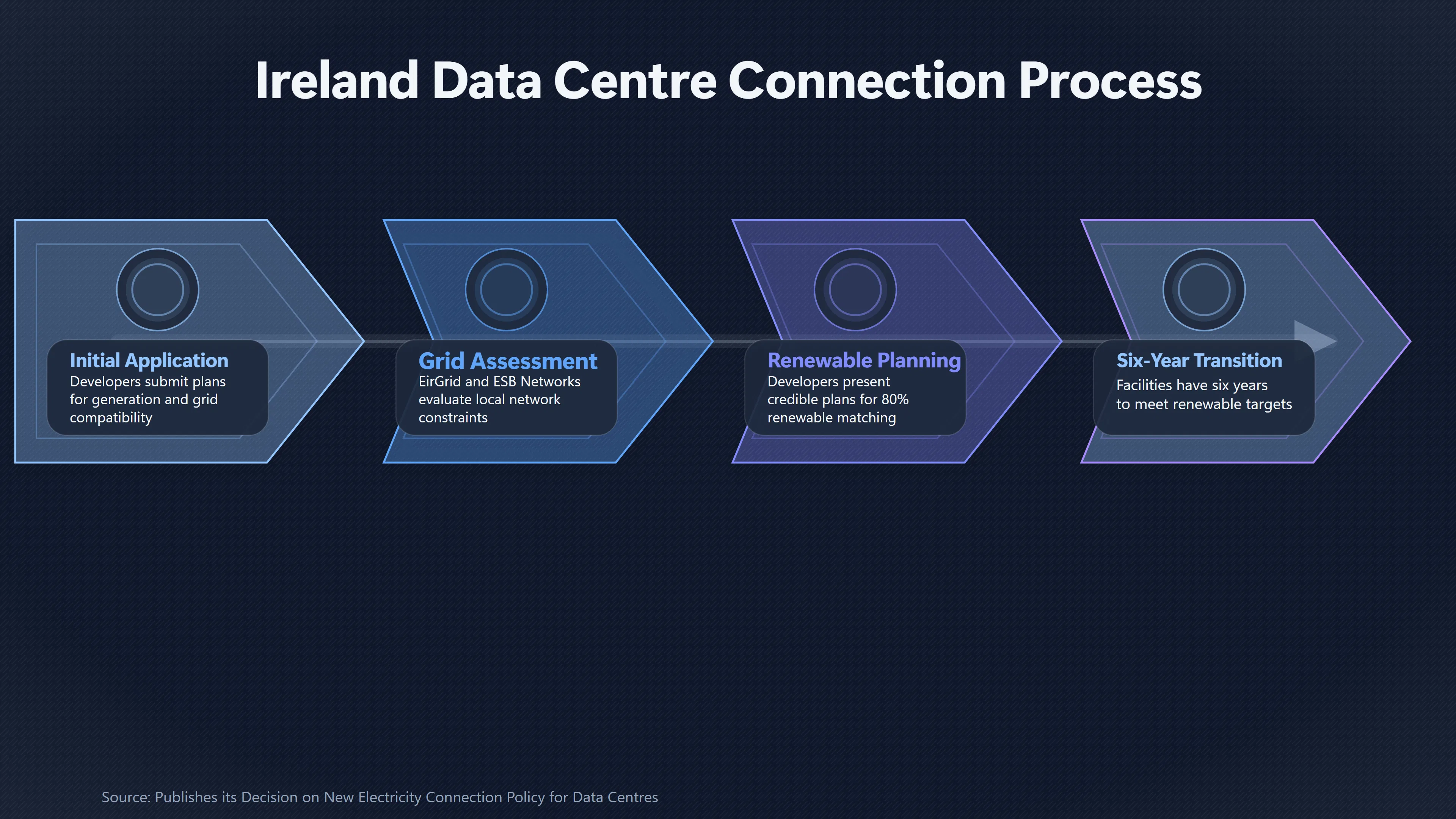
On 12 December 2025, Ireland’s Commission for Regulation of Utilities (CRU) introduced a new connection policy requiring larger data centres to provide electricity generation or storage capacity matching their maximum grid demand. Facilities above a minimum size must also match at least 80% of their annual electricity consumption with additional renewable generation in Ireland, with six years to meet that target.
The policy replaces an earlier, highly restrictive approach with a conditional route to new connections. It aims to protect electricity reliability while allowing further investment in cloud computing and AI infrastructure. The unresolved question is whether these requirements genuinely prevent costs from being passed to households, businesses and the environment. CRU
What must data centres provide under the new rules?
The most important distinction is between providing enough dependable electricity capacity and supporting enough renewable electricity over a year. Ireland’s policy requires both, but they solve different problems.
| Requirement | What developers must do | What it means for costs |
| Generation or storage | Provide capacity capable of matching the site’s maximum permitted grid import, subject to size thresholds | Developers must finance or contract for additional electricity infrastructure |
| 80% renewable electricity | Support additional renewable generation in Ireland equivalent to at least 80% of annual electricity demand | Creates demand for new wind and solar projects rather than relying solely on existing supplies |
| Six-year transition | Deliver the renewable requirement within six years of the data centre receiving power | Gives developers time to build projects, but permits an initial period before full compliance |
| Grid location assessment | Demonstrate that the proposed connection can be accommodated without unacceptable network constraints | A developer may still face refusal, delays or expensive infrastructure requirements |
| Wholesale market participation | Make qualifying generation or storage available through Ireland’s electricity market | Additional capacity can support the wider system and potentially earn revenue |
The policy applies specifically to data centres rather than automatically imposing identical obligations on all large industrial electricity users. The detailed requirements depend on a facility’s maximum import capacity (MIC), meaning the maximum electricity it is contractually permitted to draw from the grid. Arthur Cox LLP
Different rules for different sizes
Ireland uses megavolt-amperes (MVA) to measure connection capacity. This is closely related to megawatts (MW), although the two are not always numerically identical.
- Below 1 MVA: The principal generation and renewable electricity obligations do not apply, although local network constraints still matter.
- From 1 MVA to below 10 MVA: The developer must provide an electricity-producing unit, known as an autoproducer, capable of covering the site’s maximum import capacity on a reliability-adjusted basis. It must participate in the wholesale market.
- At least 10 MVA: The developer must provide on-site or nearby dispatchable generation and/or storage matching the site’s maximum import capacity, after adjustments for how reliably that equipment can deliver electricity. This equipment must be separately connected and metered and participate in the electricity market.
These distinctions are important because the largest facilities, including many hyperscale cloud and AI data centres, fall into the most demanding category.
The generation requirement also applies as a facility expands. A large data centre cannot simply increase its electricity imports to full planned capacity before the corresponding qualifying generation or storage is available. Arthur Cox LLP
Why Ireland replaced its earlier restrictions
Ireland’s December 2025 decision followed several years in which the country’s data centre industry grew faster than the electricity system could comfortably accommodate in its most popular locations.
In November 2021, the CRU introduced restrictions requiring electricity system operators to assess proposed data centre connections against network constraints, generation availability and the potential contribution of on-site generation.
Although these rules were not a formal nationwide prohibition, they made new connections particularly difficult around Dublin. Industry representatives described the resulting situation as a de facto moratorium.
The December 2025 decision superseded the earlier direction for new applications and established clearer conditions under which developers could seek connections. Rather than relying primarily on restrictive case-by-case assessments, the new framework requires applicants to arrive with plans for supporting generation, renewable electricity and grid compatibility. CRU
The electricity demand behind the decision
The CRU reported that data centres accounted for 22% of Ireland’s national electricity demand in 2024, up from 5% in 2015.
The regulator also cited EirGrid forecasts suggesting that, under the assumptions used at the time, data centre electricity demand could rise from 9.4 terawatt-hours (TWh) in 2025 to 14.6 TWh in 2034, reaching approximately 31% of national electricity demand.
These are projections, not guaranteed outcomes. Actual demand will depend on connection approvals, investment decisions, computing efficiency and the pace of infrastructure construction. CRU
The scale nevertheless explains the regulatory intervention. A rapidly expanding sector consuming a substantial share of national electricity cannot be treated as a collection of ordinary commercial connections.
The problem is particularly pronounced around Dublin, where major technology companies have concentrated data centres to benefit from established fibre networks, cloud infrastructure and existing operations.
Ireland therefore faced a difficult choice: continue restricting new connections, potentially discouraging investment, or permit further development while requiring operators to contribute more directly to electricity supply.
The 2025 policy represents the second approach.
Does the generation requirement mean data centres must produce all their own electricity?
No. The policy requires qualifying generation or storage capacity to be available, not that every unit of electricity consumed by a data centre must be produced on its premises.
This distinction is central to understanding both the benefits and limitations of Ireland’s approach.
Large data centres must provide dispatchable capacity. Dispatchable means electricity generation or storage that can be called upon when the system needs it, rather than relying entirely on weather conditions.
Qualifying equipment can be located at the data centre or sufficiently close to it electrically. For larger facilities, it must participate in the wholesale electricity market, allowing its output to contribute to the wider electricity system rather than being reserved exclusively for the data centre.
The developer can build the equipment directly or contract with another provider. Arthur Cox LLP
Why the amount of dependable power matters
Consider a hypothetical data centre with a maximum grid import capacity of 100 MW, assuming for simplicity that its power factor makes 100 MW approximately equivalent to its relevant connection capacity.
Under the new framework, it would need qualifying generation or storage with a reliability-adjusted capacity matching that maximum import.
But installing equipment labelled as 100 MW does not necessarily satisfy the requirement.
The regulator uses de-rating, which reduces the amount of capacity credited to equipment according to how reliably it can supply electricity when needed.
For example, if a hypothetical storage system received a 50% capacity credit, 100 MW of installed storage would count as only 50 MW of dependable capacity. It would therefore need additional capacity to satisfy a 100 MW obligation.
This is an illustration rather than an actual Irish de-rating factor. The applicable ratings depend on the technology and electricity market rules.
The distinction matters because batteries may provide valuable short-term support without necessarily covering a prolonged period of high demand or low renewable output.
The CRU’s design therefore encourages equipment capable of contributing to electricity security, not simply the installation of enough nameplate capacity to satisfy a headline target. Energy Ireland
The possibility of more gas generation
One consequence is that gas-fired generation may remain attractive to developers.
Gas engines and turbines can provide controllable electricity output over extended periods, making them potential candidates for meeting dependable-capacity requirements.
This creates a tension between electricity reliability and climate policy.
Additional gas capacity may reduce the risk of electricity shortages, but its operation produces carbon dioxide and can prolong dependence on fossil-fuel infrastructure.
The rules permit qualifying storage and other technologies, so they do not mandate gas generation. Nevertheless, environmental groups have challenged the policy partly because it allows further fossil-fuel electricity production. StackPath
What does the 80% renewable electricity requirement actually guarantee?
The renewable electricity requirement is designed to ensure that data centre expansion supports additional clean electricity generation in Ireland.
Facilities covered by the obligation must match at least 80% of their annual electricity consumption with qualifying renewable generation in the Republic of Ireland.
Crucially, developers cannot simply count electricity from renewable already supported under specified existing public subsidy schemes, including REFIT, RESS and ORESS.
The intention is to encourage genuinely additional renewable capacity rather than allow companies to claim credit for that would already have been developed with public support. CRU
Developers can meet the obligation through arrangements such as corporate power purchase agreements, where a business contracts to buy electricity from a renewable generator, or by developing qualifying renewable directly.
The policy also allows fully repowered renewable to qualify under the relevant conditions.
Annual matching is not round-the-clock clean electricity
Suppose a data centre consumes 500 gigawatt-hours (GWh) of electricity annually.
Its 80% obligation would correspond to:
- Annual electricity consumption: 500 GWh
- Required qualifying renewable generation: 400 GWh
- Remaining annual consumption not covered by the 80% requirement: 100 GWh
This does not mean that 80% of the electricity physically reaching the data centre must come from wind or solar power at every moment.
A wind farm may generate large amounts of electricity overnight or during windy periods, while the data centre continues consuming electricity during calm periods.
Annual matching can therefore coexist with substantial dependence on gas-fired generation at particular hours.
That does not make the renewable requirement meaningless. If it drives genuinely additional wind or solar investment, it can increase clean electricity supply and displace fossil generation elsewhere on the system.
However, it is not equivalent to a guarantee of continuous carbon-free operation. CRU
Why the six-year transition is controversial
The CRU allows developers six years from the energisation of a data centre to achieve the renewable electricity requirement.
This recognises that building wind and solar involves land agreements, planning permission, grid connections, financing and construction.
The developer must still present a credible renewable electricity plan when applying for a connection and report on progress. Failure to meet relevant obligations can ultimately affect its permitted electricity import capacity. Arthur Cox LLP
The advantage is that data centres need not wait for every associated renewable project to finish construction before operating.
The disadvantage is that electricity demand can arrive years before all the promised renewable generation.
For households and the wider grid, that timing matters. If demand grows faster than clean electricity supply, existing generators must meet the difference.
The six-year period is therefore a compromise between encouraging investment and ensuring new computing demand is accompanied by sufficient clean generation.
Who actually pays for the additional electricity infrastructure?
The new rules move some costs directly onto data centre developers, but they do not make every consequence of data centre expansion a private expense.
The financial outcome depends on which infrastructure is being built, how it is connected, how electricity market payments are structured and whether costs are recovered through regulated network tariffs.
| Cost or benefit | Who initially bears it? | What remains uncertain? |
| New qualifying generation or storage | Data centre developer or contracted energy provider | How much is recovered through electricity market revenue |
| New renewable projects | Renewable developer, backed by data centre contracts or investment | Whether contracts support genuinely additional generation |
| Data centre electricity consumption | Data centre operator through electricity bills and network charges | How changes in market prices affect other consumers |
| Shared transmission and distribution upgrades | Network companies, with costs recovered under regulated arrangements | How much is attributable to individual data centres versus shared system needs |
| Additional fossil-fuel emissions | Not necessarily fully reflected in the developer’s direct costs | How climate and environmental costs are distributed |
| Electricity security benefits | Wider electricity system when new capacity is available | Whether the new capacity is dependable when most needed |
The policy is strongest where it explicitly requires developers to arrange additional electricity infrastructure. It is less conclusive where the question concerns the allocation of wider network costs and environmental impacts.

Developers pay for power capacity, but can earn money from it
The CRU requires qualifying generation to participate in the wholesale electricity market.
That means a generator associated with a data centre may receive revenue from selling electricity and, where eligible, from providing capacity or other electricity system services.
Ireland’s capacity market pays qualifying providers for making dependable generation capacity available, subject to market rules.
The December 2025 framework places restrictions on the capacity-market participation of associated generation, including limiting relevant contracts to one-year terms. Arthur Cox LLP
This matters for the claim that data centres must pay for their own power.
A developer may finance a new generator, but the generator can subsequently earn income through a market funded by electricity consumers.
That does not automatically constitute an unfair subsidy. Electricity markets routinely pay generators for useful supply and reliability services.
The question is whether the payments reflect genuine benefits to the wider system, or whether other customers effectively help finance infrastructure made necessary by one particularly large new consumer.
Answering that requires examining actual project costs, market revenues and regulatory cost allocation, not merely identifying who owns the generator.
Network charges do not eliminate every shared cost
Data centres continue paying network charges for using Ireland’s electricity transmission and distribution systems.
These charges help recover the costs of operating, maintaining and developing the shared network.
However, a large data centre may require new substations, stronger transmission lines, additional transformers or other reinforcement.
Some costs may be recovered directly from the connecting customer, while broader system investments can be recovered through regulated network tariffs.
The December 2025 policy does not establish a blanket rule that each data centre must independently finance every upstream reinforcement associated with its electricity demand. Arthur Cox LLP
This is where cost allocation becomes particularly important.
If a network upgrade benefits multiple customers, sharing its costs may be reasonable. But if substantial investment is driven mainly by new data centre demand, spreading too much of the expense across ordinary electricity users raises fairness concerns.
Conversely, requiring one developer to pay for infrastructure that will serve a whole region for decades could discourage economically useful investment.
The policy therefore reduces some opportunities for cost shifting without settling the wider debate over who should pay for grid expansion.
Why the new rules do not solve Dublin’s grid constraints
A data centre can satisfy the generation and renewable requirements yet still be unable to obtain a viable electricity connection.
That is because electricity generation capacity and network delivery capacity are different things.
Additional electricity generation may help the national system meet demand, but it cannot automatically remove congestion on an overloaded transmission line or create spare capacity at a constrained substation.
The CRU consequently requires EirGrid and ESB Networks to assess the location of each proposed data centre connection.
In 2026, the system operators published more detailed application procedures and information about where new connections could be accommodated.
The resulting assessment remained particularly restrictive around Dublin. EirGrid
Dublin remains the hardest location
EirGrid’s 2026 connection information identifies the Greater Dublin region as fully constrained for large data centre development.
Other areas offer some potential capacity, but not necessarily immediate connections.
A June 2026 analysis of the published network assessments identified possible capacity of approximately 50–100 MW at certain locations around Galway, Limerick and Cork, subject to network conditions and project-specific assessments.
It also noted that refurbishment requirements at some substations could delay connections until the mid-2030s. These figures are indicative, not guaranteed connection offers. Mason Hayes Curran
This changes the economics of proposed AI infrastructure.
A developer may need to choose between a preferred Dublin location with strong digital connectivity but limited electricity capacity, and a location elsewhere with better power prospects but additional fibre, network or operational costs.
Even a project willing to build its own generation may face years of delay if the surrounding electricity network cannot accommodate it.
More paperwork is not the same as more grid capacity
The new application processes also require developers to demonstrate credible progress on planning permission and associated energy projects.
For large transmission-connected data centres, EirGrid requires planning-related evidence before key stages of the connection application. Associated generation and renewable face their own planning and connection requirements.
These conditions reduce the risk of speculative occupying scarce connection capacity without realistic delivery plans.
But they also mean that developing a data centre increasingly involves coordinating several major infrastructure simultaneously: the computing facility, its dependable generation, its renewable electricity arrangements and its network connection. Mason Hayes Curran
The resulting delays and costs can be substantial even before the first servers are installed.
Is the policy fair to households and other businesses?
There are credible arguments both for and against Ireland’s approach.
Supporters see the policy as a way to make data centre expansion more compatible with electricity security and renewable investment.
Industry organisations welcomed the December 2025 decision because it replaced prolonged uncertainty with clearer connection requirements.
Wind Energy Ireland also welcomed the policy, arguing that it could encourage investment in new renewable projects. CRU
The potential public benefits are tangible.
New dispatchable generation can contribute to system reliability. New renewable contracts can support wind and solar construction. Data centre investment can support construction employment, digital services and associated economic activity.
The relevant question is whether those benefits outweigh the infrastructure costs and environmental consequences, and how fairly they are distributed.
The argument that developers should carry more of the burden
Environmental campaigners have questioned whether the new rules sufficiently protect Ireland’s climate targets.
Friends of the Earth argued after the December 2025 decision that annual renewable matching does not necessarily deliver corresponding reductions in actual emissions.
In March 2026, Friends of the Irish Environment, Friends of the Earth Ireland and ClientEarth pursued a High Court challenge to the CRU’s policy, raising concerns about its compatibility with climate obligations and the scope for additional fossil-fuel generation. CRU
The challenge is significant because it concerns the legal and environmental foundations of the connection framework, not simply whether a particular data centre should receive planning permission.
The policy remained subject to judicial review proceedings in the 2026 implementation documents. The existence of that challenge does not itself establish that the rules are unlawful. Mason Hayes Curran
Why the distribution of costs matters
Households and smaller businesses do not necessarily benefit from data centre expansion in proportion to the additional electricity infrastructure it requires.
For example, a large data centre may have the financial resources to secure long-term renewable electricity contracts, develop private generation and absorb connection delays.
A smaller industrial business cannot always make equivalent investments.
There is also a question of priority. If grid capacity, renewable projects, skilled workers and network equipment are limited, rapid data centre expansion can compete with housing electrification, industrial development and the wider transition away from fossil fuels.
That does not mean the same resources would automatically be available to other users if a data centre were refused. Infrastructure investment can create additional capacity and economic opportunities.
It does mean that the true public cost depends on what else the electricity system could have supported with the same scarce resources.
An April 2026 report by an Irish parliamentary committee examining private electricity wires recorded concerns that large energy users could gain preferential access to renewable generation while retaining dependence on the public grid for back-up. It also highlighted the risk of costs being shifted towards households and smaller businesses. Oireachtas Data
These concerns extend beyond the December connection decision, but they illustrate why requiring developers to arrange their own power is not sufficient, by itself, to settle questions of fairness.
What would show that the policy is working?
The success of Ireland’s approach cannot be judged simply by the number of new data centres receiving connections.
A meaningful assessment needs to distinguish between investment commitments and infrastructure that is actually operating.
Four outcomes are particularly important.
First, dependable capacity must arrive when promised. If new data centres begin operating before sufficient qualifying generation becomes available, the intended reliability benefit is weakened. The rules linking electricity import capacity to the delivery and performance of generation are therefore essential.
Second, renewable electricity must be genuinely additional. A long-term contract is more valuable to the public if it helps bring a new wind or solar farm into operation than if it merely reallocates the environmental claims associated with existing generation. The CRU’s exclusion of specified publicly supported addresses part of this problem, but actual delivery still needs scrutiny.
Third, network investment must be transparent. The public needs to know which upgrades are primarily required by data centres, which benefit multiple users and how costs are allocated. The regulator’s requirement for more regular publication of network constraints is a useful step, but connection-capacity maps alone do not reveal the full financial burden.
Fourth, emissions and electricity reliability must be measured in practice. Annual renewable matching, installed generator capacity and signed contracts are indicators of compliance. They do not, individually, establish the real emissions or reliability effects of a new data centre. CRU
There is also a time dimension. The CRU’s six-year renewable transition means that a facility connected in 2026 could have until 2032 to fulfil its annual renewable matching requirement. A favourable assessment based on initial investment announcements could therefore prove premature.
What Ireland’s rules mean for the cost of AI
Ireland’s policy illustrates a wider change in the economics of AI and cloud infrastructure.
Electricity is no longer merely an operating expense that data centre companies pay after construction. In constrained markets, access to dependable power is becoming a condition of development itself.
A large AI data centre may require investment not only in chips, servers, cooling equipment and buildings, but also in electricity generation, storage, renewable and grid connections.
These additional requirements can increase upfront capital expenditure and make project delivery more complicated. They can also create useful electricity infrastructure that would otherwise take longer to develop.
The December 2025 rules therefore represent a meaningful shift towards making developers account for the electricity system they depend on.
But the distinction between paying for new generation and paying the full social cost of electricity demand remains important.
A data centre can finance a gas turbine while contributing to additional emissions. It can sign renewable contracts while relying on fossil-fuel electricity during periods of low wind. It can pay network charges while some wider reinforcement costs are shared with other consumers.
Ireland’s answer is that new data centres must contribute much more directly to the power infrastructure needed to support their expansion. It is not that they must pay every cost themselves.
Whether the balance proves fair will depend on the delivery of promised generation, the actual addition of renewable capacity, the allocation of grid costs and the environmental consequences of further electricity demand.
For Ireland, the central policy test is not simply whether the new rules allow more data centres to be built. It is whether they allow that growth without transferring disproportionate financial, reliability and climate costs to the rest of the electricity system.
Amazon book picks
Further Reading
Books and field guides related to Must Ireland's Data Centres Pay for Their Own Power?. Use these as the next step if you want deeper reading beyond the article.
Demand-Side Energy and Power Management in Data Centers
This book explains the principles, foundations and methodologies adopted in data centers to achieve demand-side energy and peak power...
Building a Sustainable Future at the Intersection of...
The convergence of semiconductors, energy, and artificial intelligence (AI) creates a more sustainable and technologically advanced...

The taking issue
First published 1973. Subjects: Land use, Law and legislation, Police power.
eBay marketplace picks
Marketplace Samples
Live-tested eBay searches with available results related to this page.
Selected fromartificial intelligence poster oneBay.co.uk.
 </article>
<article class="fr-book-card" data-ebay-listing-card data-ebay-card-kind="listing" data-ebay-card-position="2"data-offer-freshness="current" data-offer-observed-at="2026-10-26T20:24:24Z">

Current eBay listing
A I Artificial Intelligence 6 Movie Poster Art Print Print Classic Rare Gallery
 </article>
<article class="fr-book-card" data-ebay-listing-card data-ebay-card-kind="listing" data-ebay-card-position="4"data-offer-freshness="current" data-offer-observed-at="2026-10-26T20:24:24Z">
 </article>
Endnotes
1.
Source: cru.ie
Title: Publishes its Decision on New Electricity Connection Policy for Data Centres
Link:https://www.cru.ie/en-ie/about-us/news/the-cru-publishes-its-decision-on-new-electricity-connection-policy-for-data-centres/
2.
Source: cru.ie
Link:https://www.cru.ie/about-us/news/new-electricity-connection-policy-for-data-centre/
3.
Source: stackpath.ie
Title: Data centre planning in Ireland: grants, refusals, appeals
Link:https://stackpath.ie/data-centre-planning-ireland
Additional References
4.
Source: irishlegal.com
Link:https://www.irishlegal.com/articles/supreme-court-leave-to-appeal-refused-in-data-centre-planning-permission-challenge
Source snippet
Irish Legal News October 13, 2026 — SUPREME COURT: LEAVE TO APPEAL REFUSED IN DATA CENTRE PLANNING PERMISSION CHALLENGE 13 Oct 2026 Image...
Published: October 13, 2026
5.
Source: sartoriglobal.com
Title: Dublin Data Center Connection Counsel
Link:https://sartoriglobal.com/insights/market/dublin-data-center-connection-counsel/
Source snippet
Sartori & Partners August 25, 2026 — 09 Sources THE STATUTE, THE REGULATOR'S DIRECTIONS, THE OPERATOR'S PROCESS AND THE UTILITY FILINGS...
Published: August 25, 2026
6.
Source: pila.ie
Link:https://www.pila.ie/resources/bulletin/2026/10/21/supreme-court-refuses-appeal-challenging-planning-permission-for-clare-data-centre
Source snippet
PILA October 21, 2026 — SUPREME COURT REFUSES APPEAL CHALLENGING PLANNING PERMISSION FOR CLARE DATA CENTRE The Supreme Court has refused...
Published: October 21, 2026
7.
Source: ifsc.ie
Link:https://www.ifsc.ie/news/data-centres-and-the-grid-how-recent-irish-policy-will-shape-the-sector
8.
Source: irishtimes.com
Link:https://www.irishtimes.com/ireland/2026/04/28/environmental-groups-granted-leave-to-challenge-data-centre-policy/
9.
Source: youtube.com
Link:https://www.youtube.com/watch?v=NWIYvXFu7tg
10.
Source: youtube.com
Link:https://www.youtube.com/watch?v=h12sjm8GZ3w
11.
Source: youtube.com
Link:https://www.youtube.com/watch?v=hUtakazndVg
12.
Source: youtube.com
Link:https://www.youtube.com/watch?v=mEAdigVp50M
13.
Source: youtube.com
Link:https://www.youtube.com/watch?v=mzhW9jE9Z4M