Within AI Power Demand
Could AI Data Centres Push Up Electricity Bills?
Expanding AI data centres can require costly electricity infrastructure, raising questions about who funds upgrades and who bears the financial risks.
Published
On this page
- The cost of supplying AI data centres with new generation and grid infrastructure
- How infrastructure spending can affect technology companies, electricity customers and taxpayers
- How grid planning, connection charges and uncertain demand forecasts shape who pays
Page outline Jump by section
Updated
Introduction
AI data centres could push up electricity bills, but the outcome depends heavily on who is required to pay for the power stations, cables, substations and grid upgrades needed to serve them. Technology companies normally pay for the electricity they consume and may fund their own connections or power supplies. However, wider electricity infrastructure is often financed by regulated network companies and recovered through charges paid by households and businesses.
The central question is whether AI companies pay the additional costs their facilities create, or whether some of those costs are spread across other electricity customers and taxpayers.
This is becoming a significant policy issue. The International Energy Agency (IEA) expects global data centre electricity consumption to rise from approximately 485 terawatt-hours (TWh) in 2025 to 950 TWh in 2030, with AI-focused facilities growing particularly quickly. The expansion is creating demand for infrastructure that can take years to build and may remain in service for decades. IEA
The financial consequences depend on decisions made before a data centre opens: which infrastructure is approved, who finances construction, how costs are allocated through electricity tariffs, and what happens if projected AI demand fails to materialise.
What electricity infrastructure does AI actually require?
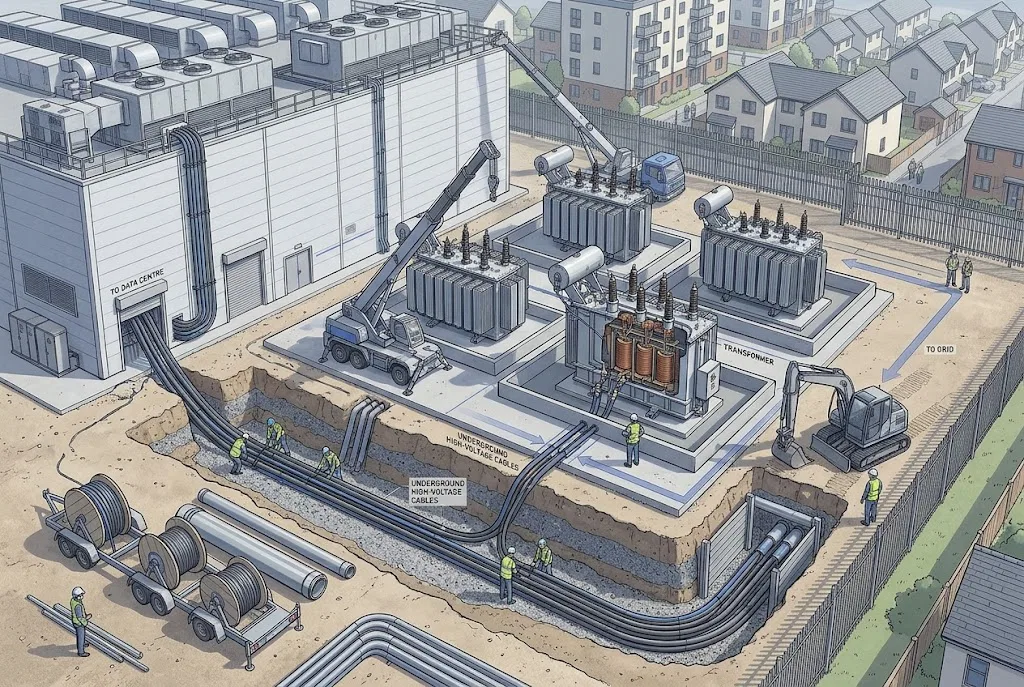
A large AI data centre needs more than a connection to an existing electricity cable. It may require substantial new generating capacity, high-voltage transmission infrastructure, local substations and equipment to keep the electricity supply stable.
These investments serve different purposes, and the distinction matters because their costs are recovered in different ways.
New electricity generation provides the additional power needed to run servers, cooling equipment and supporting systems. This may come from new renewable projects, gas-fired power stations, nuclear generation or existing power plants operating more intensively.
Transmission infrastructure moves large quantities of electricity across regions. New high-voltage lines may be necessary when data centres are concentrated far from existing generating capacity or where transmission networks are already congested.
Distribution and connection infrastructure delivers electricity to individual sites. Large facilities may need dedicated substations, transformers, switching equipment and new cables. Some connect directly to transmission networks rather than ordinary local distribution networks.
System-wide infrastructure maintains reliability. Electricity networks must have sufficient capacity to manage demand peaks, equipment failures and unexpected interruptions. The need for reserve capacity, storage or network reinforcement can create costs beyond the equipment physically connected to a data centre.
The IEA’s World Energy Investment 2025 estimated that meeting growing data centre electricity demand would require more than US$170 billion of investment in new electricity generation capacity globally by 2030. This is a generation investment estimate, not a complete bill for every transmission line, substation or local connection. 10th Edition
Why electricity infrastructure can cost more than expected
A data centre operator may budget for a particular electricity connection, only to discover that the local grid cannot supply the requested power without substantial reinforcement.
For example, connecting a 200-megawatt (MW) facility may involve upgrading a nearby substation. But if the wider transmission network cannot reliably deliver another 200 MW to the area, additional work may be needed much further away.
The resulting costs may be distributed across several infrastructure and electricity customers, rather than appearing as one identifiable charge to the data centre developer.
Timing adds another difficulty. The IEA’s 2025 Energy and AI assessment found that new transmission lines can take four to eight years to develop in advanced economies. It also estimated that grid constraints could delay around 20% of planned global data centre capacity by 2030. IEA
This creates pressure to invest ahead of confirmed demand. Waiting until every AI project is operational risks electricity shortages and lengthy connection delays. Building too early, however, risks leaving customers paying for infrastructure that turns out to be unnecessary.
Who pays for the new power stations and grid upgrades?
There is no universal rule requiring technology companies to pay every cost associated with their electricity demand. Payment depends on the ownership of the infrastructure, electricity market rules, connection agreements and decisions by regulators.
In practice, several groups can contribute to the same project.
| Who pays? | Typical financial responsibility | Main risk |
| Data centre developers and technology companies | Site connections, electricity purchases, dedicated equipment and contracted generation | Paying for capacity that is no longer needed |
| Electricity network companies | Financing approved transmission and distribution upgrades | Construction costs and investment recovery |
| Households and other electricity customers | Network charges and some shared system costs | Higher bills or costs from unused infrastructure |
| Power generators and investors | Construction and financing of new generating capacity | Electricity sales or contracts failing to cover investment |
| Governments and taxpayers | Subsidies, tax incentives, public financing or guarantees | Public spending without sufficient economic return |
These categories overlap. A network company might finance a new substation initially, recover part of its cost from the data centre through connection charges, and recover another part from electricity users over many years.
Technology companies: direct payments and long-term contracts
Major technology companies can finance their electricity needs in several ways. They may pay directly for dedicated connection assets, enter long-term electricity supply agreements or invest in power generation.
A power purchase agreement (PPA) is a contract under which a company agrees to buy electricity from a generator, often for several years. Such agreements can help developers finance new renewable or other generating because they provide greater certainty about future revenue.
The IEA reported that the technology sector accounted for around 40% of corporate renewable power purchase agreements signed in 2025. Technology companies are also supporting investment in nuclear and advanced geothermal electricity generation. IEA
However, signing a power purchase agreement does not necessarily mean a technology company has paid for all the infrastructure needed to deliver that electricity.
A wind farm, for example, may require new transmission capacity. A data centre buying its electricity may still depend on network upgrades financed through charges collected from a much wider group of customers.
Likewise, buying enough renewable electricity over a year does not automatically guarantee that the data centre can receive carbon-free electricity during every hour it operates. Other generators, storage or grid services may still be needed.
The important distinction is between paying for electricity and paying the full additional cost of making that electricity reliably available at a particular location.
Electricity network companies: financing now, recovering costs later
Electricity transmission and distribution networks are expensive assets with long operating lives. Their owners typically finance construction through borrowing and investment capital, then recover approved expenditure through regulated charges.
In Great Britain, the energy regulator Ofgem controls how much revenue regulated network companies can collect through its RIIO framework. This is intended to allow necessary investment while protecting consumers from excessive charges.
Ofgem’s electricity transmission price control for April 2026 to March 2031 includes provision for major network investment, with further funding dependent on assessed system needs and costs. Ofgem
This arrangement means network shareholders and lenders provide much of the initial financing, but electricity customers ultimately fund substantial portions of approved investment through their bills.
The distinction between financing and paying is essential. A project described as privately financed does not necessarily mean its long-term costs will be borne exclusively by private investors.
Households and businesses: shared network charges
Domestic and business electricity bills include charges associated with operating, maintaining and expanding the electricity network.
When a network upgrade benefits many users, its costs may be shared across customers. This is reasonable where the investment improves reliability, enables renewable generation or supports wider economic development.
The controversy arises when infrastructure is built primarily because of a small number of large data centres, but significant costs are allocated to customers who receive little direct benefit.
Even where data centres pay appropriate connection and network charges, rapid demand growth can increase electricity prices by requiring more expensive generation or placing pressure on available supplies.
This means two separate questions must be considered: whether a data centre pays its allocated share of infrastructure costs, and whether its arrival increases the overall cost of supplying electricity to everyone.
Could AI data centres push up household electricity bills?
Yes. Large data centres can increase household electricity costs through both network investment and changes in wholesale electricity markets. But higher demand does not automatically mean every household will pay more, and the effects vary considerably by region.
A particularly important distinction is between the cost of constructing additional infrastructure and the cost of electricity itself.
Network investment can raise regulated charges as utilities recover spending on new lines, transformers and substations. At the same time, growing electricity demand may increase wholesale prices if additional generation cannot be built quickly enough.
Conversely, a large customer can sometimes improve the economics of existing infrastructure by using spare capacity and contributing substantial revenue towards fixed costs.
The net effect depends on local conditions, the timing of investment and the rules governing cost allocation.
Virginia: a measurable risk to residential bills
The US state of Virginia provides one of the clearest independent assessments of how data centre growth could affect ordinary electricity customers.
In December 2024, Virginia’s Joint Legislative Audit and Review Commission (JLARC) published a detailed investigation into the state’s rapidly expanding data centre industry.
The investigation found that existing electricity rates were appropriately allocating the current cost of service to data centres. However, it also concluded that future growth could increase costs for other customers because substantial new generation and transmission infrastructure would be required.
Its modelling suggested that a typical Dominion Energy residential customer could face an additional US$14–37 per month in generation-and transmission-related charges by 2040, depending on the growth scenario and assumptions. These were projected increases attributable to data centre demand, expressed in inflation-adjusted dollars, not observed bill increases. Data Centers in Virginia
The finding is significant because it challenges two simplistic claims.
First, data centres do not necessarily receive electricity without paying their share. Virginia’s investigation found that existing tariffs were recovering their allocated costs.
Second, paying current allocated costs does not guarantee that future data centre expansion will leave other customers unaffected.
When a region needs more power stations, transmission capacity and electricity imports, the cost of supplying electricity can rise for the whole system.
Virginia’s projections should not be applied directly to the UK or other US states. They depend on local demand forecasts, utility investment plans, electricity market conditions and regulatory arrangements.
They nevertheless demonstrate how the question can be investigated: compare household electricity costs under different data centre growth scenarios rather than assuming that all costs are either absorbed by technology companies or passed to households.
Britain: grid investment is not the same as an AI bill surcharge
Britain also faces substantial electricity network investment, but it would be misleading to attribute the full cost of national grid expansion to AI.
Transmission upgrades are needed for several reasons, including renewable electricity generation, the electrification of transport and heating, industrial demand, replacement of ageing equipment and the changing geography of electricity supply.
In its December 2025 RIIO-3 decisions, Ofgem outlined a potential programme of more than £70 billion of electricity transmission upgrades over five years, with only part of the prospective spending authorised immediately.
Ofgem estimated that network charges associated with the relevant regulated sectors could rise by approximately £108 annually for a median-use household by 2031 if all prospective electricity transmission investment proved necessary. It also identified potential savings from reduced congestion and greater access to cheaper generation. Ofgem
The £108 figure is not an estimate of the cost of AI data centres to British households. It concerns a much wider infrastructure programme, and Ofgem cautioned against treating the network-charge increase as an equivalent rise in overall energy bills.
The relevant policy question is how much additional investment is specifically caused by data centre connections, and whether the charges paid by those developments reflect that cost.
Without project-level cost allocation and credible counterfactual forecasts showing what would have been built without the data centres, it is not possible to assign a reliable national household bill increase to AI alone.
What happens when data centres do not pay their full costs?
The problem of shifting costs from one group of electricity users to another is known as cost shifting. It can occur when a large customer creates additional infrastructure costs but the rules governing electricity charges allocate some of those costs elsewhere.
Not every shared cost is an unfair subsidy. Electricity networks are shared systems, and an upgrade built partly for a data centre may also improve reliability or accommodate future industrial development.
The challenge is identifying which costs would have arisen anyway and which are genuinely additional.
What research reveals about electricity prices
A June 2026 working paper from researchers associated with the Massachusetts Institute of Technology’s Center for Energy and Environmental Policy Research examined the relationship between data centre development and electricity prices in the United States.
The researchers linked data centre openings between 2010 and 2024 with electricity prices, infrastructure investment and utility regulation.
They estimated that data centre entry increased average retail electricity prices by 2.7%, with different effects across customer groups:
- Residential customers: 2.1%.
- Commercial customers: 2.8%.
- Industrial customers: 4.2%.
The study found larger effects among investor-owned utilities, where average prices increased by an estimated 5.6%, and much smaller effects among publicly owned utilities. It found no corresponding effect among electricity cooperatives. CEEPR
These findings suggest that utility ownership and regulation can influence how the costs of data centre expansion are distributed.
They do not establish that every new AI data centre will increase local electricity prices by those percentages. The study covers historical data centre development, including facilities not primarily used for AI, and its estimates reflect the particular markets and period examined.
Nevertheless, it provides evidence that the question of who pays is not merely theoretical. Electricity prices can change following data centre development, and the institutional arrangements governing utilities appear to matter.
When additional demand could lower costs
There is also an important counterargument.
Electricity networks have substantial fixed costs. If a large data centre connects in an area with spare generation and transmission capacity, it can contribute revenue towards infrastructure that already exists.
In some circumstances, that additional revenue may reduce the share of fixed costs paid by other customers.
A data centre may also improve system efficiency if it can operate when electricity is abundant and inexpensive, or reduce consumption during periods of high demand.
The UK government’s AI Growth Zones policy illustrates this possibility. It proposes electricity cost discounts for qualifying data centres in parts of Scotland and northern England where additional demand could make use of renewable generation that might otherwise be constrained by insufficient transmission capacity.
The proposed discounts could reach £24 per megawatt-hour in Scotland, £16 in Cumbria and £14 in the North East, subject to eligibility and implementation arrangements. The government intends the support to reflect measurable electricity system savings rather than impose additional costs on other billpayers. GOV.UK
The claim requires careful assessment. A data centre that consumes otherwise unused renewable electricity at particular times may still require reliable power during periods when renewable output is low.
Whether such a project reduces total system costs depends on its operating pattern, connection requirements, location and the value of the electricity system benefits it provides.
How can regulators make AI companies pay more of the costs?
Governments and electricity regulators are increasingly developing special rules for large data centres.
The purpose is not necessarily to discourage AI infrastructure. It is to ensure that developers make credible financial commitments before utilities spend substantial sums expanding electricity networks on their behalf.
Three mechanisms are particularly important: separate electricity tariffs, minimum payment obligations and financial guarantees.
Virginia: minimum payments even when demand falls
In November 2025, Virginia’s State Corporation Commission approved a new electricity rate class for very large customers, including data centres.
The GS-5 tariff applies to customers with demand of at least 25 MW and is scheduled to take effect on 1 January 2027.
Under the approved arrangements, qualifying large customers must pay minimum charges based on 85% of contracted transmission and distribution demand and 60% of contracted generation demand, alongside other contractual protections. SCC Virginia
The regulator’s February 2026 summary also describes minimum service commitments of 14 years and collateral requirements intended to protect other customers from financial losses. SCC Virginia
These requirements address a basic problem: an electricity network may need to invest in infrastructure for a facility expected to use hundreds of megawatts, but the facility might ultimately consume much less.
Without minimum payment obligations, the utility could be left recovering the investment from its remaining customers.
A long-term contract makes the developer responsible for a substantial share of the capacity it requested, even if its commercial plans change.
However, these protections do not eliminate every risk. They depend on enforceable contracts, financially sound counterparties and accurate decisions about which costs should be allocated to large customers.
Ohio: contracts, collateral and exit fees
Ohio has adopted a similar approach.
In July 2025, the Public Utilities Commission of Ohio approved a special tariff for data centres served by AEP Ohio, now operating as Ohio Power Company.
The arrangements include long-term electricity service contracts, minimum demand charges, collateral requirements and financial penalties for certain early exits.
The utility’s published tariff sets out minimum payment rules linked to contracted capacity and requires qualifying customers to provide financial security. aepohio.com
These rules help distinguish serious development proposals from that reserve large amounts of electricity capacity without making firm financial commitments.
They also transfer some risk from ordinary electricity customers to the companies requesting the infrastructure.
In February 2026, AEP Ohio reported that developers had signed binding contracts covering 5,642 MW under the new tariff. This was separate from 12,219 MW of data centre contracts signed before the tariff took effect. aepohio.com
The figures show that substantial electricity demand can be supported by binding contractual commitments. They do not, by themselves, prove that all future infrastructure costs will be recovered or that every proposed facility will operate at its contracted capacity.
The broader lesson is that connection requests become more useful for electricity planning when developers must back them with credible financial obligations.
Why uncertain AI demand creates financial risks
One of the most difficult problems is that electricity infrastructure must often be planned years before the associated data centre is fully operational.
A utility may receive applications for several large AI facilities and begin preparing major network upgrades. Yet some developers may cancel projects, reduce their planned computing capacity or postpone construction.
Others may submit applications in several locations while intending to proceed with only one.
This creates a gap between requested electricity capacity and the demand that will actually materialise.
The danger of building infrastructure nobody uses
Consider a hypothetical electricity network preparing to serve three proposed data centres, each requesting 200 MW.
Together, the represent 600 MW of potential demand. The network operator might plan new substations, transmission reinforcement and additional generation capacity on that basis.
If only one facility is built, much of the planned infrastructure could become unnecessary or underused.
Electricity infrastructure is not always easy to relocate or repurpose. A dedicated substation or transmission upgrade may have limited alternative uses if the expected customer disappears.
Such investments can become stranded assets: infrastructure whose costs cannot be recovered as originally expected because demand or commercial circumstances have changed.
The consequences depend on the contracts and regulatory framework. Developers might be required to pay cancellation charges. Network shareholders might absorb some losses. Alternatively, regulators might permit remaining costs to be recovered through wider electricity tariffs.
This is why demand forecasting is also a question of financial accountability.
Britain’s connection queue illustrates the problem
In July 2026, Ofgem reported that demand connection offers had increased from 41 gigawatts (GW) to 125 GW between November 2024 and June 2025, largely driven by data centre applications.
The regulator warned that speculative could occupy scarce connection capacity, delay viable developments and distort decisions about future network investment.
It proposed a Data Centre Commitment Fee of £237,500–£712,500 per MW for relevant large developments, together with milestones requiring developers to demonstrate progress. Under the consultation proposal, fees would be returned when reached energisation but forfeited under specified circumstances if left the queue early. Ofgem
For a proposed 100 MW facility, the suggested fee range would correspond to approximately £23.75 million–£71.25 million.
That is a substantial financial commitment, designed to discourage speculative reservations of electricity capacity.
Ofgem also proposed requiring evidence of credible end-users, electrical equipment procurement and the financial and technical capability to complete projects. Ofgem
As of October 2026, these figures describe consultation proposals rather than proof that the proposed fee structure has been implemented.
The distinction matters because a connection application is not the same as an operating data centre. Treating the entire application queue as certain future electricity demand could lead to unnecessary infrastructure spending.
Why forecasting AI electricity demand is unusually difficult
AI data centre demand depends on several commercial and technological uncertainties.
Faster or more efficient chips could reduce the electricity required for individual AI tasks. However, lower computing costs might also encourage much greater use of AI services, increasing total electricity consumption.
Some planned facilities may be built for anticipated demand that does not emerge. Others may become commercially successful and expand more quickly than expected.
Investment conditions also matter. The IEA’s 2026 assessment noted that data centre investment increasingly depends on access to capital markets, making expansion sensitive to expectations about AI profitability and wider financing conditions. IEA
Electricity planners therefore face an unusually difficult task: deciding how much long-lived infrastructure to build for an industry whose demand forecasts can change much faster than power stations and transmission networks can be constructed.
Who pays when a data centre builds its own power supply?
Some AI infrastructure developers are considering electricity generation located at or near their data centres.
These arrangements can include gas-fired generation, dedicated renewable facilities, battery storage or power supplied directly from an existing generating station.
Building or contracting dedicated generation can reduce dependence on constrained grid connections. It can also transfer some investment costs directly to the data centre developer.
However, private generation does not necessarily remove the need for shared electricity infrastructure.
A facility may still require backup supply, emergency imports, transmission access or services that maintain electricity system stability.
If the data centre relies on the public grid when its own generation is unavailable, regulators must determine what it should pay for that service.
The dispute over co-located data centres
In the United States, some large data centres have sought to locate alongside existing power stations and obtain electricity directly from them.
This arrangement is commonly called co-location.
Supporters argue that co-location can allow data centres to access power more quickly and reduce the need for some network upgrades.
Critics raise questions about whether the arrangements adequately compensate the electricity system for backup services and whether redirecting existing generation to data centres could increase costs for other customers.
In February 2025, the US Federal Energy Regulatory Commission (FERC) opened proceedings concerning co-located large electricity users in the PJM electricity market, which serves parts of the eastern United States.
FERC’s review focused on electricity tariffs, system reliability and the fair allocation of costs. In December 2025, the commission addressed the rules governing co-located loads and the development of transmission services that recognise their ability to limit electricity withdrawals from the grid. Federal Energy Regulatory Commission
In June 2026, FERC extended its attention to large-load connections across all six regional grid operators under its jurisdiction, requiring them to justify or reform relevant connection rules. Federal Energy Regulatory Commission
These interventions reflect an important principle: the cost of electricity infrastructure depends not only on how much power a data centre consumes, but also on what services it expects the wider network to provide.
A facility with its own power station may impose relatively little demand on the public grid during normal operation while still needing substantial capacity during emergencies.
If it pays only for ordinary electricity consumption, some costs associated with maintaining that backup capability could fall on other customers.
Conversely, charging a self-supplied data centre as though it relied continuously on the full public network could overstate the costs it creates.
The appropriate tariff must reflect the actual services provided and the costs those services impose.
Should taxpayers subsidise electricity infrastructure for AI?
Public funding introduces another layer to the question of who pays.
Governments may support data centre development through tax relief, grants, public infrastructure spending, discounted land, subsidised electricity arrangements or financial guarantees.
These measures are often justified by expectations of economic growth, investment, employment and increased technological capacity.
But they can also shift costs or risks from private developers to taxpayers.
Tax incentives and forgone public revenue
In the United States, state governments have competed to attract data centres through tax exemptions and other incentives.
According to the National Conference of State Legislatures, at least 38 states offered dedicated data centre tax incentives in 2026.
Fourteen states extended incentives to electricity consumed by data centres, potentially reducing the tax revenue collected from large energy users. NCSL
An electricity tax exemption is not the same as a subsidy for constructing a transmission line. Nevertheless, it affects the overall distribution of costs and benefits.
If a data centre receives substantial tax relief while public authorities invest in supporting infrastructure, the economic case depends on whether the resulting employment, investment and tax revenue justify the public support.
The answer may differ sharply between locations.
A project built where infrastructure already exists may require relatively little additional public investment. Another project could demand expensive road, electricity or other upgrades before it can operate.
The relevant comparison is not simply the value of investment announced by the technology company. It is the additional economic benefit generated after accounting for public expenditure and forgone revenue.
Britain’s AI Growth Zones and targeted support
The UK government’s AI Growth Zones policy aims to encourage data centre investment in strategically selected locations.
Its proposed electricity pricing support is particularly relevant because it links financial incentives to the geography of the electricity network.
The government’s argument is that data centres located near underused renewable generation can reduce electricity system costs. In those circumstances, returning some of the savings to the data centre operator may encourage investment in locations that are beneficial to the wider system. GOV.UK
This differs from providing an unconditional discount to every AI data centre.
However, the policy’s success depends on whether the projected system savings actually occur.
Regulators and policymakers need to distinguish between discounts funded by genuine reductions in electricity system costs and discounts that effectively transfer costs to other users.
Transparent reporting is particularly important where the benefits depend on future operating patterns rather than immediately observable savings.
The missing UK cost figure
An important limitation in Britain’s public evidence became clear in September 2026.
In response to a parliamentary question asking what proportion of electricity network reinforcement costs for new data centres would be paid by developers, network operators and electricity consumers, the government stated that Ofgem was responsible for the charging framework.
It also confirmed that the Department for Energy Security and Net Zero was not tracking network reinforcement cost data specifically associated with new data centres. UK Parliament
This means there is no readily available, comprehensive government figure identifying the total network reinforcement investment attributable to data centre demand.
The absence of such a figure makes it harder to assess the full financial consequences of AI infrastructure policy.
It also makes it difficult to compare public support for data centres with the additional electricity infrastructure spending they require.
How should grid connection charges be designed?
Electricity connection charges are one of the most direct ways to determine how infrastructure costs are distributed.
In Great Britain, the National Energy System Operator identifies several categories of electricity system charges.
These include connection charges for assets linking individual users to the transmission network, transmission network use-of-system charges for the wider grid, and balancing charges associated with operating the system reliably. National Energy System Operator
Ofgem’s guidance on distribution connections explains that connection costs may be recovered directly from the connecting customer or from wider network users through electricity bills. Ofgem
The design of these charges can encourage or discourage different kinds of investment.
If developers must pay all the costs of extensive network reinforcement, they may choose locations with spare capacity. That can reduce pressure on congested networks, but it may also make otherwise valuable uneconomic.
If too many costs are shared, developers may have little incentive to consider the infrastructure consequences of their location choices.
A balanced approach must account for both the immediate costs caused by the connection and the longer-term benefits of infrastructure that can serve other users.
The importance of location
Two data centres with identical electricity demand can impose very different costs on the electricity system.
One might be located near available generation and existing high-voltage infrastructure. Another might be built in an area where transmission lines are already heavily used.
The second facility could require substantially more investment even though both consume the same amount of electricity.
Location-sensitive connection and network charges can help reflect these differences.
However, location alone is not enough. The timing of demand also matters.
A data centre that can reduce consumption during periods of electricity scarcity may impose lower system costs than an otherwise identical facility that requires uninterrupted maximum power.
Financial incentives for flexible demand, storage and carefully managed backup generation can therefore reduce infrastructure requirements in some circumstances.
The IEA has identified flexible data centre operation and better use of available grid capacity as potential ways to reduce connection bottlenecks. IEA
The practical challenge is ensuring that promised flexibility is real, measurable and enforceable rather than merely an assumption used to justify a cheaper connection.
What would fair cost sharing look like?
A fair approach does not necessarily require AI companies to fund every piece of electricity infrastructure they use.
Electricity networks provide shared benefits, and some upgrades would be necessary even without data centres.
Equally, ordinary electricity customers should not automatically carry the financial risks of speculative AI developments.
The strongest policy approaches combine several safeguards.
-
Charge developers for identifiable additional costs. Where infrastructure is required primarily to serve a particular data centre, the developer should face charges that reflect those costs, subject to appropriate treatment of benefits for other network users.
-
Require credible financial commitments. Minimum payments, long-term contracts, deposits and guarantees can reduce the risk that other customers are left paying for abandoned projects.
-
Test demand forecasts before approving major investment. Network operators should distinguish firm, financially committed developments from speculative applications and update their forecasts as progress.
-
Reward genuine electricity system benefits. Data centres that locate in suitable areas, use otherwise constrained generation or provide reliable flexibility may justify lower charges where independently assessed savings support them.
-
Make cost allocation transparent. Regulators should publish enough information to show how much infrastructure is being built for large electricity users, what developers are contributing and what costs are being recovered from everyone else.
-
Evaluate public incentives against measurable returns. Tax relief and electricity discounts should be assessed against their actual economic benefits, fiscal costs and effects on other electricity customers.
None of these measures completely removes uncertainty.
Long-term electricity infrastructure investment will always involve forecasts, and some shared spending may be justified even when individual change.
The objective is to allocate risks deliberately rather than allowing them to fall on households, businesses or taxpayers simply because contractual and regulatory arrangements were inadequate.
Who ultimately bears the financial risk?
The central financial risk is a mismatch between the speed of AI development and the much longer life of electricity infrastructure.
Technology companies can change investment plans, replace computing equipment or shift workloads between facilities within a relatively short period.
Transmission lines, substations and generating plants are built to operate for decades.
That difference creates difficult choices for regulators.
If electricity networks invest too cautiously, viable data centres may face lengthy delays, and economic development may be constrained by inadequate power supplies.
If they invest too aggressively, customers may end up funding expensive infrastructure that is underused.
The evidence from Virginia shows that data centre expansion can increase projected household electricity costs even where existing tariffs appropriately recover the current cost of service. Research across US utilities also suggests that the effects on electricity prices vary with utility ownership and regulatory arrangements. Data Centers in Virginia
Meanwhile, the policies emerging in Virginia, Ohio and Britain show that governments and regulators are increasingly treating large data centre connections as a distinct financial risk requiring stronger safeguards.
The decisive issue is not whether AI companies pay electricity bills. They do. It is whether their payments cover the additional generation, network capacity and reliability services their facilities require, including the financial consequences if promised demand never arrives.
AI data centres do not inevitably have to make electricity more expensive for everyone else. But preventing unfair cost shifting requires credible demand forecasts, enforceable developer commitments, transparent infrastructure spending and regulation that assigns costs to those responsible for creating them.
Without those safeguards, part of the cost of expanding AI infrastructure can move quietly from technology companies’investment budgets into electricity bills and public finances.
Amazon book picks
Further Reading
Books and field guides related to Could AI Data Centres Push Up Electricity Bills?. Use these as the next step if you want deeper reading beyond the article.
Demand-Side Energy and Power Management in Data Centers
This book explains the principles, foundations and methodologies adopted in data centers to achieve demand-side energy and peak power...
The Desert Data Centers
Into this moment of escalating demand for AI Data Centers, the world's deserts have announced themselves as a serious answer. Not in...
The AI Data Center Boom Explained
Behind every AI response is a physical world of computer chips, servers, power lines, and cooling systems. What happens when that world...
Endnotes
1.
Source: iea.org
Link:https://www.iea.org/reports/key-questions-on-energy-and-ai/executive-summary%C2%A0
2.
Source: iea.org
Link:https://www.iea.org/reports/energy-and-ai/executive-summary%C2%A0
3.
Source: iea.blob.core.windows.net
Link:https://iea.blob.core.windows.net/assets/0bc6e310-2c82-4d75-a8b6-f3965fc6821f/WorldEnergyInvestment2025.pdf
4.
Source: iea.org
Title: AI and energy security
Link:https://www.iea.org/reports/energy-and-ai/ai-and-energy-security
5.
Source: iea.org
Link:https://www.iea.org/news/data-centre-electricity-use-surged-in-2025-even-with-tightening-bottlenecks-driving-a-scramble-for-solutions?__cf_chl_f_tk=mPlSI9KgDo0inioCRhuh6kU7U80qA.4CGq1WWVhvZcU-1783084545-1.0.1.1-072zjVfFsXXPnHR.edts3ccVzFC5OHDol3NSdHt3s8Y
6.
Source: ofgem.gov.uk
Link:https://www.ofgem.gov.uk/decision/riio-3-final-determinations-electricity-transmission-gas-distribution-and-gas-transmission-sectors
7.
Source: questions-statements.parliament.uk
Title: Written questions and answers
Link:https://questions-statements.parliament.uk/written-questions/detail/2026-09-02/26555
8.
Source: puco.ohio.gov
Link:https://puco.ohio.gov/news/process-protects-aep-customers-from-potential-data-center-costs
9.
Source: ofgem.gov.uk
Link:https://www.ofgem.gov.uk/press-release/ofgem-acts-free-grid-capacity-tackling-speculative-data-centre-projects
Source snippet
Ofgem July 29, 2026...
Published: July 29, 2026
10.
Source: ofgem.gov.uk
Title: www.ofgem.gov.uk Proposed data centre connection reforms
Link:https://www.ofgem.gov.uk/cy/consultation/proposed-data-centre-connection-reforms
Source snippet
Ofgem July 29, 2026...
Published: July 29, 2026
11.
Source: ferc.gov
Link:https://www.ferc.gov/news-events/news/ferc-launches-aggressive-targeted-action-speed-large-load-integration
Source snippet
Federal Energy Regulatory Commission June 18, 2026...
Published: June 18, 2026
12.
Source: ofgem.gov.uk
Title: www.ofgem.gov.uk Connect update: demand connections reform
Link:https://www.ofgem.gov.uk/cy/policy/connect-update-demand-connections-reform
Source snippet
Ofgem June 16, 2026...
Published: June 16, 2026
Additional References
13.
Source: youtube.com
Link:https://www.youtube.com/watch?v=NWIYvXFu7tg
14.
Source: youtube.com
Link:https://www.youtube.com/watch?v=h12sjm8GZ3w
15.
Source: youtube.com
Link:https://www.youtube.com/watch?v=hUtakazndVg
16.
Source: youtube.com
Link:https://www.youtube.com/watch?v=mEAdigVp50M