Can Power Grids Keep Up With AI Growth?
Artificial intelligence (AI) is driving a rapid increase in data centre electricity demand. Training powerful AI models, running everyday AI services and cooling the computer chips behind them all require substantial amounts of electricity.
Published
Page outline Jump by section
Updated
Introduction
The International Energy Agency (IEA) estimates that data centres consumed approximately 485 terawatt-hours (TWh) of electricity worldwide in 2025. Its April 2026 outlook consumption of around 950 TWh by 2030, roughly doubling in five years. AI-focused data centres are expected to grow considerably faster than the sector overall. IEA
Although data centres still account for a relatively small proportion of global electricity consumption, their concentration in particular regions is creating significant challenges. Electricity availability, grid connections and infrastructure costs are increasingly shaping where AI facilities can be built and how quickly they can operate.
How much electricity do AI data centres use?
The scale of electricity demand becomes clearer when comparing global estimates with national figures.
| Measure | Electricity demand |
| Global data centres, 2024 | Approximately 415 TWh |
| Global data centres, 2025 | Approximately 485 TWh |
| Global data centres, 2030 | Approximately 950 TWh projected |
| Global electricity share, 2030 | Around 3% projected |
| US electricity share, 2030 | 9.5–15.3% projected |
Sources: IEA, Energy and AI (2025) and Key Questions on Energy and AI (2026); Lawrence Berkeley National Laboratory, United States Data Center Energy Usage Report: 2025 Update (2026). IEA
A terawatt-hour is one billion kilowatt-hours (kWh). For perspective, a data centre using 100 megawatts (MW) continuously would consume approximately 876 million kWh, or 0.876 TWh, over a year.
These estimates cover all data centres, not just AI. Traditional cloud computing, video streaming, business software, online storage and other digital services also contribute to electricity demand.
Separating AI electricity consumption from other computing activities remains difficult because many facilities run mixed workloads. The IEA’s 2026 assessment nevertheless that electricity consumption from AI-focused data centres will triple between 2025 and 2030, even as total data centre demand approximately doubles. IEA
This distinction matters. It would be misleading to attribute the entire data centre electricity footprint to AI, but equally misleading to ignore AI’s growing contribution to new infrastructure demand.
Why does AI require so much electricity?
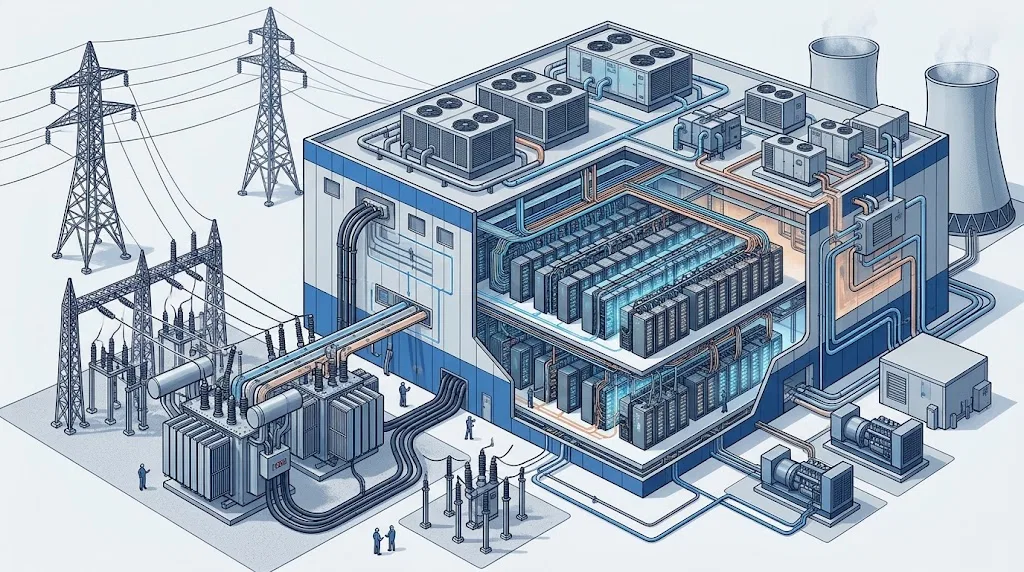
AI electricity demand arises from several interconnected activities: training models, using those models, storing and moving data, and keeping the underlying hardware operating safely.
Training and inference
Training is the process of developing an AI model by processing large quantities of information and repeatedly adjusting its internal calculations. Large training runs can involve thousands of specialised computer chips operating together for extended periods.
These chips, often graphics processing units (GPUs) or other AI accelerators, perform enormous numbers of mathematical calculations. They consume electricity directly and generate heat that must be removed.
Inference is what happens when a trained model produces an answer, image, prediction or other output. A single interaction may require much less electricity than a major training run, but inference can occur millions or billions of times across a widely used service.
As AI adoption increases, the cumulative electricity demand from inference becomes increasingly important. More complex reasoning, longer outputs, larger models and automated systems performing repeated tasks can also increase the amount of computation required.
The IEA’s 2025 analysis projected annual electricity consumption growth of approximately 30% for accelerated servers, which are strongly associated with AI, compared with 9% for conventional servers. Accelerated servers accounted for almost half the projected increase in global data centre electricity consumption between 2024 and 2030. IEA
Cooling and supporting equipment
The electricity consumed by AI chips is only part of a data centre’s total demand.
Facilities also need cooling equipment, pumps, fans, networking hardware, storage systems, power conversion equipment and systems that protect against electrical interruptions.
Cooling is particularly important because high-performance AI chips produce substantial amounts of heat in a relatively small space. Traditional air cooling can become less practical as the power consumption of individual server racks increases.
Operators are therefore adopting liquid cooling, which transfers heat away from chips using circulating fluids. Depending on the design, this can reduce some cooling energy requirements, but pumps, heat exchangers and other supporting equipment still consume electricity.
A 2026 IEA assessment found that AI server power density increased elevenfold between 2020 and 2025 and could rise a further fourfold by 2027. This places additional pressure on cooling systems, power distribution equipment and electrical infrastructure. IEA
Why is electricity demand growing faster than efficiency improvements?
Computer chips and data centres have become substantially more efficient. Modern hardware can perform more calculations for each unit of electricity than earlier generations.
However, efficiency improvements do not necessarily reduce total electricity consumption.
If computing becomes cheaper and faster, companies may deploy more AI services, process larger workloads or use more sophisticated models. The resulting growth in demand can outweigh the electricity saved per calculation.
This is sometimes described as a rebound effect: efficiency lowers the cost of using a resource, encouraging greater consumption.
Historical evidence shows that efficiency can make a substantial difference. Lawrence Berkeley National Laboratory found that US data centre electricity consumption remained relatively stable during parts of the 2010s despite considerable growth in digital services. Improvements in server utilisation, cooling and the shift towards larger cloud facilities helped offset rising computing demand. LBL ETA Publications
The present AI expansion is different because the number and power consumption of specialised servers are increasing rapidly.
Google reports that its data centres achieved an average power usage effectiveness (PUE) of 1.09 in 2025. PUE measures total facility electricity use divided by the electricity consumed by computing equipment. A value of 1.09 means approximately 9% additional electricity was used for supporting infrastructure relative to computing electricity consumption.
This indicates efficient facility operation, but does not establish that total electricity consumption is falling. A highly efficient data centre can still use more electricity each year if it contains more chips or processes more work. Google’s figures are also company-reported and should not be assumed to represent the entire industry. Google Data Centers
The central question is therefore not simply whether AI chips become more efficient, but whether efficiency gains outpace growth in the amount of AI computation performed.
Where is electricity demand putting the greatest pressure on grids?
The global electricity share of data centres can appear relatively modest. Their local impact can be much larger.
Data centres tend to cluster around established technology hubs, major network connections, cloud infrastructure and areas offering suitable land or tax incentives.
This concentration can create major electricity demand in regions where transmission lines, substations and generation capacity are already heavily used.
Ireland: data centres consume nearly a quarter of metered electricity
Ireland provides one of the clearest examples of how data centre demand can reshape a national electricity system.
According to the Central Statistics Office, data centres accounted for 23% of Ireland’s metered electricity consumption in 2025, compared with 5% in 2015.
Their annual electricity consumption reached approximately 7.66 TWh in 2025, an increase of 10% from the previous year. Consumption by other metered users grew by only 2%. Central Statistics Office
These figures cover all data centres, not exclusively AI. Nevertheless, they illustrate the infrastructure pressures that can arise when computing facilities become a major electricity-consuming industry.
The Irish experience also demonstrates why national averages can conceal important regional differences. Electricity demand concentrated around particular network connections can create local constraints even when a country’s overall generating capacity appears sufficient.
United States: rapid growth in a major AI market
The United States faces especially strong electricity demand from expanding AI and cloud infrastructure.
Lawrence Berkeley National Laboratory’s June 2026 report estimated that data centres could account for 11.8% of US electricity consumption by 2030 in its reference scenario, with a range of 9.5% to 15.3% across alternative scenarios. OSTI
These are projections, not measured future consumption. Their wide range reflects uncertainty about hardware deployment, computing demand, equipment efficiency and other factors.
Nevertheless, the potential scale is significant. It suggests that data centres could become one of the major sources of additional electricity demand in parts of the US power system.
United Kingdom: growing demand and uncertain forecasts
The UK faces similar questions about electricity availability, although its data centre market and grid conditions differ from those of the United States.
In July 2026, the Department for Energy Security and Net Zero confirmed that its principal published electricity demand forecasts did not separately identify data centre demand. Instead, data centres were included within broader economic and technology-sector projections.
The government also acknowledged substantial uncertainty about AI-capable data centre capacity, utilisation and the speed at which facilities would reach full operation. UK Parliament
This matters because electricity infrastructure requires long-term planning. Overestimating demand can lead to expensive infrastructure that is underused, while underestimating it can produce connection delays, congestion and competition for available capacity.
Can electricity grids keep up with AI expansion?
Electricity supply is becoming one of the most important physical constraints on AI infrastructure.
Building a data centre can be considerably faster than constructing the electricity infrastructure needed to supply it.
The IEA estimates that new transmission lines in advanced economies can take four to eight years to develop. Transformers, cables and other essential components also face supply constraints.
Its 2025 analysis concluded that grid limitations could delay approximately 20% of planned global data centre capacity through 2030 if the relevant constraints are not addressed. IEA
Three problems are particularly important.
Generation capacity: A region needs enough electricity production to meet additional demand, including during periods when renewable generation is low.
Transmission capacity: Electricity must be transported from power stations to areas where data centres operate. Additional generation does not solve local shortages if transmission networks cannot deliver it.
Connection capacity: Individual facilities need suitable substations, transformers and distribution infrastructure. A proposed data centre may face delays even when sufficient electricity exists elsewhere on the network.
A further complication is that planned data centre do not always become operational. Developers may submit multiple connection applications while exploring different locations, and some may be cancelled or scaled back.
Treating every proposed connection as guaranteed future demand risks overstating infrastructure requirements. Treating the entire pipeline as speculative risks failing to prepare for genuine growth.
The IEA’s 2026 assessment identifies electricity equipment, advanced chips, finance and planning processes as interconnected constraints on data centre expansion. IEA
Who pays for the additional electricity infrastructure?
The financial consequences of AI electricity demand extend beyond technology companies.
Data centre operators generally pay for the electricity they consume, and they may contribute directly towards dedicated connections or infrastructure upgrades. However, the wider electricity system operates through shared networks, regulated charges and wholesale electricity markets.
When additional demand requires new power stations, transmission lines or substations, the allocation of those costs becomes a major policy question.
Some costs may be recovered from data centre customers. Others can be spread across electricity consumers through network charges or reflected in higher wholesale electricity prices.

Virginia shows how household costs could rise
Virginia, home to a major concentration of US data centres, provides a detailed example.
A 2024 study by Virginia’s Joint Legislative Audit and Review Commission (JLARC) found that existing electricity tariffs were generally allocating current service costs appropriately, including those attributable to data centres.
However, it also warned that rapid future growth could increase electricity system costs for other customers.
Depending on the scenario, the study estimated that a typical residential customer of Dominion Energy could face an additional $14–$37 per month in generation and transmission costs by 2040, measured in constant dollars. Data Centers in Virginia
These figures are scenario estimates, not an observed increase or a forecast that applies universally. They demonstrate how new infrastructure requirements can affect households even when data centre operators pay substantial electricity bills themselves.
The study also highlighted the risk of stranded assets. If utilities build expensive infrastructure for anticipated AI demand that never materialises, the remaining costs may still need to be recovered.
This creates a difficult balance: grids must prepare for growth without transferring unreasonable financial risks from private technology investments to other electricity consumers.
Will AI data centres increase carbon emissions?
The climate impact of AI electricity demand depends heavily on how the additional electricity is generated.
A data centre powered by a low-carbon electricity system has a different operational emissions footprint from one supplied predominantly by coal or natural gas.
The IEA estimated that electricity generation associated with all data centres produced approximately 180 million tonnes of indirect carbon dioxide emissions annually in its 2025 assessment. This represented around 0.5% of global fuel-combustion emissions.
In its central scenario, those emissions were projected to increase by almost 80% by 2030. IEA
Again, these figures include non-AI computing.
Renewable energy purchases do not eliminate every emissions concern
Technology companies increasingly purchase renewable electricity through long-term contracts known as power purchase agreements.
These agreements can help finance new wind and solar and reduce exposure to fossil fuel electricity prices.
However, purchasing renewable electricity equivalent to annual consumption is not necessarily the same as operating on carbon-free electricity every hour.
A data centre may consume electricity at night when local solar generation is unavailable, or during periods when wind output is low. The grid must still balance supply and demand.
The environmental effect therefore depends on when and where clean electricity is generated, whether it adds genuinely new capacity and what alternative electricity generation would otherwise have been used.
The IEA expects renewable energy to contribute substantially to meeting growing data centre demand, but also identifies natural gas and coal as important sources of additional electricity in several scenarios. IEA
This creates a genuine trade-off. AI infrastructure can help finance clean energy development, but rapid electricity demand growth can also extend reliance on fossil fuel generation where low-carbon supply and grid capacity cannot expand quickly enough.
Could AI electricity demand compete with homes and other industries?
Electricity grids have to serve many demands simultaneously.
Alongside data centres, governments and utilities are planning for electric vehicles, heat pumps, industrial electrification and new manufacturing facilities.
These activities can compete for grid connections, equipment, investment and electricity supply.
The competition is not necessarily direct or permanent. New generation and network investment can increase total capacity, while some demand can be shifted away from congested periods.
However, short-term constraints matter.
The IEA warns that rapid data centre expansion could create trade-offs with affordability, manufacturing growth and wider electrification objectives if electricity infrastructure fails to keep pace. IEA
There is also a difference between a data centre’s annual electricity consumption and its maximum power requirement.
A facility might use relatively modest amounts of electricity while operating below full capacity, yet require a connection designed for much higher future demand. The grid may need to reserve capacity and invest in equipment before the facility reaches its expected operating level.
That distinction makes the terms of electricity connection agreements particularly important.
Can data centres reduce pressure on electricity networks?
Several approaches could make growing AI electricity demand easier to accommodate. None removes the need for electricity, but each can affect how much new infrastructure is required.
More efficient computing: Improved chips, software and model design can reduce electricity consumption per unit of useful AI work. The overall benefit depends on whether demand grows faster than efficiency improves.
Better cooling: Liquid cooling, improved heat management and efficient facility design can reduce the electricity required for supporting systems.
Flexible workloads: Some AI training and batch-processing tasks can potentially be scheduled during periods of abundant electricity supply. Real-time services generally have less flexibility because users expect immediate responses.
Battery storage: Batteries can help manage short-term changes in power demand and provide backup or grid-support services. They shift electricity consumption across time rather than generating new energy.
Location choices: Building facilities near available generation and strong transmission connections can reduce the need for costly network expansion.
Additional clean generation: Wind, solar, geothermal, nuclear and other sources can help meet demand, although their costs, construction times and operating characteristics differ.
The IEA’s 2026 assessment suggests that approximately 20–25 gigawatts of battery storage could be installed in data centres globally by 2030. Whether such systems benefit the wider grid depends on their operation and the commercial incentives involved. IEA
A particularly important opportunity is to make some computing demand responsive to electricity conditions.
For example, a training job that does not need to finish immediately might be scheduled for a period of high renewable generation or lower network congestion. This could reduce pressure during peak demand.
Such flexibility is not universal. Large distributed training jobs may be difficult to interrupt, and some services require high availability around the clock.
How reliable are forecasts of AI electricity demand?
Forecasting AI electricity consumption is unusually difficult because both the technology and its commercial market are changing rapidly.
The strongest projections generally use scenarios rather than claiming to know exactly how much electricity will be required.
Several uncertainties are especially important.
- AI adoption: Demand depends on how extensively businesses and consumers use AI services.
- Hardware efficiency: Future chips may deliver considerably more computing performance per watt.
- Model design: Smaller, specialised or more efficient models may reduce the computing required for particular tasks.
- Infrastructure deployment: Grid delays, construction costs and chip availability can limit how quickly new facilities operate.
- Commercial returns: If AI services generate less revenue than investors expect, some planned infrastructure may be postponed or cancelled.
These factors can push electricity demand in different directions.
More efficient AI could lower electricity use per task, but also make AI economical for many more applications. Conversely, demand could grow strongly while physical infrastructure bottlenecks prevent projected capacity from being built.
The IEA’s April 2026 outlook maintained a central estimate of approximately 950 TWh for global data centres in 2030, close to its previous projection, while highlighting constraints that reduce the likelihood of the most aggressive near-term expansion scenarios. IEA
This illustrates why forecasts should be treated as conditional estimates rather than inevitable outcomes.
It is also important to distinguish electricity consumption from planned power capacity. A proposed 1 GW data centre campus does not automatically consume 8.76 TWh annually. That figure would require continuous operation at 1 GW for an entire year.
Actual electricity use depends on when equipment becomes operational, its utilisation, the facility’s power requirements and periods of reduced activity.
What does AI electricity demand mean for the wider economy?
The growth of AI infrastructure represents a substantial investment in physical assets, not simply an increase in software activity.
Data centre development requires land, buildings, chips, electrical equipment, cooling systems, grid connections and dependable electricity supply.
These requirements create economic opportunities for construction firms, electrical equipment manufacturers, energy developers and network operators.
They also introduce financial risks.
Electricity infrastructure is generally built to operate over many years, while AI hardware and commercial expectations can change much more quickly. A grid connection or power station built around a particular forecast may remain in service long after the computing equipment that justified it has been replaced.
The IEA’s 2026 report notes that data centre investment increasingly depends on capital markets as well as technology companies’own finances. This makes electricity demand growth sensitive to financing conditions and expectations about future AI revenues. IEA
There is therefore an important distinction between economically productive electricity demand and electricity demand that ultimately produces disappointing financial returns.
High electricity consumption does not automatically mean that AI investment is wasteful. Equally, the expectation of future economic benefits does not remove the need to examine who finances infrastructure, who receives the benefits and who carries the risks.
What should governments and communities be asking?
The most useful questions about AI electricity demand concern measurable costs and enforceable commitments rather than broad promises about technological progress.
When a major data centre is proposed, public scrutiny can focus on several practical issues:
- How much electricity will the facility consume annually, and what is its expected peak power demand?
- How much new generation, transmission or distribution infrastructure will be required?
- Who will pay for those upgrades if the facility proceeds, expands, operates below expectations or closes?
- Will the development increase electricity costs for existing consumers?
- What proportion of its electricity will be supplied by additional low-carbon generation, and when will that generation be available?
- Can the operator reduce or shift demand during periods of grid stress?
- How will actual electricity consumption be reported after the facility opens?
These questions help distinguish a credible infrastructure proposal from one that relies heavily on uncertain future capacity or benefits.
They also recognise that different communities face different pressures. A region with abundant low-carbon generation and spare network capacity may accommodate new data centres relatively easily. A region already experiencing grid congestion, high electricity prices or limited generation capacity may face much greater costs.
The same data centre can therefore have very different consequences depending on its location.
The central trade-off: expanding AI without transferring its costs
AI data centre electricity demand is growing quickly, but its consequences cannot be understood from global electricity figures alone.
The IEA’s projection of approximately 950 TWh by 2030 indicates a major expansion in computing infrastructure. Yet the most immediate challenges are often local: a congested substation, a delayed transmission line, insufficient generation capacity or a dispute over who should finance an upgrade.
The evidence also points to two competing realities. Efficiency improvements and new electricity infrastructure can make AI computing more productive and easier to accommodate. At the same time, rapid growth can increase carbon emissions, create new demands on electricity networks and expose households or businesses to additional costs.
The crucial issue is not whether AI should consume electricity at all. Modern economies routinely allocate energy to activities considered valuable, from manufacturing and transport to healthcare and communications.
It is whether the benefits of additional AI computing justify the infrastructure required, whether its electricity supply can expand sustainably, and whether the financial and environmental costs are distributed fairly.
As AI moves from an emerging technology into a major source of industrial electricity demand, those questions will increasingly shape energy planning, investment decisions and the practical limits of further expansion.
Amazon book picks
Further Reading
Books and field guides related to Can Power Grids Keep Up With AI Growth?. Use these as the next step if you want deeper reading beyond the article.

The eventual millionaire
First published 2014. Subjects: New business enterprises, Growth, Management, Small business, Entrepreneurship.

Ten stupid things that keep churches from growing
First published 2009. Subjects: Church growth.

On the brink of everything
First published 2018. Subjects: Aging, Life, Conduct of life, SELF-HELP / Aging, SELF-HELP / Personal Growth / Happiness.

eBay marketplace picks
Marketplace Samples
Live-tested eBay searches with available results related to this page.
Selected frompower grids poster oneBay.co.uk.

Current eBay listing
Energy Map of Africa – Oil, Gas Hydroelectric Solar Wind Pipelines & Power Grids
 </article>
Endnotes
1.
Source: iea.org
Link:https://www.iea.org/reports/key-questions-on-energy-and-ai/executive-summary%C2%A0
2.
Source: iea.org
Title: Energy demand from AI
Link:https://www.iea.org/reports/energy-and-ai/energy-demand-from-aI
3.
Source: bies.lbl.gov
Title: united states data center energy 2025
Link:https://bies.lbl.gov/publications/united-states-data-center-energy-2025
4.
Source: eta-publications.lbl.gov
Title: us data center energy usage report lbnl 2001637 0
Link:https://eta-publications.lbl.gov/sites/default/files/2024-12/us_data_center_energy_usage_report_lbnl-2001637_0.pdf
5.
Source: lordsbusiness.parliament.uk
Title: uk Written Question
Link:https://lordsbusiness.parliament.uk/ItemOfBusiness?businessPaperDate=2026-09-02&itemOfBusinessId=175724§ionId=50
Additional References
6.
Source: ofgem.gov.uk
Title: Ofgem acts to free up grid capacity by tackling speculative data centre projects
Link:https://www.ofgem.gov.uk/press-release/ofgem-acts-free-grid-capacity-tackling-speculative-data-centre-projects
Source snippet
Ofgem July 29, 2026 — OFGEM ACTS TO FREE UP GRID CAPACITY BY TACKLING SPECULATIVE DATA CENTRE PROJECTS Publication type: Press release Pu...
Published: July 29, 2026
7.
Source: ourworldindata.org
Title: How much energy do data centers and artificial intelligence use?
Link:https://ourworldindata.org/how-much-energy-do-data-centers-and-artificial-intelligence-use
Source snippet
Our World in Data July 20, 2026 — HOW MUCH OF THE WORLD’S ELECTRICITY IS USED FOR DATA CENTERS AND ARTIFICIAL INTELLIGENCE? Let’s start w...
Published: July 20, 2026
8.
Source: eenews.net
Title: Virginia mulls shifting major grid costs to data centers
Link:https://www.eenews.net/articles/virginia-mulls-shifting-major-grid-costs-to-data-centers/
Source snippet
07/16/2026 06:35 AM EDT State residents have paid $2.8 billion for transmission lines related to data centers since 2021, reg...
9.
Source: eenews.net
Title: Virginia to offload more grid costs onto data centers
Link:https://www.eenews.net/articles/virginia-to-offload-more-grid-costs-onto-data-centers/
Source snippet
08/06/2026 06:29 AM EDT The decision is expected to shift hundreds of millions of dollars in transmission costs away from the pu...
10.
Source: datacenters.google
Link:https://www.datacenters.google/efficiency/
11.
Source: youtube.com
Link:https://www.youtube.com/watch?v=JIjJtyRjiOI
12.
Source: youtube.com
Link:https://www.youtube.com/watch?v=dyP3PRqlkxE
13.
Source: youtube.com
Link:https://www.youtube.com/watch?v=sKpc5rzwGrs
14.
Source: ons.gov.uk
Title: Data centres and the UK National Accounts
Link:https://www.ons.gov.uk/economy/nationalaccounts/uksectoraccounts/methodologies/datacentresandtheuknationalaccounts
15.
Source: www-cloud.cso.ie
Link:https://www-cloud.cso.ie/en/releasesandpublications/ep/p-dcmec/datacentresmeteredelectricityconsumption2025/keyfindings/