Within Grid Pressure
Why Dublin's Data Centres Are Straining the Local Grid
Dublin's concentration of data centres is creating electricity bottlenecks that additional power generation elsewhere in Ireland cannot solve alone.
Published
On this page
- Why so many data centres were built around Dublin
- How substations and transmission bottlenecks restrict electricity connections
- What grid congestion means for new data centres and other electricity users
Page outline Jump by section
Updated
Introduction
Dublin’s data centre boom has created one of Europe’s clearest examples of electricity demand growing faster than the local grid can accommodate. Large computing facilities have clustered around the Irish capital, particularly in west Dublin, where they depend on the same high-voltage transmission infrastructure and substations used to supply other businesses and communities.
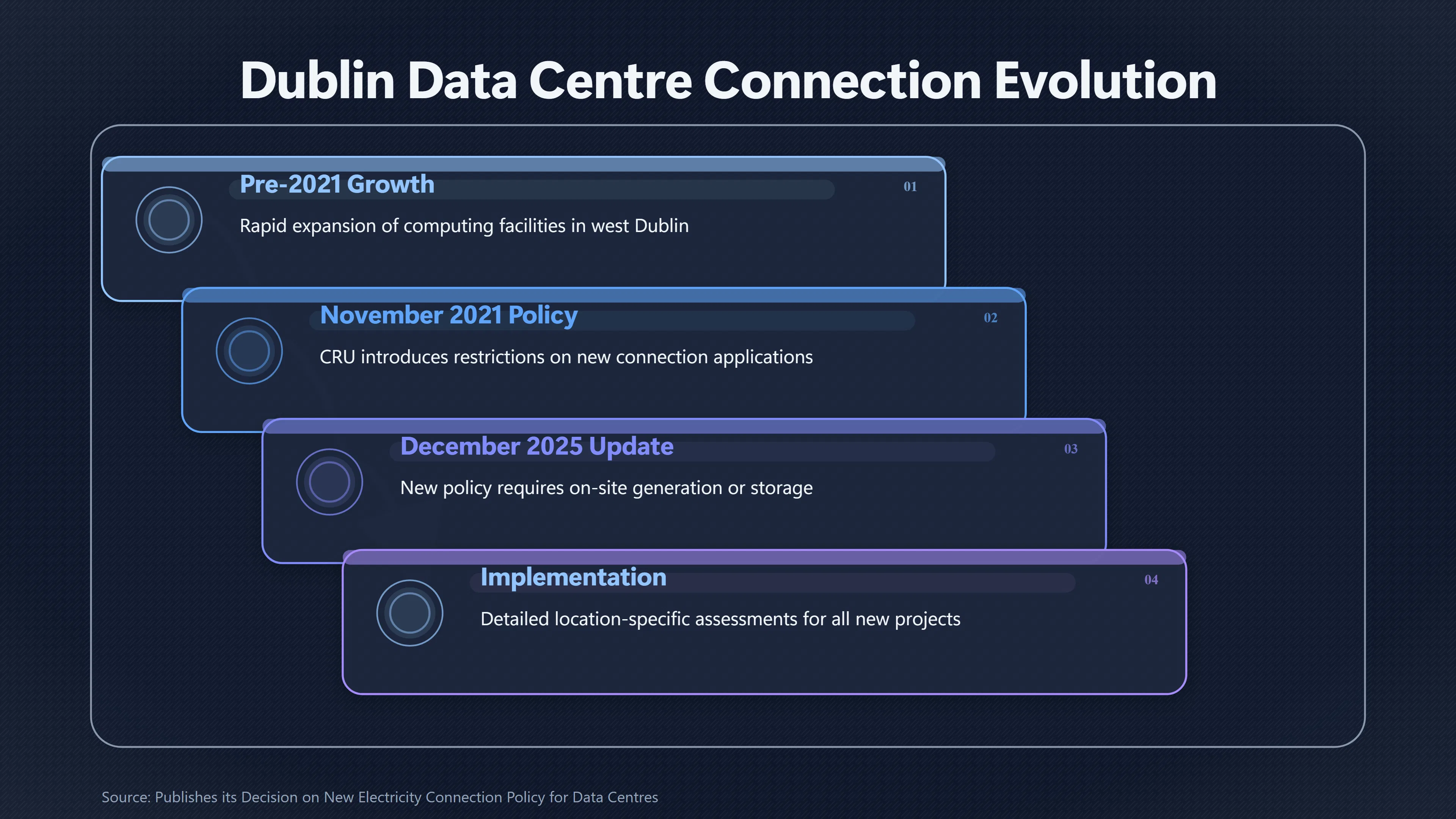
The pressure became serious enough for Ireland’s electricity regulator to introduce restrictions on new data centre connections in November 2021. The problem was not simply a national shortage of electricity: it was also the difficulty of delivering enough power into the Greater Dublin area without overloading critical network infrastructure.
By 2025, data centres accounted for 23% of Ireland’s metered electricity consumption, up from 5% in 2015. These are national figures, not Dublin-specific measurements, but they illustrate the scale of the demand growth behind the capital’s grid constraints. Houses of the Oireachtas
Dublin’s experience reveals an important limitation of expanding electricity generation: building more power stations or wind farms elsewhere does not automatically create additional capacity in the substations and transmission lines serving a concentrated group of large electricity users.
Why so many data centres were built around Dublin
Dublin became a major European data centre hub because several commercial and technical advantages reinforced one another.
Ireland’s position as an English-speaking member of the European Union, its established technology sector and its corporate tax environment helped attract international cloud companies. Dublin also offered access to international telecommunications networks, including submarine cables connecting Ireland with Britain, Europe and North America.
For operators, concentrating facilities in an established technology hub offers practical advantages. Existing fibre-optic connections can be extended, specialist contractors are already familiar with the industry, and neighbouring facilities can share access to suppliers, maintenance services and other infrastructure.
These advantages encouraged further development around established industrial locations, particularly west and south-west Dublin.
The resulting concentration is visible in areas such as Grange Castle in Clondalkin and nearby parts of the Dublin industrial corridor. These locations became attractive to large cloud operators and specialist data centre developers because of their industrial land, digital connectivity and proximity to existing infrastructure.
However, the same concentration that benefits the computing industry creates a problem for the electricity system.
A single data centre can require tens of megawatts of electricity. A campus containing multiple buildings may need substantially more. When several operators seek large connections within the same geographical area, their combined demand can exceed the spare capacity available in nearby substations and transmission circuits.
Unlike an ordinary office development, a large data centre may maintain a substantial electrical load throughout the day and night. Servers, networking equipment, cooling systems and supporting infrastructure must operate continuously.
The result is a concentrated, relatively persistent demand for electricity that can leave little spare capacity for additional large connections.
Ireland’s Central Statistics Office (CSO) recorded data centre electricity consumption rising from 1,240 gigawatt-hours (GWh) in 2015 to 7,663 GWh in 2025. This represents more than a sixfold increase over a decade. Central Statistics Office
The figures also show why Dublin’s infrastructure difficulties cannot be understood solely through national electricity demand. A substantial part of this growth occurred in a sector whose facilities were geographically concentrated, while the electricity network serving those locations could not expand at the same speed.
How transmission lines and substations became bottlenecks
Dublin’s electricity problem involves a distinction between having enough electricity available somewhere on the system and having sufficient network capacity to deliver it to a particular site.
Ireland’s transmission network, operated by EirGrid, carries electricity at high voltages across the country. Substations connect different parts of the system, transform electricity between voltage levels and distribute power towards customers.
Large data centres may connect directly to the transmission system or through infrastructure operated by ESB Networks, Ireland’s distribution network operator.
Both arrangements depend on the physical capacity of the surrounding electricity network.

Why additional generation elsewhere cannot solve the problem alone
Consider a hypothetical data centre campus in west Dublin requesting a new 100-megawatt (MW) connection.
Even if an additional 100 MW of generation becomes available elsewhere in Ireland, the new campus cannot necessarily use it. Electricity must pass through transmission circuits, substations and transformers capable of carrying the additional load.
If a critical transformer is already approaching its permitted operating limit, adding more generation upstream does not increase that transformer’s capacity.
Similarly, if a transmission line into Dublin is constrained, electricity generated in another region may be unable to reach the proposed facility without exceeding safe operating limits.
Electricity networks must also remain secure when equipment unexpectedly fails. A connection that appears technically possible under normal conditions may be unacceptable if the loss of a single major line or transformer would overload the remaining infrastructure.
This is one reason network operators cannot simply allocate every available megawatt of theoretical capacity to new customers.
The constraint can therefore arise at several points:
- Transmission circuits: High-voltage lines may lack sufficient spare capacity to carry additional electricity into a heavily developed area.
- Substations: Transformers and switching equipment may be unable to accommodate another large customer without substantial reinforcement.
- Security requirements: Network operators must preserve sufficient operating margins to manage equipment failures and other disturbances.
- Construction lead times: New substations, transmission routes and transformers can require lengthy planning, procurement, approval and construction processes.
These limitations explain why an electricity connection is not simply a commercial agreement to purchase enough power. It is also a technical commitment by the network operator to deliver that power safely and reliably.
Why Dublin’s problem became a regulatory issue
By 2021, EirGrid had warned that continued data centre growth was creating significant network and electricity security concerns.
On 23 November 2021, the Commission for Regulation of Utilities (CRU) issued a direction changing how new data centre connection applications would be assessed.
The regulator required network operators to consider whether a proposed data centre was located in a constrained area, whether it could provide suitable on-site generation or storage, and whether it could reduce its electricity consumption when instructed.
The Greater Dublin region was subsequently identified as an area with regional transmission constraints. Houses of the Oireachtas
This marked an important change in how Ireland approached large computing facilities.
Previously, the main commercial question for developers was often how quickly they could obtain a suitable connection and bring a facility into operation. Under the revised approach, the location and flexibility of the proposed electricity demand became central considerations.
A developer offering to pay for electricity was no longer sufficient evidence that the grid could accommodate the project.
The network also had to be capable of supporting the facility without creating unacceptable risks for the wider system.
The Castlebaggot substation: when an upgrade was consumed before completion
The clearest illustration of Dublin’s grid problem is the Castlebaggot 220-kilovolt substation in west Dublin.
Castlebaggot was developed to reinforce electricity supplies in a rapidly growing area, including support for housing and industrial development. Yet demand from data centres absorbed the additional capacity so quickly that the investment could not deliver the expected headroom for other major electricity users.
In August 2025, RTÉ reported on internal EirGrid documents supplied to the Irish Government. The documents described the capacity at Castlebaggot as having been exhausted by data centre demand before the new bulk supply point was completed.
They also identified west and north Dublin as particularly constrained parts of the network. RTÉ
This is significant because Castlebaggot was not an ageing piece of infrastructure that had simply reached the end of its useful life. It was a network reinforcement intended to increase the area’s capacity.
The problem was that demand for connections had already overtaken the additional capacity being created.
In January 2026, The Irish Times reported further details from an internal government document obtained through a freedom-of-information request. The document compared a west Dublin data centre requiring around 100 MW with a nearby pharmaceutical plant requiring approximately 10 MW and employing 2,000 people.
It also indicated that the Castlebaggot reinforcement had insufficient remaining capacity to support major housing expansion or other substantial enterprises in the area. The Irish Times
The comparison illustrates the different economic demands placed on a limited network. Both a pharmaceutical factory and a data centre may generate valuable activity, but their electricity requirements, employment footprints and local infrastructure needs can be very different.
It does not establish that every data centre uses 100 MW, or that the pharmaceutical plant necessarily creates greater economic value. It does show why the allocation of scarce grid capacity has become a public policy question rather than a purely technical decision.
The Irish Government subsequently argued that revised connection assessment rules would prevent a repetition of the historical Castlebaggot situation. That is an important qualification: the case demonstrates how capacity was allocated under earlier arrangements, not proof that identical outcomes will occur under newer rules. The Irish Times
What the connection restrictions actually mean
Ireland’s 2021 policy is sometimes described as a blanket ban on new Dublin data centres. That description is too broad.
The CRU did not formally impose a nationwide moratorium on data centre connections. Instead, it instructed electricity network operators to apply additional criteria when considering applications.
In practice, however, the restrictions made it considerably more difficult to obtain new connections in heavily constrained parts of Dublin.
The distinction matters because a project can face an effective barrier to connection even without legislation explicitly prohibiting its construction.
An operator may obtain planning permission for a building but still be unable to secure the electricity capacity needed to operate it. Equally, an existing facility with an agreed connection is in a different position from a proposed development seeking additional power.
Ireland’s policy continued to evolve after 2021.
On 12 December 2025, the CRU published a new electricity connection policy for data centres, replacing the broader regional approach with more detailed assessments of individual locations and their network constraints.
The policy requires new data centres to provide suitable generation or storage capacity, either on-site or nearby, matching their requested maximum electricity import capacity. It also requires at least 80% of annual electricity demand to be matched by additional renewable generation in the Republic of Ireland, subject to a six-year development period. CRU
These requirements serve different purposes.
Generation or storage capacity can help address the wider electricity system’s ability to meet demand, particularly when other supplies are under pressure. Renewable electricity development is intended to support the transition towards lower-carbon generation.
Neither requirement automatically removes a local transmission bottleneck.
A data centre could contract enough wind generation to cover most of its annual electricity use and still be unable to obtain a suitable connection in west Dublin. The electricity must still reach the site through a network capable of carrying it.
The 2026 implementation guidance made this distinction more explicit. A June 2026 analysis of EirGrid’s updated connection information reported that the Greater Dublin region remained fully constrained for large data centre development, while some potential capacity existed at selected high-voltage locations elsewhere in Ireland. Mason Hayes Curran
This means the new policy offers a route for assessing future projects, but it does not amount to a general reopening of Dublin’s electricity network to unrestricted data centre expansion.
What grid congestion means for other electricity users
The consequences of Dublin’s data centre concentration extend beyond the technology companies seeking new connections.
When a substation has limited spare capacity, the network operator must consider the combined effect of all customers seeking to connect. That can include manufacturers, commercial premises, housing developments and infrastructure supporting electric heating or transport.
This does not mean that every household or small business is competing directly with a data centre for an identical connection. Different customers connect at different voltage levels, and many smaller developments can be accommodated through local network arrangements.
The conflict becomes more acute when several major developments depend on the same upstream transmission capacity.
Castlebaggot illustrates the potential consequence: network infrastructure built to support wider development can have much of its available capacity committed to a relatively small number of large industrial customers.
The economic question is therefore not simply whether data centres generate jobs, investment and tax revenue. It is also whether the network capacity they consume limits other activities that could have used the same infrastructure.
There is no straightforward universal answer. A large cloud facility can support substantial economic activity beyond its immediate employment. Equally, housing, manufacturing and transport electrification can produce benefits that are not captured by comparing connection charges or electricity consumption alone.
The difficulty is that electricity infrastructure has long construction lead times, while decisions about allocating connection capacity can shape regional development for years.
Who pays for the necessary upgrades?
Data centre developers generally face connection charges and may be required to fund infrastructure associated with their projects. But electricity networks also need broader reinforcement that serves multiple customers.
The division of costs depends on regulatory decisions about which upgrades are directly attributable to a particular customer and which form part of the wider network investment programme.
Where reinforcement costs enter the regulated electricity network asset base, they can ultimately be recovered through network tariffs paid by electricity users. The precise distribution depends on tariff design and the charges applied to different customer groups.
This creates a legitimate question about cost allocation: should existing customers contribute to network upgrades made necessary partly by rapid growth in a highly concentrated commercial sector?
There is also a competing consideration. Some infrastructure upgrades can provide long-term benefits to households and businesses beyond the original data centre development. Charging one developer for every shared-network improvement could discourage investment in infrastructure that other customers would eventually need.
RTÉ’s 2025 investigation reported concerns within government about the potential impact of data centre-driven network investment on household electricity bills. Those concerns are evidence of a policy risk, not proof that a specific amount of household bill increases can already be attributed to Dublin data centres. RTÉ
The distinction between direct connection costs, shared network investment and eventual customer bills is essential to understanding who bears the financial cost of Dublin’s electricity bottlenecks.
How Dublin’s electricity grid is being reinforced
EirGrid is responding through major transmission reinforcement designed to increase capacity, improve resilience and allow electricity to flow more effectively into and around Dublin.
These demonstrate the scale of physical construction required to support continued development in the capital.
One example is the[Kildare–Dublin Grid Reinforcement Project]eirgrid.ieOpen source on eirgrid.ie., which includes plans for new high-voltage substations near Steelstown and Hynestown, together with connections to existing infrastructure at Maynooth, Inchicore and Carrickmines.
The project is intended to address rising electricity demand across west Dublin and east Kildare, including housing, commercial development and the electrification of transport and heating.
In May 2026, EirGrid launched another public consultation on the technology required for a connection between Steelstown and Carrickmines. The proposed circuit would initially operate at 220 kilovolts but could be built to accommodate future operation at 400 kilovolts. eirgrid.ie
This illustrates an important practical difficulty. Increasing electricity capacity requires much more than installing larger transformers.
New infrastructure may involve acquiring land, identifying routes, constructing substations, laying underground cables and obtaining planning approval. In densely developed areas, existing roads, railways, settlements and other infrastructure can make these especially complicated.
EirGrid’s[Powering Up Dublin programme]eirgrid.ieOpen source on eirgrid.ie. also involves more than 50 kilometres of high-voltage underground cables, substation improvements and a new transmission substation in central Dublin.
These works address ageing infrastructure as well as increasing demand. Not all the investment is attributable to data centres, and much of it would still be needed to accommodate housing growth, renewable electricity and the wider transition away from fossil fuels. EirGrid
The distinction matters when evaluating the cost of the data centre boom. Dublin’s network was already facing substantial modernisation requirements, but concentrated demand from computing facilities has increased the urgency of some capacity constraints.
Why new infrastructure may still take years to relieve congestion
Grid reinforcement is not an immediate solution.
A project can spend several years moving through technical assessment, public consultation, planning and construction before the additional capacity becomes available.
Network operators must also coordinate multiple projects. A new local substation may provide limited benefit if the upstream transmission system still cannot deliver sufficient electricity.
EirGrid’s Kildare–Meath Grid Upgrade provides another example. The project involves a new 400-kilovolt connection between Dunstown in County Kildare and Woodland in County Meath, intended to improve electricity transfers towards the east of Ireland.
EirGrid explains that electricity generated in the south and south-west must travel through major transmission corridors towards demand centres. The new connection is intended to reduce dependence on existing routes and improve security if one becomes unavailable. EirGrid
This is the infrastructure challenge behind Dublin’s data centre restrictions: sufficient capacity must exist throughout the relevant network, not just at the final connection point.
Would moving data centres outside Dublin solve the problem?
Dispersing new data centres across Ireland could reduce the concentration of electricity demand in Dublin, particularly if facilities were located near suitable generation and strong transmission infrastructure.
However, moving development does not automatically eliminate grid constraints.
A large data centre connected in another county can create a new local bottleneck if its demand exceeds the spare capacity of nearby substations or transmission circuits.
This concern was highlighted in the January 2026 reporting on the internal government document concerning Castlebaggot. The document warned that new large data centre connections in other regions could create additional constrained areas. The Irish Times
The relevant question is therefore not simply whether a facility is located inside or outside Dublin. It is whether the proposed site has adequate electrical capacity, suitable infrastructure and a credible plan for meeting its demand.
Location near renewable generation can help, but the timing of renewable output also matters. A data centre operating continuously may require electricity when nearby wind or solar generation is low.
The most effective locations are likely to be those where generation, network capacity, flexibility and future development plans can be coordinated rather than considered separately.
That is also the logic behind the CRU’s newer location-specific connection assessments.
What Dublin’s case tells us about AI electricity demand
Dublin’s grid pressure developed before the latest wave of demand for generative AI. Its data centres support a mixture of cloud computing, business software, digital services, storage and other workloads.
It would therefore be misleading to attribute the city’s existing network constraints entirely to AI.
The CSO’s electricity figures measure data centre consumption rather than separating AI training, AI inference and conventional computing. They cannot establish precisely how much of Dublin’s electricity demand is caused by AI systems.
Nevertheless, Dublin is directly relevant to the future cost of AI infrastructure.
AI computing can increase the power density and total electricity requirements of some facilities, particularly those built around large clusters of specialised chips. Where such facilities are developed in established data centre hubs, they add to the same underlying problem: substantial new demand concentrated at a limited number of grid connection points.
The International Energy Agency’s December 2025 assessment of Ireland identified data centre growth in Greater Dublin as a major contributor to network congestion and connection delays. It found that almost all of the country’s approximately 2.2 GW of operating and contracted data centre demand in 2024 was concentrated in Dublin. IEA Blob Storage
That concentration helps explain why the problem cannot be measured adequately using national electricity consumption figures alone.
Ireland’s electricity regulator has projected that data centre demand could reach 31% of national electricity demand by 2034 under its forecast assumptions, although actual outcomes will depend on project development, electricity connections and future demand. CRU
For Dublin, the immediate issue is whether transmission reinforcement can create enough capacity for existing commitments and wider regional growth, rather than how much additional computing capacity developers would ideally like to build.
The city illustrates three connected costs of concentrated AI and cloud infrastructure.
First, the physical cost includes new substations, transmission circuits, transformers and other equipment needed to deliver electricity to increasingly powerful computing facilities.
Second, the economic cost includes delays, network investment and the opportunity cost of allocating limited electricity capacity to one type of development rather than another.
Third, the public policy cost arises when regulators and governments must decide how to distribute capacity, maintain reliability and divide infrastructure costs among developers and other electricity users.
These are not necessarily arguments against data centres. Digital infrastructure provides services used throughout the economy, and investment in electricity networks can produce wider benefits.
But Dublin demonstrates that the benefits of computing infrastructure do not remove its physical constraints.
The strongest lesson from the Irish capital is that electricity demand must be planned geographically, not just nationally. A country can expand renewable generation, attract major technology investment and still face serious local grid congestion if new demand is concentrated faster than transmission and substation capacity can grow.
For AI infrastructure developers, electricity availability increasingly means more than securing an energy contract. It means finding a location where the physical network can reliably deliver the power required, at a cost and on a timetable that the wider electricity system can support.
Amazon book picks
Further Reading
Books and field guides related to Why Dublin's Data Centres Are Straining the Local Grid. Use these as the next step if you want deeper reading beyond the article.
The Growth of AI Data Centers and the Impact on Global Water...
AI data centers are rapidly emerging in rural areas across the globe as the demand for artificial intelligence technologies continues to...
The 90% Code
We are entering an era of existential velocity. Technology is scaling exponentially while the institutions meant to govern it remain...
Steel and Beyond
Metal opens up a vast range of fascinating possibilities in today's building industry. Here the latest technical processes are presented...
eBay marketplace picks
Marketplace Samples
Live-tested eBay searches with available results related to this page.
Selected fromartificial intelligence poster oneBay.co.uk.
 </article>
<article class="fr-book-card" data-ebay-listing-card data-ebay-card-kind="listing" data-ebay-card-position="2"data-offer-freshness="current" data-offer-observed-at="2026-10-26T20:24:24Z">
 </article>
<article class="fr-book-card" data-ebay-listing-card data-ebay-card-kind="listing" data-ebay-card-position="3"data-offer-freshness="current" data-offer-observed-at="2026-10-26T20:24:24Z">

Current eBay listing
AI ARTIFICIAL INTELLIGENCE . 2001 ORIGINAL MOVIE POSTER vintage 24 YEARS OLD
 </article>
References
Kildare Dublin in Grid Reinforcement Project(https://www.eirgrid.ie/kildaredublin)
Endnotes
1.
Source: oireachtas.ie
Link:https://www.oireachtas.ie/en/debates/question/2024-03-20/107/
2.
Source: cso.ie
Link:https://www.cso.ie/en/releasesandpublications/ep/p-dcmec/datacentresmeteredelectricityconsumption2025/keyfindings/?trk=article-ssr-frontend-pulse_little-text-block
3.
Source: cru.ie
Title: Publishes its Decision on New Electricity Connection Policy for Data Centres
Link:https://www.cru.ie/about-us/news/the-cru-publishes-its-decision-on-new-electricity-connection-policy-for-data-centres/
4.
Source: cso.ie
Link:https://www.cso.ie/en/releasesandpublications/ep/p-dcmec/datacentresmeteredelectricityconsumption2025/index.html
5.
Source: eirgrid.ie
Link:https://www.eirgrid.ie/news/eirgrid-launches-public-consultation-critical-electricity-grid-upgrade-kildare-and-south-0
6.
Source: cms.eirgrid.ie
Title: Kildare Dublin
Link:https://cms.eirgrid.ie/sites/default/files/publications/Kildare-Dublin-May-2025-Brochure.pdf
7.
Source: cms.eirgrid.ie
Title: Step 3 Report
Link:https://cms.eirgrid.ie/sites/default/files/publications/Kildare-Dublin-Grid-Upgrade-Step-3-Report-May-2025.pdf
Additional References
8.
Source: youtube.com
Link:https://www.youtube.com/watch?v=NWIYvXFu7tg
9.
Source: youtube.com
Link:https://www.youtube.com/watch?v=d_8rJKBVpCc
10.
Source: youtube.com
Link:https://www.youtube.com/watch?v=r6eSoadwxXE
11.
Source: irishtimes.com
Title: The Irish Times Dublin data centre uses as much power as 200,000 homes
Link:https://www.irishtimes.com/environment/2026/01/15/single-data-centre-comsumes-10-times-electricity-of-nearby-pharma-plant-employing-2000/
12.
Source: rte.ie
Title: RTÉ Govt warned of rising household bills as data centres strain grid
Link:https://www.rte.ie/news/primetime/2025/0821/1529518-govt-warned-of-rising-household-bills-as-data-centres-strain-grid/
13.
Source: mhc.ie
Title: www.mhc.ie New data centre connection rules
Link:https://www.mhc.ie/latest/insights/new-data-centre-connection-rules
Source snippet
Mason Hayes Curran June 11, 2026...
Published: June 11, 2026
14.
Source: rte.ie
Title: CSO Data centres account for 23% of electricity usage
Link:https://www.rte.ie/news/business/2026/0707/1582175-cso-data-centre-energy-figures/