Within AI Energy Use
How Much Power Does Training a Large AI Model Need?
A major AI training run can consume tens of gigawatt-hours, while experiments, chip utilisation and cooling add to its electricity footprint.
Published
On this page
- Why thousands of AI chips require so much electricity during training
- What a 50 MW training run and the Gemini Ultra estimate reveal about power demand
- How experiments, training duration and data centre overheads increase total consumption
Page outline Jump by section
Updated
Introduction
Training a large artificial intelligence (AI) model can consume tens or even hundreds of gigawatt-hours (GWh) of electricity, depending on the number of chips, their power requirements and how long training continues. A gigawatt-hour is one million kilowatt-hours (kWh), the unit used on household electricity bills.
For perspective, a training system drawing 50 megawatts (MW) continuously for 60 days would consume 72 GWh. That is enough electricity to supply approximately 20,000 UK households for a year, assuming annual consumption of 3,600 kWh each. The comparison illustrates the scale, rather than describing a particular AI model.
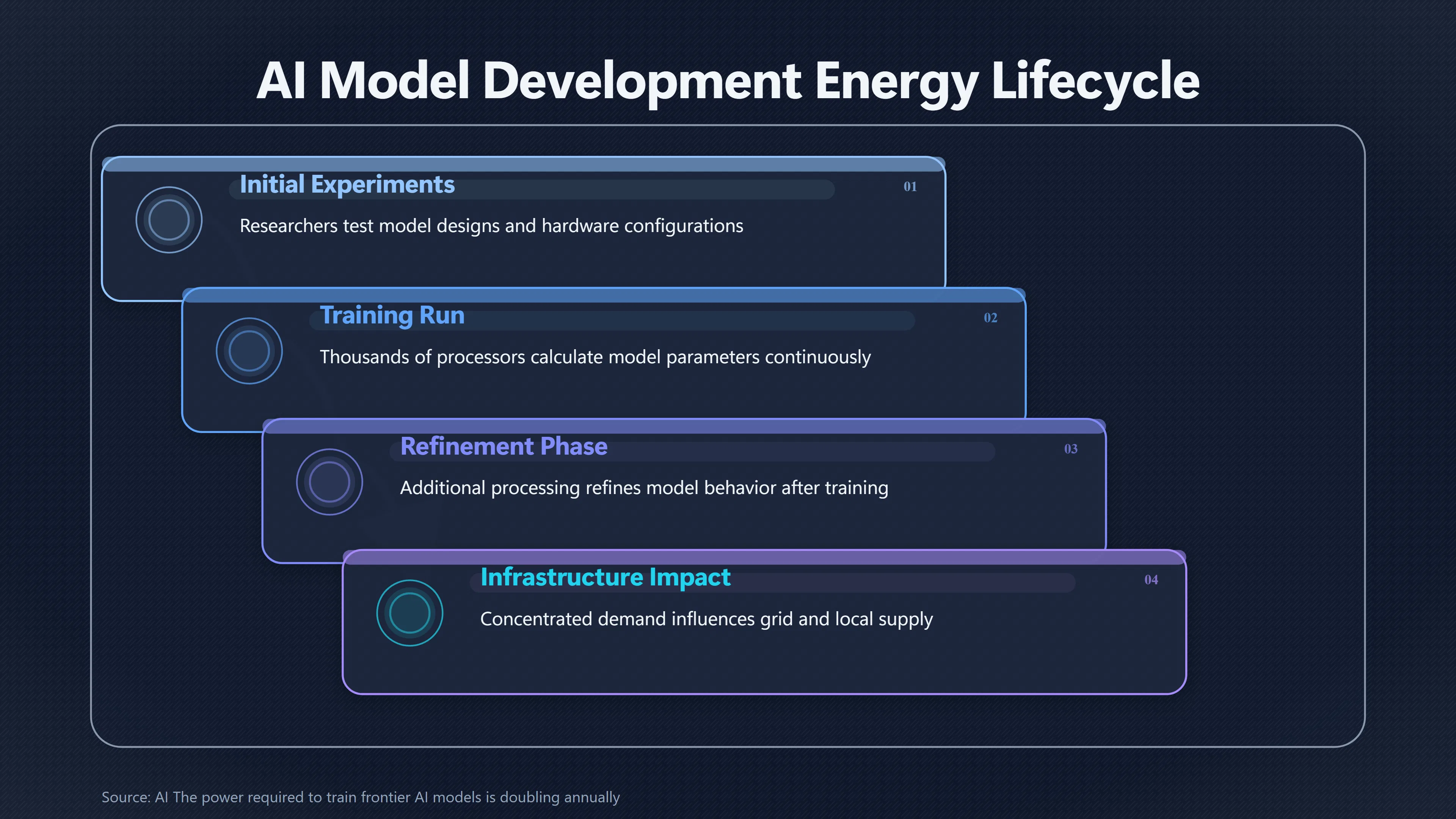
The electricity does not simply power the AI processors. Servers, networking equipment, cooling systems and supporting infrastructure also consume energy. Experiments conducted before the final training run can increase the overall footprint further.
Understanding these costs matters because training creates concentrated electricity demand that can influence data centre construction, grid connections, infrastructure investment and local electricity supplies.
Why do thousands of AI chips consume so much electricity during training?
Training a large AI model involves repeatedly processing enormous datasets and adjusting the numerical settings that determine how the model operates. These settings, known as parameters, can number in the billions or trillions.
The work is divided between thousands of specialised processors, usually graphics processing units (GPUs) or tensor processing units (TPUs). These chips perform large numbers of mathematical calculations simultaneously, making them suitable for the intensive computing required by modern AI.
Unlike an ordinary computer running occasional tasks, a large training cluster may operate continuously for weeks or months. Its processors exchange information through high-speed networks while repeatedly calculating how the model should change.
The electricity required depends on four main factors:
- Number of processors: Larger clusters generally require more electrical power because more chips and supporting equipment operate simultaneously.
- Power consumption per processor: Modern AI accelerators can consume hundreds of watts each, with some newer hardware requiring considerably more.
- Training duration: A cluster running for 100 days consumes substantially more electricity than the same cluster running for 20 days at the same average power.
- Hardware utilisation: Processors do not always operate at their maximum computational capacity. Communication delays, memory limitations and interruptions can extend training without producing equivalent useful progress.
Research organisation Epoch AI found that the power requirements of leading AI training runs increased by approximately 2.1 times annually in its historical analysis published in 2024. The main driver was the growing number of processors used, rather than dramatic increases in the electricity consumption of individual chips. Epoch AI
The difference between power and electricity consumption
Power and electricity consumption are closely related but measure different things.
Power, measured in watts or megawatts, describes how quickly electricity is being used at a particular moment.
Electricity consumption, measured in kilowatt-hours, megawatt-hours or gigawatt-hours, describes the total electricity used over time.
The basic calculation is:
Electricity (MWh) = Power (MW) × Hours \text{Electricity (MWh)}=\text{Power (MW)}\times\text{Hours} Electricity (MWh) = Power (MW) × Hours
For example, a 10 MW training cluster operating continuously for 24 hours consumes 240 MWh.
A 50 MW cluster running for the same period consumes 1,200 MWh, or 1.2 GWh.
This distinction is important because a training run can have two separate consequences. Its total electricity consumption determines how much energy must be supplied, while its instantaneous power requirement determines how much electrical capacity must be available.
A data centre might have sufficient electricity available over a year but still struggle to secure a grid connection capable of supplying a large training cluster at full power.
What does a 50 MW training run actually consume?
Consider a hypothetical AI training system drawing an average of 50 MW from its computing equipment.
The longer it operates, the greater its electricity consumption.
| Training duration | Electricity used at 50 MW |
| 24 hours | 1.2 GWh |
| 7 days | 8.4 GWh |
| 30 days | 36 GWh |
| 60 days | 72 GWh |
| 90 days | 108 GWh |
| 120 days | 144 GWh |
These figures assume a constant average computing load of 50 MW. They exclude additional electricity consumed by cooling and other data centre infrastructure.
Electricity consumed by a 50 MW training workload
Illustrative calculation at a constant 50 MW, excluding facility overheads.
0 GWh 40 GWh 80 GWh 120 GWh 160 GWh 0 7 30 60 90 120
- 0: Electricity consumption 0 GWh
- 7: Electricity consumption 8.4 GWh
- 30: Electricity consumption 36 GWh
- 60: Electricity consumption 72 GWh
- 90: Electricity consumption 108 GWh
- 120: Electricity consumption 144 GWh
The relationship is straightforward: doubling training duration doubles electricity consumption if average power remains unchanged.
But actual training runs are more complicated. Power consumption changes as processors perform different tasks, encounter communication bottlenecks or experience interruptions.
A facility’s maximum rated capacity is therefore not necessarily its average electricity demand.
Estimating a training run yourself
A useful first approximation requires three pieces of information: average power, training duration and the efficiency of the data centre.
Training electricity calculator
Illustrative
Average IT power
50 MW
Training duration
60 days
Data centre efficiency (PUE)
1.10
1.20
1.40
Computing electricity
Total facility electricity
Assumes constant average IT power and the selected power usage effectiveness (PUE). The result excludes separate experiments, chip manufacturing and subsequent model use.
PUE, or power usage effectiveness, measures the ratio of total data centre electricity consumption to the electricity consumed by computing equipment.
A PUE of 1.20 means that every 1 kWh used by computing equipment is associated with 1.20 kWh of total facility electricity consumption.
This approach is consistent with the broad methodology used by Epoch AI, which estimates training power from processor electricity requirements, server overheads and data centre efficiency. Epoch AI
The main limitation is that published processor power ratings are not necessarily measured average consumption. A more reliable calculation uses actual electricity readings from the training system.
What do real AI training runs reveal?
Publicly available estimates show that training electricity consumption varies considerably between models.
Older large language models consumed hundreds or thousands of megawatt-hours. More recent frontier systems can require tens of gigawatt-hours or more.
However, disclosure remains uneven. Some developers publish processor-hours or estimated emissions without providing independently verified electricity consumption.
| Model | Training electricity | Evidence |
| GPT-3 (2020) | Approximately 1.29 GWh | Third-party estimate |
| BLOOM (2022) | Approximately 0.43 GWh | Developer-associated research |
| GPT-4 (2023) | Approximately 42.4 GWh | IEA estimate |
| Llama 3.1 405B (2024) | Approximately 21.6 GWh from GPU ratings alone | Derived from developer-reported GPU-hours; excludes additional equipment |
Sources: research published in Joule, the BLOOM study, the International Energy Agency and Meta’s Llama 3.1 model documentation. These estimates are not perfectly comparable because their boundaries and assumptions differ. DOI
GPT-4: an estimated 42.4 GWh
The International Energy Agency’s 2025 Energy and AI report estimated that GPT-4’s training equipment had a total rated power requirement of approximately 22 MW, including supporting equipment and cooling.
The IEA estimated that training lasted around 14 weeks. Applying an assumed average load factor of 84%, it calculated electricity consumption of approximately 42.4 GWh.
That works out at roughly 0.43 GWh per training day.
The estimate demonstrates how a training system drawing tens of megawatts can accumulate substantial electricity consumption over several months.
It is important, however, to distinguish an independently constructed estimate from a directly metered and publicly audited figure. The IEA’s calculation relies on assumptions about training infrastructure, duration and utilisation. BUILD UP
Llama 3.1: what 30.84 million GPU-hours means
Meta’s Llama 3.1 405B model provides another useful example because the developer disclosed the amount of processor time used.
According to Meta, training required approximately 30.84 million GPU-hours using Nvidia H100 processors, each with a rated power of 700 watts.
Multiplying these figures gives:
30.84 million hours × 0.7 kW = 21.588 GWh 30.84\text{ million hours}\times0.7\text{ kW} =21.588\text{ GWh} 30.84 million hours × 0.7 kW = 21.588 GWh
That is approximately 21.6 GWh of electricity calculated from the GPU power rating alone.
The figure is not a measurement of the model’s complete training electricity consumption. It excludes additional server equipment, networking and facility overheads, and assumes each GPU draws its rated power throughout the reported hours.
Meta also reported using more than 16,000 H100 GPUs during development. This illustrates why electricity demand can be concentrated at a relatively small number of specialised computing facilities. Hugging Face
What does the Gemini Ultra estimate tell us about training power?
Google DeepMind’s Gemini 1.0 Ultra illustrates both the scale of frontier AI training and the uncertainty surrounding publicly available estimates.
Epoch AI’s 2024 research estimated that Gemini Ultra required approximately 35 MW of electrical power during training. This was an estimate based on available information about the hardware and training process, not a publicly disclosed electricity-meter reading from Google.
Epoch’s later model-level power dataset contains a different estimate, approximately 18 MW, reflecting differences in the estimates and methodology used. These figures should not be treated as interchangeable measurements. Epoch AI
Epoch’s training-duration dataset also estimates that Gemini Ultra trained for approximately 100 days. Epoch AI
Using the 35 MW estimate as a constant average load gives:
35 MW × 24 × 100 = 84, 000 MWh 35\text{ MW}\times24\times100 =84,000\text{ MWh} 35 MW × 24 × 100 = 84, 000 MWh
That equals 84 GWh.
This is an illustrative calculation combining separate estimates. It is not a verified statement that Gemini Ultra consumed exactly 84 GWh.
The distinction matters because estimated peak or rated power cannot automatically be treated as measured average power. The resulting electricity total could change with utilisation, interruptions and the assumptions used to account for supporting equipment.
Nevertheless, the example demonstrates the scale of the challenge: a single major training project may need a large electricity supply for months.
For electricity networks, the issue is not simply the final number of gigawatt-hours. The grid must be able to deliver sufficient power to the training facilities throughout the period when the processors are operating.
How do experiments, training duration and cooling increase electricity consumption?
The final training run is only one part of developing a large AI model.
Before training begins, researchers test model designs, datasets, training methods and hardware configurations. Some experiments fail or produce results that require further changes.
After the main training run, additional processing may be needed to refine the model’s behaviour.
These activities consume electricity but are not always included in headline estimates.
Experiments and unsuccessful runs
AI development rarely follows a single uninterrupted path from design to finished model.
Researchers may train smaller versions of a model, test different settings or repeat parts of the process after discovering problems.
The electricity associated with these experiments can be substantial, particularly when they involve large clusters.
Epoch AI’s research into frontier model development costs explicitly distinguished the final training run from supporting experiments. Its analysis found that hardware accounted for the largest share of estimated development costs, while electricity represented approximately 2–6% across the models examined.
That relatively small financial share does not mean electricity demand is negligible. The cost of purchasing and operating specialised hardware can be much greater than the electricity bill, even when the power required presents a major infrastructure challenge. Epoch AI
A model’s full development footprint should therefore include experimental training and repeated runs wherever these can be identified, rather than treating the successful final run as the entire project.
Training duration and processor utilisation
The time needed to train a model depends partly on how efficiently processors perform useful calculations.
In large clusters, thousands of chips must exchange information and coordinate their work. Delays can arise from networking limitations, memory transfers or processors waiting for other parts of the system.
Hardware faults can also interrupt training. Depending on the recovery process, some calculations may need to be repeated.
Epoch AI’s research found that training durations for notable AI models increased over time, with several large models requiring approximately three months or longer. Epoch AI
Longer training runs can increase electricity consumption even when hardware becomes more energy-efficient.
This creates an important trade-off. Using more processors can shorten training time, but it also increases instantaneous power requirements. Using fewer processors may reduce the power needed at one moment while extending the period over which electricity is consumed.
Neither approach automatically guarantees the lowest total electricity consumption.
Cooling, networking and other overheads
AI processors generate heat, which must be removed to prevent overheating and maintain reliable performance.
Cooling equipment can include fans, pumps, chillers and liquid-cooling systems. The precise arrangement depends on the processor density, facility design and local climate.
Other equipment also consumes electricity, including central processing units, memory, storage devices and high-speed networking systems.
Epoch AI’s documented estimation approach applies a server overhead factor of approximately 1.82 to multi-processor systems, followed by a separate adjustment for data centre efficiency. The server factor reflects the fact that processors are only part of the equipment drawing electricity. Epoch AI
These overheads explain why multiplying a GPU’s rated wattage by the number of GPUs often understates the power capacity required by a complete training system.
It is equally important not to count the same overhead twice. If a published estimate already includes server equipment and cooling, applying another general multiplier would exaggerate consumption.
Why are training electricity estimates so uncertain?
A precise electricity figure requires more than knowing the number of processors used.
Ideally, researchers would have access to actual power measurements, training duration, processor utilisation, supporting equipment consumption and data centre electricity readings.
For many commercial AI models, some or all of these details remain unavailable.
This creates several common problems when interpreting published figures.
Rated power versus actual consumption. A processor’s rated power describes a hardware specification, not necessarily its average electricity use throughout training.
Final training versus complete development. A published figure may cover only the successful final training run, excluding experiments, failed runs and subsequent refinement.
Different infrastructure boundaries. Some calculations include only processors, while others include complete servers, networking equipment and cooling.
Electricity versus emissions. Two models consuming identical amounts of electricity can have different carbon emissions because of differences in the electricity generation supplying their facilities.
Estimated versus measured figures. Independent researchers can produce useful estimates from disclosed hardware configurations, but these are not equivalent to direct electricity measurements.
The BLOOM study illustrates why boundaries matter. Its researchers estimated approximately 24.7 tonnes of carbon dioxide equivalent emissions from the final training process using a narrower operational accounting approach, compared with approximately 50.5 tonnes when including a wider range of lifecycle impacts such as equipment manufacturing. Journal of Machine Learning Research
These are emissions figures rather than electricity totals, but they demonstrate how the apparent footprint changes when more of the development process is counted.
For readers comparing models, the most useful questions are whether a figure was measured or estimated, which activities were included and whether the same accounting boundaries were used.
What does training electricity demand cost, and who pays?
Electricity consumption has a direct financial cost, but the amount paid depends on electricity contracts, location, timing and infrastructure arrangements.
Consider the illustrative 72 GWh training workload.
At different assumed electricity prices, its energy bill would be:
| Electricity price | Cost of 72 GWh |
| £50 per MWh | £3.6 million |
| £75 per MWh | £5.4 million |
| £100 per MWh | £7.2 million |
| £150 per MWh | £10.8 million |
These are hypothetical wholesale-style energy price assumptions, not quotations for actual AI data centre contracts. They exclude additional facility consumption, network charges, taxes and other contractual costs.
For developers, electricity is one component of a much larger investment that includes expensive processors, servers, buildings and networking infrastructure.
For electricity networks, the financial implications can extend beyond the electricity consumed during an individual training run.
A large cluster may require new transformers, substations, transmission capacity or changes to local distribution networks. Whether those costs are paid directly by the data centre operator, recovered through electricity tariffs or supported through public investment depends on local regulations and connection agreements.
The IEA’s Energy and AI report highlights the importance of electricity infrastructure and the difficulties created when rapidly growing data centre demand meets slower-moving power system development. IEA
A training run may last only a few months, but the infrastructure built to support it can remain in place for decades.
That distinction affects how electricity demand should be assessed. The economic consequences depend not only on how much electricity a model consumes but also on where the training occurs, how quickly new capacity is required and how infrastructure costs are distributed.
Can more efficient AI chips reduce training electricity demand?
More efficient processors can perform more calculations for each unit of electricity consumed.
Improvements in chip design, numerical precision and training software have substantially increased the amount of AI computation possible per watt.
Epoch AI’s historical analysis found that improvements in hardware efficiency and training methods partly offset the rapid growth in computing requirements for frontier models. Even so, the estimated power requirements of the largest training runs continued to increase. Epoch AI
This happens because efficiency and scale can move in opposite directions.
A new processor might use less electricity to perform a given calculation, but developers may use the efficiency improvement to train a much larger model or process substantially more data.
The result can be lower electricity consumption per calculation alongside higher total electricity consumption.
There are also practical trade-offs. Larger clusters may complete training faster but require greater electrical capacity. More efficient cooling may reduce facility overheads but involve additional capital investment or water consumption, depending on the system.
Training smaller or more specialised models can reduce computing requirements for some applications. However, the electricity savings depend on the training method, model design and the amount of additional development work required.
Efficiency improvements are therefore important, but they do not establish that total AI training electricity demand will decline.
What does this mean for future AI data centre electricity demand?
Training a large AI model is best understood as a substantial, concentrated industrial electricity load.
A single training run can consume tens of gigawatt-hours, while the largest systems may require power capacity comparable to major industrial facilities.
The available evidence supports three important conclusions.
First, the electricity required to train a model cannot be judged from its parameter count alone. Processor type, training duration, utilisation and supporting infrastructure all matter.
Second, the final training run is not necessarily the full electricity cost of developing the model. Experiments, repeated training, refinement and infrastructure overheads can materially increase the total.
Third, electricity demand creates infrastructure costs beyond the energy bill. The need to deliver tens or hundreds of megawatts to a concentrated location can influence grid investment, electricity supply arrangements and data centre planning.
These pressures may intensify if developers continue increasing training scale. Epoch AI’s 2025 research suggested that individual frontier training runs had already exceeded 100 MW and explored scenarios in which power requirements could reach several gigawatts by 2030. Those figures are projections rather than guaranteed outcomes, and depend on continued investment, technological progress and access to sufficient electrical capacity. epochai.substack.com
The central question is therefore not whether every AI model consumes an extraordinary amount of electricity. Many do not. It is how much electricity the largest training require, how often they are repeated and whether electricity networks can accommodate their growth without shifting disproportionate costs onto other users.
Measuring training electricity accurately is an essential starting point for answering those questions and for understanding the wider physical and economic costs of AI data centres.
Amazon book picks
Further Reading
Books and field guides related to How Much Power Does Training a Large AI Model Need?. Use these as the next step if you want deeper reading beyond the article.
Mastering Sovereign Artificial Intelligence
Data, like oil or minerals, is a vital resource – and who owns it is critical, especially as it fuels the artificial intelligence (AI)...
Strength Training for Soccer
Strength and power are key elements of soccer performance. A stronger player can sprint faster, jump higher, change direction more...
eBay marketplace picks
Marketplace Samples
Live-tested eBay searches with available results related to this page.
Selected fromflying saucer model oneBay.co.uk.

Current eBay listing
Mars Attacks Flying Saucer UFO Spaceship + Stand Movie 3D Printed Model Kit

Current eBay listing
Classic UFO Flying Saucer Replica Model 3D Printed Hand Painted Sci-Fi 14cm
Current eBay listing
Gulf Breeze UFO Model | UAP Model | UFO Toy | Flying Saucer Model | Geek Gift
 </article>
Endnotes
1.
Source: epoch.ai
Title: AI The power required to train frontier AI models is doubling annually
Link:https://epoch.ai/data-insights/power-usage-trend
2.
Source: epoch.ai
Title: AI Training compute of frontier AI models grows by 4-5x per year
Link:https://epoch.ai/publications/training-compute-of-frontier-ai-models-grows-by-4-5x-per-year
3.
Source: epoch.ai
Link:https://epoch.ai/data/ai-models-documentation/estimation
4.
Source: doi.org
Title: The growing energy footprint of artificial intelligence: Joule
Link:https://doi.org/10.1016/j.joule.2023.09.004
5.
Source: epoch.ai
Title: Introducing the AI Chip Users Explorer
Link:https://epoch.ai/latest/introducing-the-ai-chip-users-explorer?trk=article-ssr-frontend-pulse_little-text-block
Source snippet
September 9, 2026 — * Update Sep. 9, 2026 INTRODUCING THE AI CHIP USERS EXPLORER Epoch’s estimates of how much compute the world’s larges...
Published: September 9, 2026
Additional References
6.
Source: leadgreen.ai
Title: Llama 3.1 405B Instruct: energy per million output tokens
Link:https://leadgreen.ai/models/llama-3-1-405b-instruct/
Source snippet
Lead Green October 19, 2026 — LLAMA 3.1 405B INSTRUCT: GPU ENERGY PER MILLION OUTPUT TOKENS Llama 3.1 405B Instruct serves a million outp...
Published: October 19, 2026
7.
Source: earthsync.io
Title: Frontier AI energy economics: tokens per MWh
Link:https://earthsync.io/resources/frontier-ai-tokens-per-megawatt-hour
Source snippet
EarthSync September 19, 2026 — ENERGY PER TRAINING RUN# Training is the other big use of power, and some of it is publicly disclosed. Met...
Published: September 19, 2026
8.
Source: mdpi.com
Link:https://www.mdpi.com/2073-431x/15/10/660
9.
Source: youtube.com
Link:https://www.youtube.com/watch?v=8M3MciEmC5c
Source snippet
[https://www.youtube.com/watch?v=8M3MciEmC5c](https://www.youtube.com/watch?v=8M3MciEmC5c)...
10.
Source: youtube.com
Link:https://www.youtube.com/watch?v=WNt_1bSODIo
11.
Source: youtube.com
Link:https://www.youtube.com/watch?v=XtT5i0ZeHHE
12.
Source: youtube.com
Link:https://www.youtube.com/watch?v=cz3AYYZBiGs
13.
Source: aiadoption.org
Title: power draw to train frontier models
Link:https://aiadoption.org/data/power-draw-to-train-frontier-models/
14.
Source: build-up.ec.europa.eu
Title: BUILD UP Energy and AI
Link:https://build-up.ec.europa.eu/system/files/2025-04/PChtNmAZVk_11_04_2025_145800.pdf
15.
Source: aiadoption.org
Title: google ai statistics
Link:https://aiadoption.org/google-ai-statistics/