Within Cooling Costs
Can AI Data Centres Save Water Without Using More Electricity?
Using less water to cool AI data centres can increase electricity demand, especially when dry cooling systems face high outdoor temperatures.
Published
On this page
- Why evaporative cooling saves electricity but consumes water
- How dry and closed loop heat rejection perform during hot weather
- Choosing cooling systems when local water supplies and electricity costs are constrained
Page outline Jump by section
Updated
Introduction
AI data centres can save substantial amounts of water by switching from evaporative cooling to dry cooling, but this often increases electricity demand. The trade-off becomes particularly difficult in hot, water-stressed regions, where dry cooling equipment must work hardest precisely when electricity grids may already be under pressure.
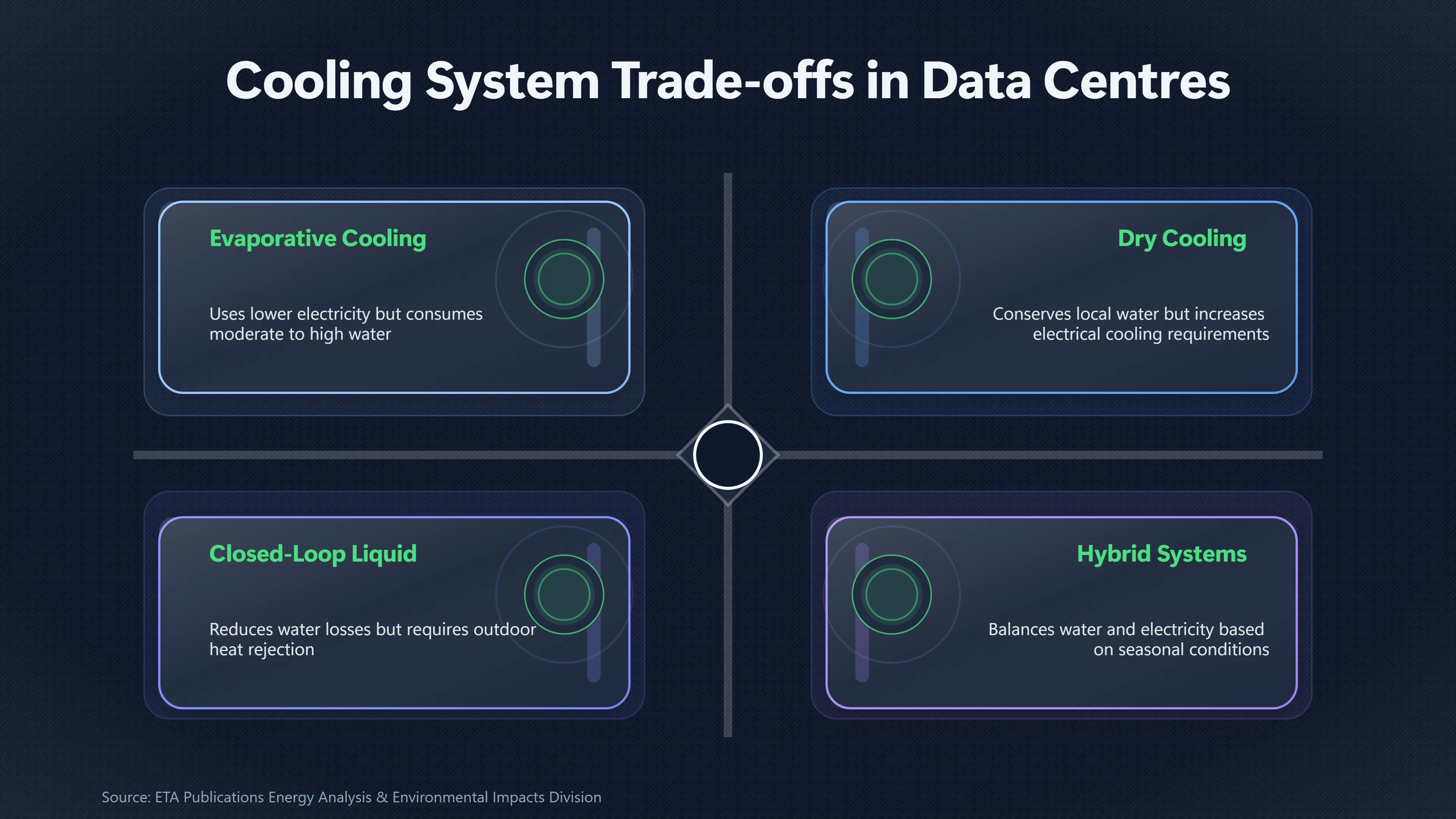
There is no universally superior cooling system. Evaporative cooling generally uses less electricity to remove heat but consumes water. Dry cooling greatly reduces direct water consumption, yet can require more fan power, mechanical refrigeration and electrical infrastructure. Hybrid systems can balance the two, although they may still consume water during the hottest periods.
Research comparing two data centres in Phoenix, Arizona, found that the air-cooled facility had nearly 13% higher power usage effectiveness (PUE), indicating greater electricity overhead, but 66% lower source water usage effectiveness (WUE), which includes water associated with electricity generation. ScienceDirect
For water-stressed communities, the central question is therefore not simply whether a data centre uses water. It is whether the electricity saved through evaporation justifies consuming a scarce local resource, and whether avoiding that consumption shifts environmental costs elsewhere.
Which cooling system makes the most sense?
The practical choice depends on local water availability, outdoor temperatures, electricity costs and the reliability requirements of the data centre.
| Cooling approach | Electricity demand | Direct water consumption | Main consideration |
| Evaporative cooling | Generally lower | Moderate to high | Efficient heat removal, but depends on reliable water supplies |
| Dry cooling | Often higher, particularly in hot weather | Very low or zero for heat rejection | Conserves local water but increases electrical cooling requirements |
| Closed-loop liquid cooling with dry heat rejection | Potentially efficient, depending on coolant temperatures | Very low during normal operation | Reduces water losses but still requires outdoor heat rejection |
| Hybrid dry and evaporative cooling | Between the alternatives, depending on operation | Variable | Can minimise annual water use while preserving cooling capacity during heatwaves |
These are engineering tendencies rather than fixed performance rankings. A well-designed dry system in a favourable climate can outperform a poorly operated evaporative system.
The distinction between liquid cooling inside a data centre and water consumption outside it is especially important. Liquid circulating through AI servers does not necessarily get consumed. The question is how that liquid eventually releases its heat to the environment.
The US Department of Energy and Lawrence Berkeley National Laboratory identify both cooling technology and local climate as major determinants of electricity and water efficiency. Department of Energy
For decision-makers, three principles follow.
- Where water supplies are severely constrained, dry cooling deserves strong consideration, even if its electricity requirements are somewhat higher.
- Where electricity capacity is the main bottleneck and water is sustainably available, evaporative cooling may provide a better overall result.
- Where both resources are constrained, hybrid operation, higher-temperature liquid cooling and careful site selection may be more effective than choosing either extreme.
The rest of the decision depends on understanding where the water and electricity actually go.
Why evaporative cooling saves electricity but consumes water
Evaporative cooling exploits a simple physical process: water absorbs heat when it changes from liquid into vapour.
The same principle explains why sweating cools the human body. A data centre can use it to transfer heat into the atmosphere without relying as heavily on energy-intensive refrigeration.
In a conventional water-cooled installation, heat passes from servers into a cooling system and eventually reaches an outdoor cooling tower. Some water evaporates, carrying heat away. Replacement water must continually enter the system.
This allows cooling equipment to operate at temperatures that would be difficult to achieve using outdoor air alone.
The advantage of the wet-bulb temperature
Two outdoor temperature measurements help explain the difference.
Dry-bulb temperature is the ordinary air temperature reported in weather forecasts.
Wet-bulb temperature reflects the cooling achievable through evaporation. It depends on both temperature and humidity.
In hot, dry conditions, wet-bulb temperature can be substantially lower than dry-bulb temperature. An evaporative system can exploit this difference to reject heat more effectively.
A dry cooling system cannot obtain the same evaporative advantage. Its performance is largely constrained by the temperature of the surrounding air.
This explains why evaporative cooling can be attractive in desert regions despite their limited water supplies: the dry climate makes evaporation particularly effective.
The US National Renewable Energy Laboratory identifies lower cooling temperatures, reduced airflow requirements and improved energy efficiency as important advantages of water-cooled heat rejection, while emphasising its dependence on a continuous water supply. NREL
Where the water actually goes
Evaporative systems circulate much more water than they consume. Nevertheless, the losses are unavoidable if evaporation is the principal cooling mechanism.
Water leaves the system through evaporation, small amounts of escaping droplets and the controlled discharge of mineral-rich water.
The last process is called blowdown. As water evaporates, dissolved minerals remain behind. Operators must periodically remove some concentrated water to prevent scaling, corrosion and operational problems.
The distinction matters because water withdrawal and water consumption are not identical.
Water that evaporates is consumed from the immediate local water system. Water discharged through blowdown may enter wastewater treatment and potentially return to the wider water system, although its availability and quality can change.
The US Department of Energy explains that increasing a cooling tower’s cycles of concentration from three to six can reduce replacement-water requirements by approximately 20% and blowdown by 50%. This improves water efficiency without eliminating the fundamental evaporation requirement. Department of Energy
For operators, better water treatment and monitoring can therefore reduce consumption and operating costs. But even an efficiently managed evaporative system continues to depend on water availability.
Why low electricity use is not the whole environmental answer
An evaporative system may achieve an excellent electricity-efficiency rating while drawing heavily on municipal water, groundwater or other local sources.
That distinction becomes politically important when data centres compete with households, agriculture, industry and ecosystems for limited supplies.
A litre of water consumed in a relatively water-rich region does not necessarily carry the same social or environmental cost as a litre consumed in an overallocated desert basin.
Consequently, the electricity savings from evaporative cooling cannot be evaluated independently of local water conditions.
A 2025 Lawrence Berkeley National Laboratory review found that water consumption per unit of data centre workload varies enormously, with cooling technology, electricity supply, server efficiency and location all influencing the outcome. The researchers concluded that there is no single configuration that minimises water use everywhere. Energy Technologies Area

How dry cooling performs during hot weather
Dry cooling removes heat without deliberately evaporating water into the atmosphere.
Typically, fans move outdoor air across heat exchangers containing a circulating fluid. Heat passes into the air and is released outdoors.
Some systems use mechanical chillers to maintain sufficiently low temperatures. Others can reject heat directly when outdoor conditions permit.
The main attraction is straightforward: a dry heat-rejection system can operate with little or no routine water consumption.
Its main weakness is that heat transfer becomes more difficult as outdoor temperatures rise.
Why heatwaves increase electricity demand
Imagine an AI data centre operating continuously through a summer afternoon.
Its servers generate heat regardless of whether the weather is mild or extremely hot. The cooling equipment must continue removing that heat to maintain safe operating temperatures.
When outdoor air is cool, a dry cooler can transfer heat efficiently.
When outdoor temperatures approach the temperature of the circulating coolant, the difference driving heat transfer becomes smaller. Operators may need greater airflow, more heat-exchanger capacity or mechanical refrigeration.
That can mean additional fan electricity, greater compressor electricity and higher peak power demand.
The consequences extend beyond the data centre’s electricity bill.
If many facilities increase cooling demand during the same heatwave, their requirements may coincide with high regional demand from air conditioning. Electricity suppliers must then accommodate additional load during already challenging periods.
This is particularly significant where grid connections, substations or transmission capacity are constrained.
Research published in Resources, Conservation and Recycling in 2022 found that air-cooled data centre electricity efficiency was more sensitive to seasonal outdoor temperature changes than the efficiency of a facility using water-cooled and evaporative systems. ScienceDirect
The finding illustrates a broader problem: an annual average electricity-efficiency figure can conceal much higher cooling requirements during the hottest hours.
The limits of purely dry heat rejection
Dry cooling also faces a physical temperature limit.
A dry heat exchanger generally cannot cool its circulating fluid below the outdoor air temperature without additional refrigeration or another cooling mechanism.
The exact achievable temperature depends on heat-exchanger design, airflow and operating conditions.
This becomes particularly important for high-density AI equipment, where cooling systems must maintain acceptable temperatures across many tightly packed processors.
If the liquid returning from the servers is sufficiently warm, dry heat rejection may work efficiently across much of the year.
If the required supply temperature is relatively low, the system may need mechanical refrigeration during hot weather.
A 2026 preliminary study comparing dry and evaporative-assisted cooling across 12 US data centre markets found that, under some extreme design conditions in Phoenix, Las Vegas and Tucson, the modelled dry systems could not achieve the specified coolant temperature without changing the cooling arrangement. The findings are useful for understanding physical constraints, although the study is a preprint and its results depend on the particular design assumptions. SSRN
This does not mean dry cooling is impossible in desert climates. It means that cooling temperature requirements, equipment sizing and the availability of supplementary refrigeration can determine whether a particular design is practical.
Does closed-loop liquid cooling solve the water problem?
Closed-loop liquid cooling can substantially reduce water consumption, but the term is sometimes misunderstood.
A closed loop means that cooling fluid circulates repeatedly through a sealed system rather than being routinely discarded.
In an AI server, liquid can collect heat directly from processors and transfer it through heat exchangers to the wider cooling infrastructure.
However, that heat must still leave the building.
A closed-loop system connected to an evaporative cooling tower can still consume considerable water at the outdoor heat-rejection stage. A closed-loop system connected to dry coolers may require almost no routine cooling-water replenishment.
The decisive question is therefore how heat is rejected outdoors, not merely whether water circulates inside the servers.
Microsoft’s water-free cooling design
Microsoft provides a useful example of how operators are trying to reduce the trade-off.
In December 2024, the company announced a new AI data centre design intended to eliminate water evaporation for cooling.
The design uses chip-level liquid cooling in a closed loop, combined with heat-rejection equipment that avoids routine evaporative cooling.
Microsoft estimated that each qualifying facility could avoid more than 125 million litres of annual water withdrawals compared with a reference based on its 2024 global average water usage effectiveness.
The company also acknowledged that replacing evaporative cooling with mechanical cooling would increase power usage effectiveness, although higher operating coolant temperatures could help limit the additional electricity demand. The Microsoft Cloud Blog
The qualification is important.
The 125-million-litre figure is a company estimate against a specified reference, not a universally applicable saving for every new AI data centre. Actual savings depend on facility size, climate, utilisation and the system being replaced.
Microsoft’s 2025 environmental reporting also described the new approach as eliminating ongoing municipal water evaporation for cooling, rather than eliminating every form of water use at the site. Microsoft
The example demonstrates that near-waterless cooling is technically achievable, while leaving open the question of how much additional electricity particular installations will require.
Higher coolant temperatures can change the calculation
The most promising feature of modern direct-to-chip cooling is not simply that it uses liquid.
It is that efficient heat transfer may allow systems to operate with warmer coolant than conventional chilled-water arrangements.
Warmer coolant increases the number of outdoor hours during which heat can be rejected without mechanical refrigeration.
This can make dry cooling more practical and reduce the electricity penalty associated with avoiding evaporation.
However, achievable temperatures depend on chip specifications, server design, heat exchangers and operational safety margins.
Operators cannot assume that every AI server supports the same coolant temperatures.
Lawrence Berkeley National Laboratory’s 2024 modelling found that liquid-cooled systems with higher coolant-temperature settings could increase the opportunities for energy-saving cooling operation. LBL ETA Publications
This is why improvements in chip-level cooling can influence not only electricity efficiency inside the building but also the viability of water-saving heat rejection outside it.
What real-world comparisons reveal
The clearest evidence comes from studies that compare both electricity and water use rather than evaluating either resource in isolation.
Phoenix: lower water use despite higher electricity overhead
A 2022 study by researchers including Leila Karimi and Kerri Hickenbottom compared two colocation data centres in the greater Phoenix area.
One used air-cooled chillers. The other combined water-cooled chillers and evaporative cooling.
The researchers reported two important findings:
- The air-cooled facility’s average PUE was nearly 13% higher, meaning greater total facility electricity consumption relative to its computing electricity.
- Its source WUE was 66% lower, meaning substantially less water consumption per unit of computing electricity even after accounting for water associated with electricity generation.
The study therefore showed that a cooling system can perform worse on electricity efficiency but considerably better on water consumption. University of Arizona
This is particularly relevant to Phoenix because the region experiences intense summer heat and long-term pressure on water resources.
However, the comparison involved two existing facilities with different cooling arrangements, not two otherwise identical AI data centres. The numerical differences should not be treated as universal performance penalties for dry cooling.
The more defensible conclusion is that the direction and magnitude of the trade-off depend on the particular facility and local climate.
More recent modelling supports hybrid operation
A study published in Applied Thermal Engineering in October 2025 examined hourly cooling electricity and water requirements for data centres in Phoenix.
It compared cooling arrangements that used outdoor conditions to reduce mechanical refrigeration, including evaporative assistance.
The researchers found that adding evaporative pre-cooling to air-cooled chillers could reduce electricity consumption while increasing on-site water use. The benefits varied with the weather and operating conditions. ScienceDirect
This is the essential attraction of hybrid cooling.
Instead of consuming water throughout the year, a facility can rely on dry cooling when conditions permit and use evaporation only when the additional cooling benefit is valuable.
Such an arrangement may reduce annual water consumption substantially compared with a continuously evaporative system.
But it introduces an important question for water-stressed communities: when will the facility need water most?
If evaporative assistance is activated primarily during the hottest periods, water demand may coincide with drought restrictions, high household consumption and other seasonal pressures.
Annual water savings do not necessarily eliminate the risk of high short-term withdrawals.
Can hybrid cooling avoid the worst of both systems?
Hybrid cooling combines dry heat rejection with the ability to use evaporation when needed.
One arrangement uses dry coolers for most of the year and sprays or wets an incoming air stream during hotter conditions. This is sometimes called adiabatic cooling.
The evaporating water lowers the temperature of the air entering the heat exchanger, improving heat rejection.
The operator can therefore trade additional water consumption for reduced fan power, lower refrigeration demand or improved cooling capacity.
Hybrid systems offer a useful compromise, but their performance depends on operating rules.
A system programmed primarily to minimise electricity bills may activate evaporation frequently.
A system programmed to conserve water may tolerate higher electricity demand and reserve evaporation for exceptional conditions.
A system prioritising resilience may use water whenever needed to maintain safe equipment temperatures.
These are different operational objectives, even when the physical equipment is identical.
The 2025 Phoenix modelling and Lawrence Berkeley National Laboratory’s national cooling-system analysis both demonstrate that hybrid arrangements can occupy different positions on the electricity-water trade-off depending on their configuration and operating conditions. LBL ETA Publications
For water-stressed regions, the most relevant design may be one that places explicit limits on evaporative operation rather than simply minimising annual electricity consumption.
Those limits must still be compatible with reliable operation during extreme heat.
The hidden water cost of using more electricity
A dry-cooled data centre can report almost no direct cooling-water consumption while still contributing to water use elsewhere.
This happens because electricity generation can consume water.
Some power stations withdraw water for cooling, while certain generation technologies consume water through evaporation. The quantities vary substantially by technology, cooling arrangement and location.
If dry cooling increases a data centre’s electricity consumption, it may also increase water consumption associated with supplying that electricity.
This is why two different water measurements matter.
Site WUE measures water consumed at the data centre relative to the electricity used by its computing equipment.
Source WUE includes water associated with producing the electricity supplied to the facility.
The 2024 Lawrence Berkeley National Laboratory report emphasises that evaluating both is necessary to understand the wider water consequences of cooling choices. LBL ETA Publications
A dry-cooled facility can therefore have excellent site WUE but a less impressive source WUE.
Conversely, evaporative cooling may increase local water consumption while reducing electricity generation and its associated water requirements.
The electricity mix changes the result
Consider two hypothetical data centres with identical computing equipment and dry cooling systems.
One receives electricity largely from generation sources with low operational water consumption.
The other depends heavily on thermal power stations that consume water for cooling.
Even if both facilities have identical site water consumption and electricity efficiency, their wider water footprints can differ.
The geographic location of electricity generation also matters. Water consumed at a distant power station may affect a different river basin or community.
A 2026 research paper, Balancing Bits and Drops, modelled water use across thousands of US data centre locations and found that dry cooling’s wider benefits depend partly on local water stress, the electricity supply and the additional power required. Its analysis suggested that dry cooling is especially attractive when on-site water stress is high and the associated electricity penalty remains relatively small. DOI
This introduces a difficult but necessary distinction.
Reducing water consumption at a data centre does not automatically eliminate the water footprint of its computing operations. But shifting some water demand away from a severely stressed local supply can still be valuable, even if it does not minimise total water consumption nationally.
The relevant environmental question is not only how many litres are consumed, but where, when and from which resources.

Who bears the costs in water-stressed regions?
Cooling decisions create different financial and environmental consequences for operators, electricity suppliers and surrounding communities.
Evaporative cooling can reduce electricity costs and peak electrical demand. But it may require substantial water connections, treatment infrastructure, wastewater handling and long-term supply agreements.
Dry cooling reduces dependence on those water services but can increase electricity expenditure, installed cooling capacity and grid-connection requirements.
These costs are not necessarily borne by the same people.
Local water users
When a data centre draws water from a stressed municipal or regional system, the consequences depend on the source, timing and volume of withdrawals.
A facility with a reliable water contract may still contribute to pressure on supplies used by households, agriculture or ecosystems.
Additional infrastructure may be needed to provide treatment, pumping or storage capacity.
Whether these costs fall on the operator or are shared with other customers depends on local tariffs, contracts and infrastructure financing.
The City of Phoenix’s planning materials explicitly identify water consumption and cooling methods as concerns when assessing data centre development in an already water-constrained region. City of Phoenix
Electricity customers and grid operators
Dry cooling can shift the infrastructure burden towards electricity networks.
If a proposed AI data centre requires more peak electrical capacity because of its cooling system, the local network may need larger transformers, upgraded substations or additional generation and transmission capacity.
Those costs can affect the project’s commercial viability and the wider electricity system.
Whether other electricity customers contribute depends on utility regulation, connection charges and cost-allocation rules.
The key point is that water-saving cooling does not necessarily reduce the overall infrastructure needed to support AI computing.
Data centre operators
Operators must weigh more than annual utility bills.
A dry system may avoid water supply uncertainty, treatment requirements and some wastewater-related costs. It may also require more heat-exchanger space, greater cooling capacity and additional electrical infrastructure.
Evaporative systems may achieve lower electricity costs but face water tariffs, treatment expenses, maintenance obligations and restrictions during drought.
Hybrid systems add equipment and operational complexity, although they can offer flexibility.
A 2026 University College London-associated study examining cooling systems in an urban energy model found that evaporative cooling and closed-loop air chillers shift costs and environmental burdens between on-site water consumption, electricity demand and indirect emissions. The results reinforce the importance of assessing the wider infrastructure rather than judging systems by a single facility metric. UCL Discovery
How should cooling systems be chosen when water and electricity are constrained?
The most useful assessment compares the alternatives against the same computing workload, local weather conditions and reliability requirements.
A project should not receive a favourable environmental assessment merely because it reports low cooling electricity demand or near-zero direct water consumption.
The following criteria reveal whether the choice is appropriate.
| Decision criterion | What needs to be established |
| Local water availability | Whether supplies remain sustainable during drought and periods of peak demand |
| Annual water consumption | Expected evaporation and other losses over a full operating year |
| Peak water demand | Maximum daily and seasonal withdrawals, particularly during heatwaves |
| Annual electricity consumption | Total cooling electricity required under representative local weather |
| Peak electricity demand | Additional grid capacity required during extreme outdoor temperatures |
| Heat rejection reliability | Ability to maintain safe server temperatures during extreme weather and equipment failures |
| Indirect water consumption | Water used to generate the electricity required by each cooling option |
| Lifetime cost | Equipment, maintenance, water treatment, electricity and infrastructure expenditure |
Three questions deserve particular attention.
1. What happens during the hottest and driest weeks?
Average annual performance is not enough.
Developers should demonstrate how the system performs under realistic extreme-temperature conditions, including the possibility of hotter future summers.
For dry cooling, the critical issue is whether the system can reject sufficient heat without excessive electricity demand or loss of cooling capacity.
For evaporative cooling, it is whether the necessary water remains available when drought restrictions or competing demand intensify.
For hybrid cooling, both questions apply.
A design that appears economical across a typical year may prove costly or vulnerable during a small number of extreme days.
2. Can the water source genuinely support the facility?
The source of cooling water matters as much as its volume.
Using reclaimed wastewater can reduce demand for drinking-quality water. However, reclaimed water still requires infrastructure, treatment and a dependable supply.
Its use does not automatically eliminate environmental impacts or competing demands.
Microsoft reports using reclaimed and recycled water in several locations, including parts of the United States and Singapore, illustrating one way operators can reduce reliance on potable supplies. Microsoft Local
The appropriate assessment should establish whether the alternative water source is genuinely additional, reliable and sustainable during periods of scarcity.
3. Are both electricity and water figures independently verifiable?
Cooling efficiency claims often rely on two indicators.
Power usage effectiveness, or PUE, compares total data centre electricity consumption with the electricity consumed by computing equipment. A lower figure generally indicates less electricity overhead.
Water usage effectiveness, or WUE, measures water consumption relative to computing electricity use. A lower figure generally indicates less water consumed per unit of computing electricity.
Neither figure is sufficient by itself.
A data centre may reduce its PUE while increasing total electricity consumption by installing more AI servers.
Likewise, a facility may improve its WUE while increasing total water consumption because its computing capacity has expanded.
For example, Microsoft reported global WUE of 0.27 litres per kilowatt-hour of computing electricity for its 2025 financial year, compared with 0.30 in the preceding year. Those figures describe water-use intensity across the company’s reporting portfolio, not the total water consumption of an individual proposed facility. Microsoft Datacenters
For public planning decisions, absolute annual consumption, peak demand and local resource conditions are therefore essential alongside efficiency ratios.
What would a better cooling decision look like?
The strongest cooling strategy is not necessarily the one with the lowest electricity consumption or the smallest direct water footprint.
It is the one that can meet the computing workload reliably while keeping electricity, water and infrastructure demands within sustainable local limits.
In a region with severe water stress but relatively accessible low-water electricity generation, dry cooling may be preferable even with a modest energy penalty.
In a region with abundant sustainable water supplies but limited electricity capacity, evaporative cooling may offer a better balance.
Where both resources are under pressure, a hybrid system with strict water-use limits, higher-temperature liquid cooling and carefully designed heat rejection may be more appropriate. In some locations, the constraints may be strong enough to question whether additional data centre capacity should be built there at all.
The important unresolved issue is that these trade-offs are highly site-specific. Research demonstrates the mechanisms clearly, but there is no credible universal percentage by which dry cooling increases electricity demand or evaporative cooling increases water consumption.
That uncertainty makes transparent, location-specific assessments especially important.
As AI data centres expand, cooling decisions will influence not only operators’utility bills but also the water available to communities, the electricity capacity required from local grids and the infrastructure costs associated with supporting additional computing.
Saving water without increasing electricity demand is possible in favourable designs and climates, but it cannot be assumed. The more realistic objective is to minimise the combined costs of cooling while recognising that a litre of water saved in a drought-affected community may be worth more than the same saving elsewhere.
The central lesson is that cooling efficiency is not simply about using fewer resources. It is about deciding which resources are scarce, where the consequences fall and whether the benefits of additional AI computing justify those demands.
Amazon book picks
Further Reading
Books and field guides related to Can AI Data Centres Save Water Without Using More Electricity?. Use these as the next step if you want deeper reading beyond the article.
Mastering Sovereign Artificial Intelligence
Data, like oil or minerals, is a vital resource – and who owns it is critical, especially as it fuels the artificial intelligence (AI)...
The Ultimate Beginner’s Guide to AI Data Centers
Are you prepared for the massive infrastructure shift required to power the AI revolution? In The Ultimate Beginner’s Guide to AI Data...

Thermal guidelines for data processing environments
First published 2012. Subjects: Electronic data processing departments, Buildings, Heating and ventilation, Cooling, Design and...
Finance & Development, December 2025
We live in a world of data. From satellites and smartwatches to social media and swipes at a register, we have ways to measure the...
eBay marketplace picks
Marketplace Samples
Live-tested eBay searches with available results related to this page.
Selected fromartificial intelligence poster oneBay.co.uk.

Current eBay listing
AI ARTIFICIAL INTELLIGENCE . 2001 ORIGINAL MOVIE POSTER vintage 24 YEARS OLD
 </article>
<article class="fr-book-card" data-ebay-listing-card data-ebay-card-kind="listing" data-ebay-card-position="3"data-offer-freshness="current" data-offer-observed-at="2026-10-26T20:24:24Z">

Current eBay listing
A I Artificial Intelligence 6 Movie Poster Art Print Print Classic Rare Gallery
 </article>
Endnotes
1.
Source: sciencedirect.com
Link:https://www.sciencedirect.com/science/article/pii/S0921344922000428
2.
Source: energy.gov
Link:https://www.energy.gov/cmei/femp/cooling-water-efficiency-opportunities-federal-data-centers
3.
Source: eta-publications.lbl.gov
Title: ETA Publications Energy Analysis & Environmental Impacts Division
Link:https://eta-publications.lbl.gov/sites/default/files/2024-12/lbnl-2024-united-states-data-center-energy-usage-report.pdf
4.
Source: nrel.gov
Title: Data Center Optimization Strategies
Link:https://www.nrel.gov/docs/fy20osti/74841.pdf
5.
Source: energy.gov
Title: Department of Energy Best Management Practice #10: Cooling Tower Management
Link:https://www.energy.gov/cmei/femp/best-management-practice-10-cooling-tower-management
6.
Source: eta.lbl.gov
Link:https://eta.lbl.gov/publications/water-use-data-center-workloads
7.
Source: sciencedirect.com
Link:https://www.sciencedirect.com/science/article/pii/S0043135426014223
8.
Source: sciencedirect.com
Link:https://www.sciencedirect.com/science/article/pii/S2949821X26005053
Additional References
9.
Source: datacentercensus.com
Link:https://datacentercensus.com/water-and-power
Source snippet
Data Center Water and Power Use: Figures by Facility yesterday — > “The center may consume 1 million gallons of water daily” AWS Wilmington...
10.
Source: youtube.com
Link:https://www.youtube.com/watch?v=hMWMF5TFfLw
11.
Source: youtube.com
Link:https://www.youtube.com/watch?v=iGcHiKq67wc
12.
Source: youtube.com
Link:https://www.youtube.com/watch?v=vnE5WMwebnE
13.
Source: itechguides.com
Title: How Data Centers Use Water: Cooling, Metrics and Questions for Residents
Link:https://www.itechguides.com/how-data-centers-use-water-and-what-local-residents-can-ask/
14.
Source: itechguides.com
Title: Data Center Water Usage: Cooling, AI, U.S. Figures and Local Impacts
Link:https://www.itechguides.com/data-center-water-usage-faqs-consumption-cooling-and-local-impacts/
15.
Source: worldtradepro.com
Title: Data Center Water Usage: How Much and Why – World Trade Pro
Link:https://worldtradepro.com/blog/data-center-water-usage/