Within Who Pays
Are Households Paying for AI Data Centre Grid Upgrades?
New grid infrastructure for AI data centres can raise household electricity bills when upgrade costs are shared across customers.
Published
On this page
- How data centre connections trigger wider grid upgrades
- How Ofgem's network charges spread infrastructure costs across electricity bills
- When shared grid investment benefits households and when costs are unfairly shifted
Page outline Jump by section
Updated
Introduction
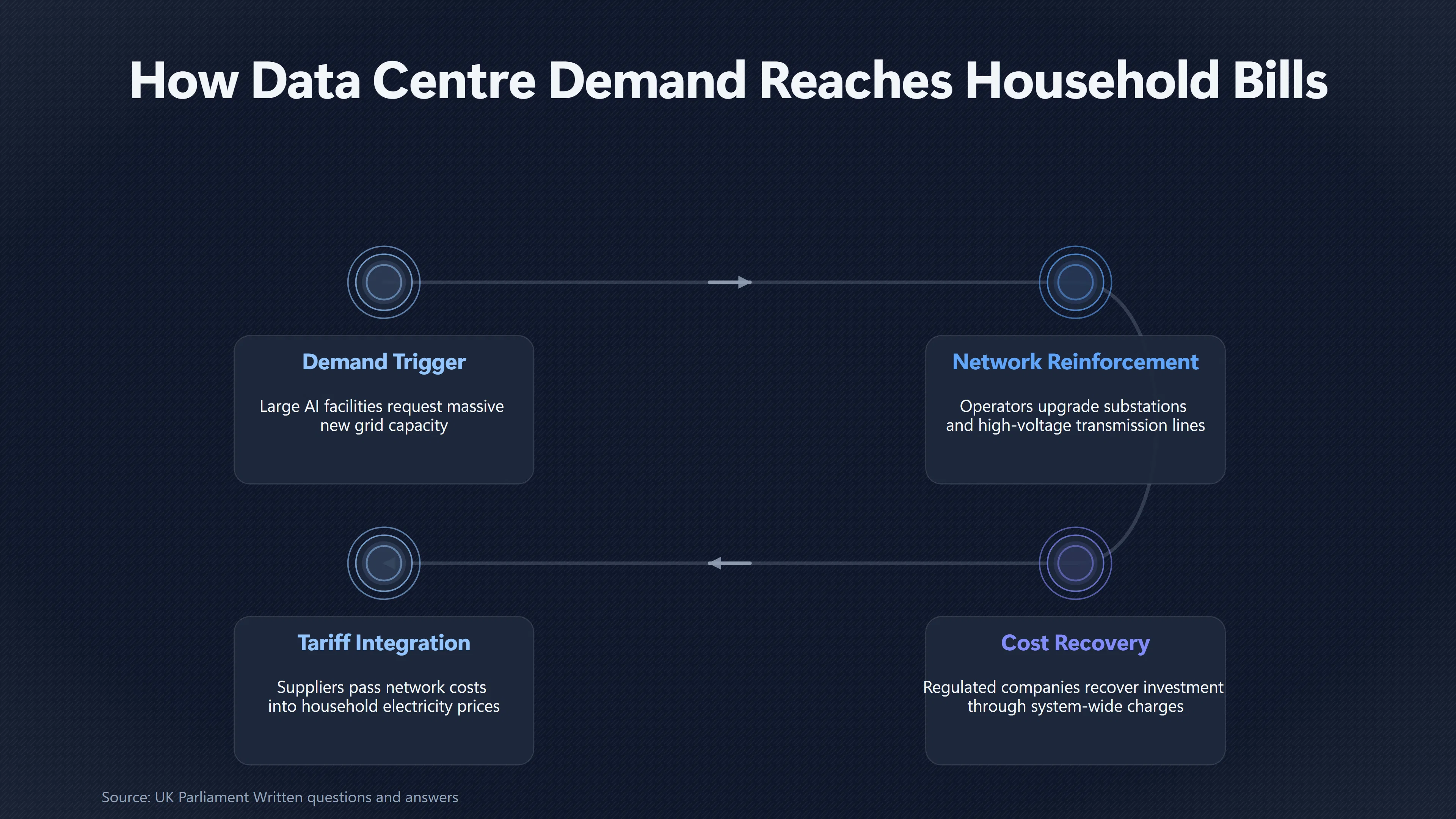
Yes, households can end up paying part of the cost of electricity grid upgrades needed by AI data centres. This happens when new substations, cables and wider network reinforcements are funded through charges shared across electricity customers, rather than paid entirely by the companies creating the additional demand.
In Great Britain, data centre operators generally pay for their own connections and contribute to ongoing network charges. However, some upgrades to the shared electricity network are recovered through regulated charges that also appear on household bills.
The distinction matters because a single large data centre can require substantial new grid capacity, while the infrastructure may be paid for over decades.
There is no reliable published figure showing how much of the average UK household electricity bill is specifically attributable to AI data centre grid upgrades. In September 2026, the government confirmed that it was not tracking network reinforcement costs associated specifically with new data centres. UK Parliament
How data centre connections trigger wider grid upgrades
A data centre does not necessarily need an entirely new electricity network. If sufficient spare capacity exists, connecting it may involve relatively limited work. But a large facility operating powerful AI chips around the clock can require hundreds of megawatts of reliable electricity capacity.
Where the existing grid cannot accommodate that demand, network operators may need to install larger transformers, reinforce substations, upgrade high-voltage cables or strengthen transmission routes serving the wider area.
The important distinction is between two types of infrastructure:
- Dedicated connection assets: Equipment built specifically to connect the data centre, such as a cable running from an existing network connection point to the facility.
- Shared network reinforcement: Upgrades to infrastructure that serves multiple customers, such as increasing the capacity of an existing substation or strengthening an electricity transmission route.
The first category is generally charged directly to the connecting customer. The second can be recovered from a wider group of electricity users, depending on the applicable charging rules.
Ofgem’s 2022 Access Significant Code Review explicitly distinguishes between these costs. It introduced a system under which customers connecting to electricity distribution networks generally pay for their dedicated connection assets but do not pay ordinary reinforcement charges, subject to safeguards for unusually expensive connections. Final Decision
Why the location of a data centre matters
Consider two hypothetical AI data centres, each requiring 200 megawatts of power.[parallelparliament.co.uk]parallelparliament.co.ukQ. Electricity: Data CentresQ. Electricity: Data Centres
The first is built near a major substation with spare capacity. Its connection might require dedicated equipment but relatively little additional reinforcement.
The second is built in an area where existing transmission lines and substations are already operating close to their limits. Serving it could require upgrades extending well beyond the site itself.
Although both facilities consume the same amount of electricity, the second may impose substantially higher infrastructure costs.
This is why the geographical concentration of data centres matters. Clusters of large facilities can create investment requirements that would not arise from the same electricity demand spread across locations with available grid capacity.
Britain’s National Energy System Operator (NESO) uses geographically differentiated transmission charges partly to reflect these differences in network costs. However, the charges do not necessarily assign every pound of new infrastructure expenditure directly to the individual project that triggered it. National Energy System Operator
How Ofgem’s network charges reach household bills
Households do not usually receive a separate charge labelled’AI data centre infrastructure’. Instead, shared network costs become part of the electricity prices charged by suppliers.
Ofgem regulates how much electricity network companies can recover through its RIIO price control framework. These regulated revenues pay for operating, maintaining and upgrading the networks, including a return on approved investment.
The costs then flow through two main charging systems.
Transmission Network Use of System (TNUoS) charges recover the cost of the high-voltage electricity network carrying power across Great Britain. NESO collects these charges from generators, electricity suppliers and certain directly connected electricity users.
Distribution Use of System (DUoS) charges recover the cost of regional and local electricity networks. These are charged to suppliers and other eligible network users, with costs ultimately reflected in electricity tariffs.
Both mechanisms can distribute infrastructure expenditure across many customers rather than assigning it entirely to one development. National Energy System Operator
How much of a household bill already pays for networks?
The House of Commons Library’s May 2026 analysis provides a useful benchmark.
NETWORK INFRASTRUCTURE CHARGES, APRIL–JUNE 2026
per year for typical electricity use
About 23% of the typical electricity price-cap bill, according to the Commons Library. This covers network infrastructure generally, not data centres specifically. House of Commons Library
These charges are recovered through a combination of electricity unit rates and daily standing charges. Consequently, households can contribute towards infrastructure costs even when their own electricity consumption has not increased.
The transmission element is particularly relevant. The Commons Library estimated that transmission network charges would add approximately £83 to a typical annual domestic electricity bill in 2026/27, compared with £51 in 2025/26. Most of this transmission cost is recovered through the standing charge. Research Briefings
That increase should not be described as an AI surcharge. Transmission investment is also needed to connect renewable generation, replace ageing equipment, improve reliability and reduce congestion. Published national bill figures do not isolate the proportion caused by data centres.
Ofgem’s December 2025 investment decisions illustrate the wider trade-off. The regulator said that prospective electricity transmission investment could contribute to network charges rising by around £108 annually for a median-use household by 2031, if all the prospective investment proceeded. It also projected savings from a more efficient electricity system, including reduced costs from network congestion. These were system-wide estimates, not data centre-specific forecasts. Ofgem
When do data centres pay, and when are costs shared?
The allocation of costs depends on where a data centre connects and which infrastructure needs upgrading.
For distribution network connections, reforms introduced in April 2023 moved towards a’fully shallow’charging model. In plain English, this means connecting electricity users generally pay for their own connection equipment, while ordinary upgrades to the existing shared distribution network are funded through network charges.
There is an important exception. Ofgem introduced a demand high-cost threshold of £1,720 per kilovolt-ampere of connection capacity, designed to prevent exceptionally expensive connections from imposing disproportionate reinforcement costs on other customers. The detailed charging rules determine which costs fall above this threshold. Final Decision
For transmission-connected data centres, separate connection and network-use charging arrangements apply. Large users can face substantial ongoing charges reflecting their demand and location. They are therefore not exempt from paying for the network simply because some investment is shared.
The financial question is whether those charges adequately reflect the additional investment and long-term risks created by a particular development.
The risk of building infrastructure that is never fully used
One particularly difficult issue arises when network operators invest on the expectation that several large data centres will open, but the are delayed, scaled down or cancelled.
Electricity infrastructure is long-lived. A new substation or transmission line may remain in the regulated asset base for decades, with its costs recovered gradually from network users.
If expected data centre demand does not appear, the infrastructure may still have to be paid for. Unless contracts or charging arrangements protect other customers, some of that burden can fall on households and existing businesses.
This concern has become more immediate in Britain. In July 2026, Ofgem reported that applications for demand connections had risen from 41 gigawatts to 125 gigawatts in less than a year, with data centres accounting for much of the increase.
The regulator proposed a data centre commitment fee and stronger project milestones to discourage speculative applications. The consultation closed in September 2026 and was awaiting a decision. These proposals were designed to improve the credibility of connection requests, not to replace the wider network charging framework. Ofgem
When shared grid investment benefits households —and when it does not
Sharing network investment costs is not automatically unfair. Electricity grids are collective infrastructure, and a stronger network can benefit more than the customer whose connection first made an upgrade necessary.
A reinforced transmission line might accommodate a new data centre while also improving reliability for nearby towns, connecting renewable electricity generation or reducing the cost of managing network congestion.
In that situation, requiring the data centre to pay the entire cost could discourage an investment that offers broader public benefits.
The argument becomes weaker when infrastructure is built primarily for a small number of commercial users, with limited benefits for everyone else.
A useful comparison comes from Virginia in the United States, one of the world’s largest data centre markets.
A 2024 study by Virginia’s Joint Legislative Audit and Review Commission found that data centres were paying their allocated costs appropriately under existing electricity tariffs. Nevertheless, it concluded that rapid data centre growth was likely to increase system-wide costs for other customers because extensive new generation and transmission infrastructure would be required.
Its modelling suggested that a typical Dominion Energy residential customer could face an additional $14–$37 per month in generation and transmission-related costs by 2040 under the scenarios examined. Those were conditional projections, not observed bill increases, and included generation costs as well as network infrastructure. Data Centers in Virginia
The distinction is revealing: a data centre can pay the charges required by existing rules while still contributing to higher costs for other customers.
The Virginia study recommended considering a separate data centre customer class and revised charging arrangements to protect residential customers. Such arrangements can help make large users more directly responsible for the infrastructure they require.
British regulators face a related choice, although the charging framework is different.
A fair approach needs to balance three considerations:
- Cost responsibility: Data centres should contribute appropriately to the additional infrastructure their electricity demand makes necessary.
- Shared benefits: Where upgrades genuinely improve the wider network, allocating some costs across customers can be justified.
- Financial protection: Long-term contracts, credible demand forecasts and financial commitments can reduce the risk of households paying for underused infrastructure.
These principles are particularly important when data centre developers request large amounts of capacity before they have demonstrated that their will proceed.
The central question is not simply whether a technology company pays an electricity bill. It is whether the charges and contractual commitments it faces cover a fair share of the infrastructure costs and risks its development creates.
What can households actually expect?
There is a credible mechanism through which AI data centre expansion can increase household electricity bills: new demand triggers shared network investment, regulated network companies recover that investment through electricity charges, and suppliers pass part of those charges to households.
But the size of the effect remains uncertain.
In Great Britain, the government confirmed in September 2026 that it did not track network reinforcement spending specifically attributable to new data centres. Without that information, it is not possible to calculate a defensible national’AI grid upgrade cost’per household. UK Parliament
The available evidence supports three conclusions.
First, households already contribute to shared electricity network investment through their tariffs, and the amount they pay for network infrastructure is rising.
Second, data centre developers are not simply receiving free connections. They pay dedicated connection costs and ongoing network charges, with additional safeguards applying to some unusually expensive projects.
Third, the fairness of the arrangement depends on whether regulators can distinguish genuinely shared infrastructure from investment principally required by a particular commercial development, while protecting customers if forecast demand does not materialise.
For households, the most important measure is therefore not the headline cost of new grid investment. It is how much additional cost remains on ordinary electricity bills after large data centre users have paid their share, and whether the resulting network improvements deliver benefits that justify that contribution.
Amazon book picks
Further Reading
Books and field guides related to Are Households Paying for AI Data Centre Grid Upgrades?. Use these as the next step if you want deeper reading beyond the article.
The Desert Data Centers
Into this moment of escalating demand for AI Data Centers, the world's deserts have announced themselves as a serious answer. Not in...
The AI Data Center Boom Explained
Behind every AI response is a physical world of computer chips, servers, power lines, and cooling systems. What happens when that world...
Bank Competition and Household Privacy in a Digital Payment...
Lenders can exploit households' payment data to infer their creditworthiness. When households value privacy, they then face a tradeoff...

Endnotes
1.
Source: questions-statements.parliament.uk
Title: UK Parliament Written questions and answers
Link:https://questions-statements.parliament.uk/written-questions/detail/2026-09-02/26555
2.
Source: neso.energy
Link:https://www.neso.energy/industry-information/charging/charges-using-great-britains-electricity-system
3.
Source: neso.energy
Link:https://www.neso.energy/industry-information/charging/tnuos-charges
4.
Source: commonslibrary.parliament.uk
Title: House of Commons Library What costs make up an electricity bill?
Link:https://commonslibrary.parliament.uk/research-briefings/cbp-10505/
5.
Source: researchbriefings.files.parliament.uk
Title: Research Briefings Research Briefing
Link:https://researchbriefings.files.parliament.uk/documents/CBP-10505/CBP-10505.pdf
6.
Source: publications.parliament.uk
Title: uk The cost of energy
Link:https://publications.parliament.uk/pa/cm5902/cmselect/cmesnz/416/report.html
7.
Source: committees.parliament.uk
Title: uk Written evidence
Link:https://committees.parliament.uk/writtenevidence/170151/html/
Additional References
8.
Source: ofgem.gov.uk
Link:https://www.ofgem.gov.uk/consultation/connection-and-use-system-code-cusc-cmp470-introducing-oversubscribed-technologies-commitment-fee-otcf?trk=article-ssr-frontend-pulse_little-text-block
Source snippet
Ofgem September 17, 2026 — CONNECTION AND USE OF SYSTEM CODE (CUSC) CMP470: INTRODUCING AN OVERSUBSCRIBED TECHNOLOGIES COMMITMENT FEE (OT...
Published: September 17, 2026
9.
Source: nationalgrid.com
Link:https://www.nationalgrid.com/national-grid-submits-further-transmission-investment-proposals-ofgem-support-britains-energy
Source snippet
National Grid October 15, 2026 — Image: Aerial photo of Lackenby substation NATIONAL GRID SUBMITS FURTHER TRANSMISSION INVESTMENT PROPOSA...
Published: October 15, 2026
10.
Source: linklaters.com
Title: Unlocking the Queue? Ofgem’s Proposed Reforms for Data Centre Connections
Link:https://www.linklaters.com/en/insights/publications/2026/september/unlocking-the-queue-ofgems-proposed-reforms-for-data-centre-connections
Source snippet
Linklaters September 22, 2026 — Publication UNLOCKING THE QUEUE? OFGEM’S PROPOSED REFORMS FOR DATA CENTRE CONNECTIONS UNLOCKING THE QUEUE...
Published: September 22, 2026
11.
Source: youtube.com
Link:https://www.youtube.com/watch?v=LkHtqyEfgGw
12.
Source: youtube.com
Link:https://www.youtube.com/watch?v=N0ZYtu-vDJQ
13.
Source: youtube.com
Link:https://www.youtube.com/watch?v=N6GwSeZO_Cg
14.
Source: youtube.com
Link:https://www.youtube.com/watch?v=dPODQ_lLZ60
15.
Source: youtube.com
Link:https://www.youtube.com/watch?v=de5oIgsEIi4
16.
Source: youtube.com
Link:https://www.youtube.com/watch?v=fqQsExCEEZc
17.
Source: parallelparliament.co.uk
Title: Q. Electricity: Data Centres
Link:https://parallelparliament.co.uk/question/26555/electricity-data-centres