Within Cooling Costs
Does Liquid Cooling Really Make AI Data Centres Cheaper?
Cooling AI processors with liquid can cut refrigeration costs, but pumps, pipework and higher server densities complicate the savings.
Published
On this page
- How direct to chip cooling removes heat from powerful AI processors
- Electricity savings versus installation, pumping and maintenance costs
- When higher rack density outweighs the benefits of efficient cooling
Page outline Jump by section
Updated
Introduction
Direct-to-chip liquid cooling can reduce the electricity needed to cool powerful AI servers, but it does not automatically make an AI data centre cheaper to build or operate. The strongest financial case is usually found in new, densely packed AI facilities where conventional air cooling is becoming impractical. Retrofitting an existing data centre is more complicated: savings on refrigeration and fans must outweigh new spending on pumps, pipework, cooling equipment, installation and maintenance.
Research published in 2026 suggests that converting from air cooling to liquid-to-chip cooling could reduce annual electricity consumption by approximately 4–13% per unit of computing work under the conditions modelled. That is a meaningful improvement, but not a universal saving. ScienceDirect
The central distinction is between three different outcomes: lower cooling costs, lower electricity consumption per unit of AI computing, and lower total electricity demand. Liquid cooling can deliver the first two while a growing AI data centre still consumes more electricity overall.
For operators comparing their options, the practical differences are:
| Decision factor | Conventional air cooling | Direct-to-chip liquid cooling |
| Initial investment | Usually lower where suitable air-cooling infrastructure already exists | Higher where new liquid infrastructure is required |
| Cooling electricity | More fan power and potentially more refrigeration | Less airflow and potential for reduced refrigeration, offset by pumping |
| High-density AI racks | Increasingly difficult at very high heat loads | Better suited to concentrated processor heat |
| Maintenance | Established servicing practices | Additional fluid management, connections and leak controls |
| Retrofit complexity | Often simpler for existing air-cooled servers | Depends on server compatibility and building infrastructure |
| Long-term economics | Attractive for lower-density equipment | Stronger where high-density computing justifies the investment |
The comparison is not simply between two machines that perform the same job. Direct-to-chip cooling can enable AI hardware configurations that would be difficult to operate with air cooling alone. That makes its value partly an electricity-saving question and partly a question of whether the data centre can accommodate the computing equipment it intends to buy.
How direct-to-chip cooling removes heat from AI processors
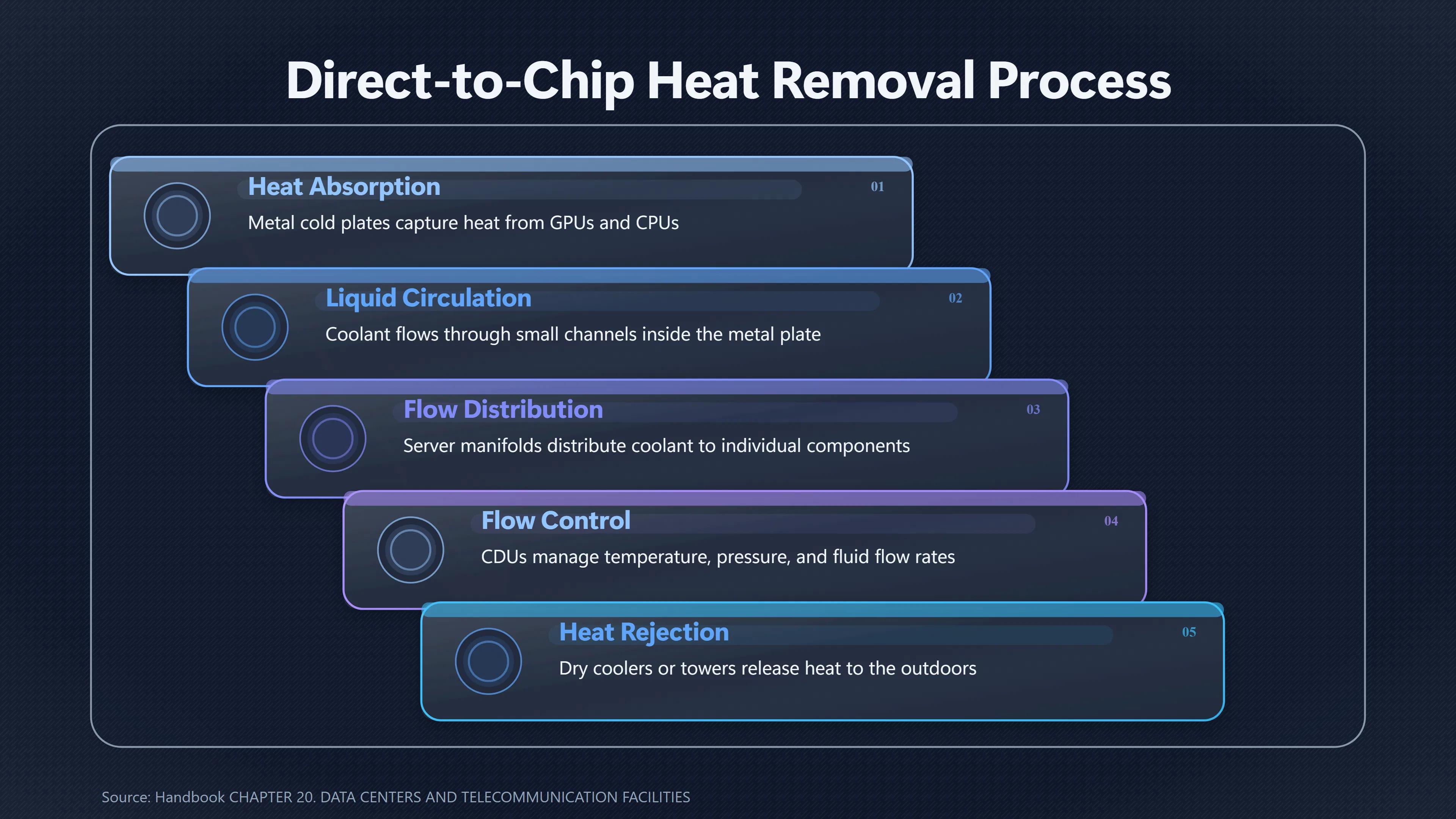
Direct-to-chip cooling transfers heat from processors into a circulating liquid rather than relying mainly on air moving through the server.
A metal component called a cold plate sits against a heat-producing chip, typically a graphics processing unit (GPU) or central processing unit (CPU). Liquid flows through small channels inside the plate, absorbs heat and carries it away through pipes.
The heat is then transferred into a wider cooling system and eventually released outside the building.
The principle is straightforward: liquid can carry substantial quantities of heat through relatively small pipes, making it better suited than air to removing intense, concentrated heat loads.
The equipment behind the cooling loop
A typical installation includes several interconnected components.
- Cold plates: Transfer heat directly from processors into the coolant.
- Server manifolds and connections: Distribute coolant to individual components and collect the warmed liquid.
- Coolant distribution units (CDUs): Control coolant flow, temperature and pressure, often separating the server circuit from the building’s cooling-water circuit.
- Pumps, valves and sensors: Maintain circulation and monitor operating conditions.
- Heat-rejection equipment: Transfers the collected heat to outdoor air or water through dry coolers, cooling towers or other systems.
These components explain why liquid cooling is not simply a matter of replacing server fans with water pipes.
The American Society of Heating, Refrigerating and Air-Conditioning Engineers (ASHRAE) describes the need to manage coolant temperatures, fluid quality, pressure, condensation and redundancy. A poorly controlled system can create reliability problems even if its heat-transfer performance is excellent. ASHRAE Handbook
Direct-to-chip systems also rarely eliminate air cooling completely. Memory, networking equipment, power supplies and other components may still release heat into the server room.
Consequently, a facility often needs to operate liquid and air cooling together. How much electricity it saves depends partly on how much heat the liquid actually captures.
Why warmer coolant can save electricity
One of the most important benefits is not merely that liquid absorbs heat effectively. It is that processors can sometimes be cooled using water at higher temperatures than conventional chilled-water systems require.
Traditional refrigeration uses electricity to maintain sufficiently low temperatures. If a direct-to-chip system can operate with warmer water, the facility may be able to reduce compressor operation or bypass mechanical refrigeration during suitable weather.
This is commonly called free cooling, although pumps, fans and other equipment still consume electricity.
Research by Lawrence Berkeley National Laboratory demonstrated the potential in 2014. Its direct-liquid-cooling study used 38 modified servers and two comparable unmodified servers, then modelled facility-wide performance. The researchers estimated that the specified retrofit could produce approximately 20% overall data centre energy savings.
That figure was conditional on the cooling-system configurations modelled, rather than a measured 20% saving across an entire commercial AI data centre. Building & Industrial Energy Systems Division
The distinction matters because the largest gains may come from avoiding refrigeration, not simply from replacing airflow with liquid circulation.

Electricity savings versus installation and maintenance costs
The strongest argument for direct-to-chip cooling is that it can reduce several sources of electricity consumption at once. The strongest objection is that obtaining those savings requires an additional engineered system.
Where the electricity savings come from
Liquid cooling can reduce electricity consumption through three main mechanisms.
Lower server fan power. When cold plates remove a large share of processor heat, server fans may operate more slowly. Fan power can be particularly significant in tightly packed servers requiring high airflow.
Reduced refrigeration. Warmer coolant can increase the number of hours when outdoor conditions allow heat to be rejected without compressor-based chilling.
Less room-air cooling. Transferring processor heat directly into liquid reduces the quantity of hot air that must be collected and cooled inside the data hall.
However, these savings must be calculated after allowing for CDU pumps, facility-water pumps, outdoor cooling fans and any remaining air-conditioning equipment.
A 2026 study in Advances in Applied Energy, examining liquid-to-chip cooling with differential temperature control, estimated annual energy improvements of 4–13% per unit of computing work and peak-demand improvements of 6–14% under its analysed configurations. It also found that higher coolant temperatures could reduce or eliminate the need for compressor-based chilling in some Australian and Asian climate conditions. ScienceDirect
The results support a genuine energy-efficiency opportunity. They do not establish that every installation will save the same percentage, particularly where an existing facility already uses efficient air cooling and outdoor-air economisers.
What the savings mean in electricity bills
Consider a hypothetical AI installation consuming 10 megawatts (MW) of computing-equipment power continuously.
Assume its total facility electricity consumption, including cooling and electrical overheads, is initially 12 MW. That corresponds to a power usage effectiveness (PUE) of 1.20.
PUE is the ratio of total data centre electricity consumption to the electricity consumed by computing equipment. A lower value generally indicates less facility overhead.
If a liquid-cooling upgrade reduced the facility’s total draw from 12 MW to 11.5 MW while computing power stayed at 10 MW, the electricity saving would be 0.5 MW.
ILLUSTRATIVE ANNUAL SAVINGS
Electricity saved
Annual saving at £0.15/kWh
Power reduction
0.5 MW
Electricity price
£ 0.15 /kWh
Calculated annual electricity cost saving
Assumes 8,760 operating hours at the selected power reduction and electricity price.
This illustrates why even modest efficiency improvements can matter financially in large facilities operating around the clock.
But the example assumes that computing power stays unchanged and that the cooling improvement persists throughout the year. Actual savings vary with workload, outdoor temperature, operating conditions and equipment performance.
It also excludes capital expenditure, financing, maintenance and any additional costs of making the facility liquid-cooling-ready.
The installation bill can change the calculation
For a new AI data centre, direct-to-chip infrastructure can be incorporated into the building’s original mechanical and electrical design.
For an existing air-cooled facility, conversion may require substantial changes.
Costs can include new pipework, distribution units, coolant-compatible servers, water-treatment equipment, monitoring systems and modifications to existing heat-rejection infrastructure.
Installation may also require periods of restricted computing capacity, temporary cooling arrangements or planned downtime.
Some older servers cannot be economically converted to direct-to-chip cooling. In those cases, the operator may need to wait for a hardware replacement cycle or buy new liquid-cooled equipment earlier than originally planned.
The Uptime Institute’s 2022 direct-liquid-cooling survey identified the cost of change, leaks, supply-chain difficulties and system failures among operators’concerns. Its 2026 analysis continued to highlight the practical obstacles facing applications that do not need very high rack densities. Uptime Institute Intelligence
This means that the same technology can be economically compelling in a new AI training facility but unattractive in a relatively efficient data centre operating conventional workloads.
How much does a retrofit cost?
A May 2026 analysis by STL Partners estimated that converting existing data centre capacity to liquid cooling could cost around US$2 million per MW, compared with upwards of US$11 million per MW for a new liquid-cooled facility.
These figures are useful for understanding the scale of investment, but they are not directly comparable prices for cooling equipment alone. A new data centre includes extensive building, electrical and other infrastructure that a retrofit can reuse. The retrofit figure also depends on whether the existing facility has sufficient power, space and infrastructure to support conversion. STL Partners
Using the earlier example of £657,000 in annual electricity savings, a hypothetical £2 million upgrade would have a simple payback period of approximately three years.
That calculation excludes financing, maintenance, downtime and equipment replacement. It is also illustrative: the hypothetical upgrade cost is not derived from STL Partners’US-dollar estimate.
A more realistic investment assessment would consider the additional cost of liquid cooling compared with the best feasible air-cooling alternative, rather than automatically charging the entire cost of a new facility to the cooling decision.
Pumping and maintenance can erode the savings
Liquid systems introduce electrical and mechanical demands that air-cooled servers do not have in the same form.
Pumps must overcome resistance as coolant moves through narrow cold-plate channels, manifolds, filters and heat exchangers. Higher flow rates and poorly designed piping can increase pumping electricity.
Operators also need to manage fluid cleanliness, corrosion, trapped air, connection integrity and component replacement.
Redundancy adds further cost. A mission-critical AI installation may need spare pumps, independent coolant circuits, backup power and monitoring equipment to prevent a cooling failure from interrupting expensive computing operations.
ASHRAE emphasises these operational requirements, including maintaining appropriate coolant temperatures and providing suitable backup arrangements. ASHRAE Handbook
A 2026 experimental study of an alternative liquid-cooling arrangement found that eliminating a conventional CDU and simplifying the hydraulic circuit could reduce rack-level pumping power by up to 88% in its tested configuration. That is not a typical saving available to every operator. It demonstrates how strongly pumping costs depend on system architecture rather than on the use of liquid alone. ScienceDirect
There is therefore no single electricity-saving percentage or maintenance-cost premium that can reliably be applied to all direct-to-chip installations.
When higher rack density outweighs cooling efficiency
Direct-to-chip cooling changes the economics of AI infrastructure because it allows more powerful equipment to be concentrated into fewer racks.
That can reduce the space and some supporting infrastructure required for a given amount of computing capacity. It can also allow operators to install substantially more computing power in the same building.
These are different outcomes, with different consequences for electricity demand.
More computing in the same space can mean more electricity
Consider two hypothetical installations occupying the same data hall.
The first contains 100 air-cooled racks, each consuming 20 kilowatts of computing-equipment power. Its total computing load is 2 MW.
The second contains 100 liquid-cooled racks, each consuming 100 kW. Its total computing load is 10 MW.
Even if the second facility has a much lower cooling overhead, it will use far more electricity overall.
| Measure | Air-cooled example | Liquid-cooled example |
| Number of racks | 100 | 100 |
| Computing power per rack | 20 kW | 100 kW |
| Total computing load | 2 MW | 10 MW |
| Assumed PUE | 1.40 | 1.15 |
| Total facility power | 2.8 MW | 11.5 MW |
| Annual electricity use | 24.5 GWh | 100.7 GWh |
These are illustrative assumptions, not measured performance figures.
The liquid-cooled facility uses less electricity per unit of computing-equipment power, yet consumes more than four times as much electricity overall.
This is particularly important when evaluating claims that efficient cooling will ease pressure on electricity grids.
An operator may use the savings to reduce its electricity bill. Alternatively, it may use the freed electrical capacity to install additional GPUs, increasing total computing output while keeping demand close to its available power limit.
In its July 2026 assessment, the Uptime Institute described increasing rack density as a longstanding commercial objective, but also noted that lower-density configurations can sometimes offer efficiency and cooling advantages. The most concentrated arrangement is not necessarily the most economical for every workload. Uptime Institute Blog
The grid connection remains a hard limit
Liquid cooling can increase the amount of computing equipment that fits within a building, but it does not create additional grid capacity.
A data centre with a 20 MW electricity connection cannot operate 30 MW of AI servers simply because its cooling system has become more efficient.
Reducing cooling overhead might release a portion of the existing electrical allocation for computing. However, larger increases in computing demand still require more electricity supply, suitable transformers, switchgear and power distribution.
This creates a significant distinction between physical rack capacity and usable electrical capacity.
For example, an existing building might have sufficient floor space for a high-density liquid-cooled AI installation but insufficient power infrastructure to operate it.
In that situation, spending heavily on cooling infrastructure may not deliver its expected financial return until additional electricity capacity becomes available.
The Uptime Institute’s 2025 global survey identified power constraints, costs and difficulties forecasting future capacity among the major challenges facing data centre operators. Uptime Intelligence
Density can improve economics without reducing total demand
For AI operators, higher density may still be valuable even when it increases absolute electricity consumption.
It can reduce the amount of building space required for a computing cluster, shorten some network connections and make it easier to deploy tightly integrated AI systems.
A new liquid-cooled facility may therefore deliver more computing capacity per square metre and potentially more computing work per pound of infrastructure investment.
But this does not prove that it delivers more useful AI output per kilowatt-hour. That depends on the processors, workloads, utilisation rates, software and cooling configuration.
The economic case should distinguish between:
- Cost per unit of installed computing capacity: How much infrastructure investment is required to accommodate the hardware?
- Electricity per unit of computing work: How efficiently does the facility perform a comparable workload?
- Total electricity demand: How much power does the complete installation draw from the grid?
An operator may improve the first two while increasing the third.
This distinction is central to understanding why AI data centre electricity demand can grow rapidly even as individual facilities become more efficient.
How to judge whether liquid cooling is worth the investment
The right decision depends on what problem the operator is trying to solve.
If the objective is simply to reduce electricity bills in an existing, relatively low-density facility, improving airflow management, controls and conventional cooling equipment may provide a better return.
If the objective is to operate high-power AI racks that cannot be cooled economically with air, direct-to-chip cooling may be necessary regardless of whether the electricity savings alone repay its installation costs.
New facilities have an advantage
A purpose-built AI data centre can incorporate liquid distribution, suitable pipe routes, cooling-water connections, electrical capacity and maintenance access from the beginning.
This avoids some of the disruption associated with modifying a live facility.
It also allows engineers to optimise the entire heat-removal system rather than connecting new liquid equipment to an older cooling plant that was designed for different conditions.
The potential advantage is especially significant when the design can avoid substantial compressor-based refrigeration.
However, the operator must still decide how much capacity to install immediately and how much to reserve for future generations of AI hardware.
Oversizing equipment creates upfront costs and potentially inefficient operation at low utilisation. Undersizing it can force expensive upgrades when more powerful servers arrive.
Existing facilities need a more cautious calculation
For an existing data centre, the strongest financial case often arises when several conditions coincide: the facility already needs a major cooling upgrade, high-density AI customers are ready to use the capacity, sufficient electrical power is available, and much of the existing building infrastructure can be reused.
STL Partners’2026 retrofit analysis identifies several costs that are easily overlooked in headline estimates, including workload migration, lost rental revenue, redesign, contractor premiums and the commercial impact of converting space that is already earning money. STL Partners
There is also a longer-term compatibility problem. A facility may outlast several generations of AI servers, and those generations may have different requirements for coolant chemistry, temperature, pressure and connections.
In September 2026, the Uptime Institute highlighted the challenge of designing shared liquid-cooling infrastructure that can support equipment from multiple manufacturers over successive hardware replacement cycles. Uptime Intelligence
A design that performs well with today’s servers could become expensive if future equipment requires substantially different operating conditions.
The figures that determine a credible business case
Before accepting an investment proposal, an operator should be able to compare the following on a consistent basis:
| Measure | Why it matters |
| Total installed cost | Captures equipment, building modifications and commissioning |
| Net cooling electricity saving | Includes pumps and remaining air cooling, not just avoided refrigeration |
| Annual operating and maintenance cost | Accounts for fluid management, inspections, replacement parts and servicing |
| Cooling performance at partial load | Tests efficiency when AI hardware is not operating at maximum power |
| Electricity price and operating hours | Determines the financial value of each kilowatt-hour saved |
| Downtime and reliability exposure | Captures the cost of interrupted computing or customer service |
| Useful computing capacity enabled | Measures the commercial value of supporting denser AI hardware |
| Expected hardware replacement cycles | Tests whether infrastructure remains compatible with future equipment |
A useful financial comparison is the total cost of ownership over the expected life of the installation. This includes capital expenditure, electricity, maintenance, financing, expected replacement costs and the consequences of outages.
Simple payback periods can be helpful, but they can conceal expensive risks and fail to capture the value of additional computing capacity.
Why cooling efficiency is not the whole electricity story
The final limitation is that liquid cooling makes it easier to remove heat, not cheaper to perform every kind of AI computation.
The chips still require substantial electricity to train AI models and process user requests. Most of that electricity ultimately becomes heat that must be rejected into the environment.
Reducing cooling overhead is therefore valuable, but its potential contribution becomes smaller as the computing equipment accounts for a greater share of total facility electricity consumption.
Lawrence Berkeley National Laboratory’s United States Data Center Energy Usage Report: 2025 Update, published in June 2026, estimated an average PUE of approximately 1.145 for US facilities serving AI equipment in 2024, declining only modestly to 1.136 by 2030. The researchers did not expect evolving cooling designs to produce a major additional industry-wide reduction in PUE beyond their existing projections. eScholarship
This is an important counterweight to claims that liquid cooling will transform the electricity economics of AI infrastructure.
For a facility already operating near a PUE of 1.1, there is relatively little remaining overhead to eliminate. Even perfect removal of cooling electricity would leave the substantial demand from processors, memory, networking and power distribution.
The 2026 Berkeley Lab update also projected that US data centres could account for approximately 9.5–15.3% of national electricity consumption by 2030, depending on the scenario. These are projections, not guaranteed outcomes, but they show why improved cooling efficiency alone cannot be assumed to offset expanding AI computing demand. OSTI
There is a further environmental distinction. Direct-to-chip cooling uses a circulating coolant loop, but the heat still has to be discharged somewhere. If the facility uses evaporative cooling towers, electricity savings may coexist with substantial water consumption. If it uses dry coolers, it may reduce direct water consumption while requiring additional fan power or facing more difficult operation in hot weather.
Berkeley Lab’s 2024 energy report found that water use varies significantly with the wider cooling architecture and climate, including for liquid-cooled facilities. LBL ETA Publications
The financial and environmental benefits therefore depend on the complete system, not merely the cold plates attached to the processors.
Direct-to-chip liquid cooling is most convincingly cheaper when it enables otherwise impractical high-density computing and reduces enough cooling overhead to justify its additional infrastructure. It is less convincing as a universal electricity-saving retrofit for ordinary data centres.
For electricity grids and the communities supplying new AI facilities, the decisive question is whether operators use those efficiency gains to reduce demand or to install more computing equipment. Liquid cooling can improve the economics of each unit of AI computing while simultaneously helping the industry expand its total electricity consumption.
Amazon book picks
Further Reading
Books and field guides related to Does Liquid Cooling Really Make AI Data Centres Cheaper?. Use these as the next step if you want deeper reading beyond the article.
AI Data Centers and Water Sustainability: Environmental...
AI increases growth in data center infrastructure, enabling advances in machine learning, cloud computing, and digital services. However,...
The Growth of AI Data Centers and the Impact on Global Water...
AI data centers are rapidly emerging in rural areas across the globe as the demand for artificial intelligence technologies continues to...
The Ultimate Beginner’s Guide to AI Data Centers
Are you prepared for the massive infrastructure shift required to power the AI revolution? In The Ultimate Beginner’s Guide to AI Data...
AI Data Center Technician
The build-out is outrunning the people who can run it. AI racks draw 120–130 kW. Air cooling stopped working at 20. What replaced it...
eBay marketplace picks
Marketplace Samples
Live-tested eBay searches with available results related to this page.
Selected fromartificial intelligence poster oneBay.co.uk.

Current eBay listing
A I Artificial Intelligence 6 Movie Poster Art Print Print Classic Rare Gallery
 </article>
<article class="fr-book-card" data-ebay-listing-card data-ebay-card-kind="listing" data-ebay-card-position="3"data-offer-freshness="current" data-offer-observed-at="2026-10-26T20:24:24Z">

Current eBay listing
AI ARTIFICIAL INTELLIGENCE . 2001 ORIGINAL MOVIE POSTER vintage 24 YEARS OLD
 </article>
Endnotes
1.
Source: handbook.ashrae.org
Title: Handbook CHAPTER 20. DATA CENTERS AND TELECOMMUNICATION FACILITIES
Link:https://handbook.ashrae.org/Handbooks/A23/SI/A23_Ch20/a23_ch20_si.aspx
2.
Source: bies.lbl.gov
Link:https://bies.lbl.gov/publications/direct-liquid-cooling-electronic
Additional References
3.
Source: doi.org
Link:https://doi.org/10.1016%2Fj.adapen.2026.100269
4.
Source: datacenterdynamics.com
Link:https://www.datacenterdynamics.com/en/whitepapers/data-center-pue-liquid-cooling-cut-10-the-ratio-moved-3/
5.
Source: journal.uptimeinstitute.com
Title: Uptime Institute Blog Liquid cooling will not outgrow its high-density niche
Link:https://journal.uptimeinstitute.com/liquid-cooling-will-not-outgrow-its-high-density-niche/
6.
Source: stlpartners.com
Title: STL Partners The retrofitting roadmap: An evolution of liquid cooling
Link:https://stlpartners.com/free_reports/the-retrofitting-roadmap-an-evolution-of-liquid-cooling/
7.
Source: intelligence.uptimeinstitute.com
Title: IT-agnostic DLC systems: key considerations
Link:https://intelligence.uptimeinstitute.com/resource/it-agnostic-dlc-systems-key-considerations
Source snippet
Uptime Intelligence September 14, 2026...
Published: September 14, 2026
8.
Source: intelligence.uptimeinstitute.com
Title: Data report 71 Direct Liquid Cooling Survey 2022 for pdf download
Link:https://intelligence.uptimeinstitute.com/sites/default/files/2023-03/Data%20report%2071_Direct%20Liquid%20Cooling%20Survey%202022_for%20pdf%20download.pdf
9.
Source: menfem.com
Title: uptime global datacenter survey 2026
Link:https://menfem.com/kb/datacenters/sources/uptime-global-datacenter-survey-2026
Source snippet
Knowledge Base | MenFem July 28, 2026...
Published: July 28, 2026
10.
Source: coloprice.com
Title: Data Center Cooling Systems: From CRAC Units to Immersion
Link:https://coloprice.com/guides/data-center-cooling-guide/
11.
Source: journal.uptimeinstitute.com
Title: Lower density brings server efficiency and cooling gains
Link:https://journal.uptimeinstitute.com/lower-density-brings-server-efficiency-and-cooling-gains/?trk=article-ssr-frontend-pulse_little-text-block
12.
Source: blog.se.com
Title: Data center power density: Why liquid cooling
Link:https://blog.se.com/datacenter/2026/07/28/data-center-power-density-planning-liquid-cooled-ai-data-centers-around-grid-and-power-constraints/